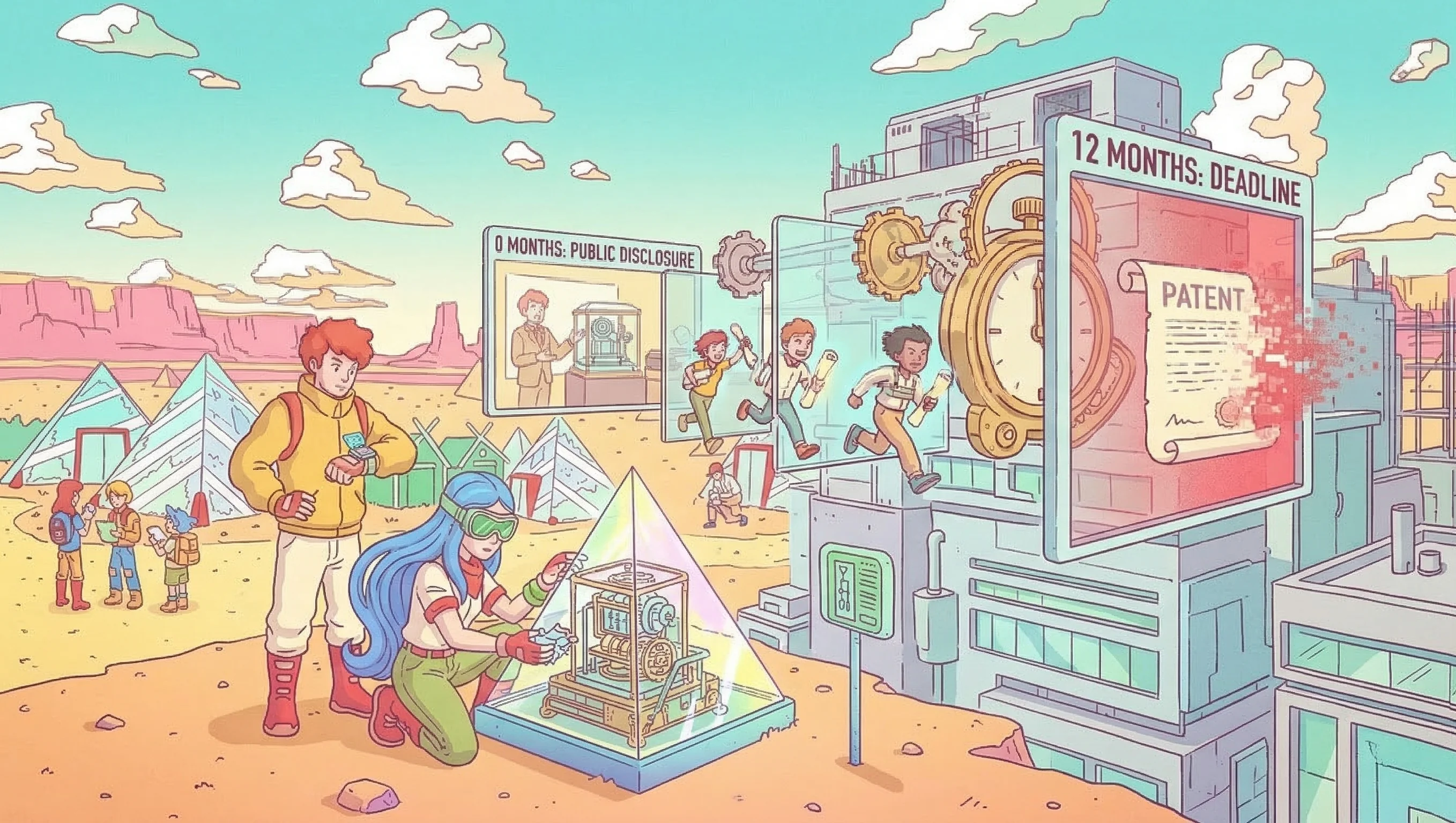
The moment you publicly disclose your invention, a clock starts. In the United States, you have 12 months from that first public disclosure to file a patent application. After 12 months, the door closes permanently. Your own disclosure becomes prior art against you, and the USPTO will reject your application.
What Counts as Public Disclosure?
Any non-confidential disclosure that makes your invention available to the public:
- Selling the product (Amazon, Etsy, Shopify, farmers market, anywhere)
- Offering the product for sale (even listing it before the first sale)
- Demonstrating at a trade show or expo (even without sales)
- Publishing a description (blog post, social media, YouTube video, magazine article)
- Crowdfunding campaigns (Kickstarter, Indiegogo, GoFundMe)
- Sharing with manufacturers without a non-disclosure agreement
- Conference presentations or academic publications
The test is whether the disclosure was public and included enough detail for someone to understand how the invention works. A vague social media post saying “I’m working on something cool” probably does not start the clock. A Kickstarter page with photos, dimensions, and feature descriptions almost certainly does.
What Does NOT Start the Clock
Some disclosures are protected:
- Conversations under NDA. Sharing your invention with a manufacturer, business partner, or investor under a signed NDA is confidential and does not trigger the 12-month period.
- Private testing. Testing your prototype at home or in a private lab is not a public disclosure.
- Discussions with your patent professional. Those conversations are confidential.
US Grace Period vs. International Rules
The 12-month window is a US-specific grace period. Most other countries operate on a strict “absolute novelty” standard: any public disclosure before filing destroys your patent rights in those countries immediately. No grace period.
If you think you might want patent protection outside the United States, file before any public disclosure. This preserves your options for international filing through the Patent Cooperation Treaty (PCT) or direct foreign filings.
Common Timing Scenarios
Kickstarter/Indiegogo launch. File the provisional before the campaign goes live. Once your campaign page is public, the clock starts. Plan to file 1-2 weeks before your launch date.
Amazon or e-commerce sales. Count backward from your first listing date. If less than 12 months have passed, you still have time. If more than 12 months, options are limited.
Trade show or expo. The show date is the disclosure date. File your provisional before the event.
Social media or YouTube. The date of the post or video upload is the disclosure date. Detailed product demos are especially clear triggers.
Talking to manufacturers. If you shared your invention with a manufacturer without an NDA, that conversation may count as a public disclosure. If the manufacturer is in another country, this is even riskier because foreign patent rights have no grace period.
How to Figure Out Your Deadline
Write down every instance where you shared your invention publicly. Find the earliest one. Count 12 months forward. That is your deadline.
What If You Miss the Deadline?
If more than 12 months have passed since your first public disclosure, you cannot get a utility patent on that version of the invention.
Two things may still be possible:
-
Design patent. If your product’s ornamental appearance is distinctive and was first disclosed less than 12 months ago, a design patent may be available. Design patents protect how the product looks, not how it works.
-
Improvements. If you have made modifications since the original disclosure, those modifications may be independently patentable as long as the improvements themselves have not been publicly disclosed for more than 12 months.
Neither is as strong as filing on time.
The Bottom Line
If you have a product you might want to patent, figure out your disclosure timeline now. If the clock is running, prioritize filing a provisional patent application. If you have not disclosed yet, file before you do.
For a full breakdown of filing costs, see the patent cost guide. For how provisionals and non-provisionals work together, see provisional vs. non-provisional explained.