Most inventors spend between $5,000 and $15,000 to get a patent, based on our 2026 survey of 200+ patent attorneys. Complex inventions run past $20,000. The price depends on what kind of patent you’re filing, how complicated your invention is, who does the work, and how many times the patent examiner pushes back.
Those numbers cover both professional fees (what you pay someone to write and file the thing) and USPTO government fees (what the patent office charges to process it).
Here’s a full breakdown.
Key facts:
- Typical total cost: $5,000 to $15,000+ (utility patent through grant)
- Provisional patent: $2,000 to $6,000
- Design patent: $1,500 to $5,000
- Micro entity USPTO fee discount: 80% off
- Timeline to grant: 18 to 36 months (utility)
Patent Cost Overview
| Patent Type | Typical Cost Range | Timeline |
|---|---|---|
| Provisional Patent | $2,000 - $6,000 | Filed in 2-4 weeks |
| Non-Provisional (Utility) Patent | $5,000 - $15,000+ | 18-36 months to grant |
| Design Patent | $1,500 - $5,000 | 12-18 months to grant |
| Patent Search | $500 - $1,500 | 1-2 weeks |
| Patent Drawings | $300 - $1,000 | 1-2 weeks |
| Office Action Response | $1,000 - $4,000 per response | 3-month deadline |
These are typical patent attorney and patent agent fees in the US based on 2025-2026 data.
What Makes Patents Expensive (Or Cheap)
A provisional for a kitchen gadget with three moving parts is a different animal than a utility application for a pharmaceutical compound with 30 pages of chemical data. The complexity of the drafting is the single biggest cost driver.
Who you hire matters a lot. A solo patent agent or small firm typically charges $150 to $300 per hour. A big law firm in a major city starts at $400 to $600. The quality of work can be identical. The billing rate is what changes.
Flat fee vs. hourly billing. Some practitioners quote a flat fee upfront. Others bill by the hour. Flat fees give you cost certainty. Hourly billing means the final number depends on how long the work takes.
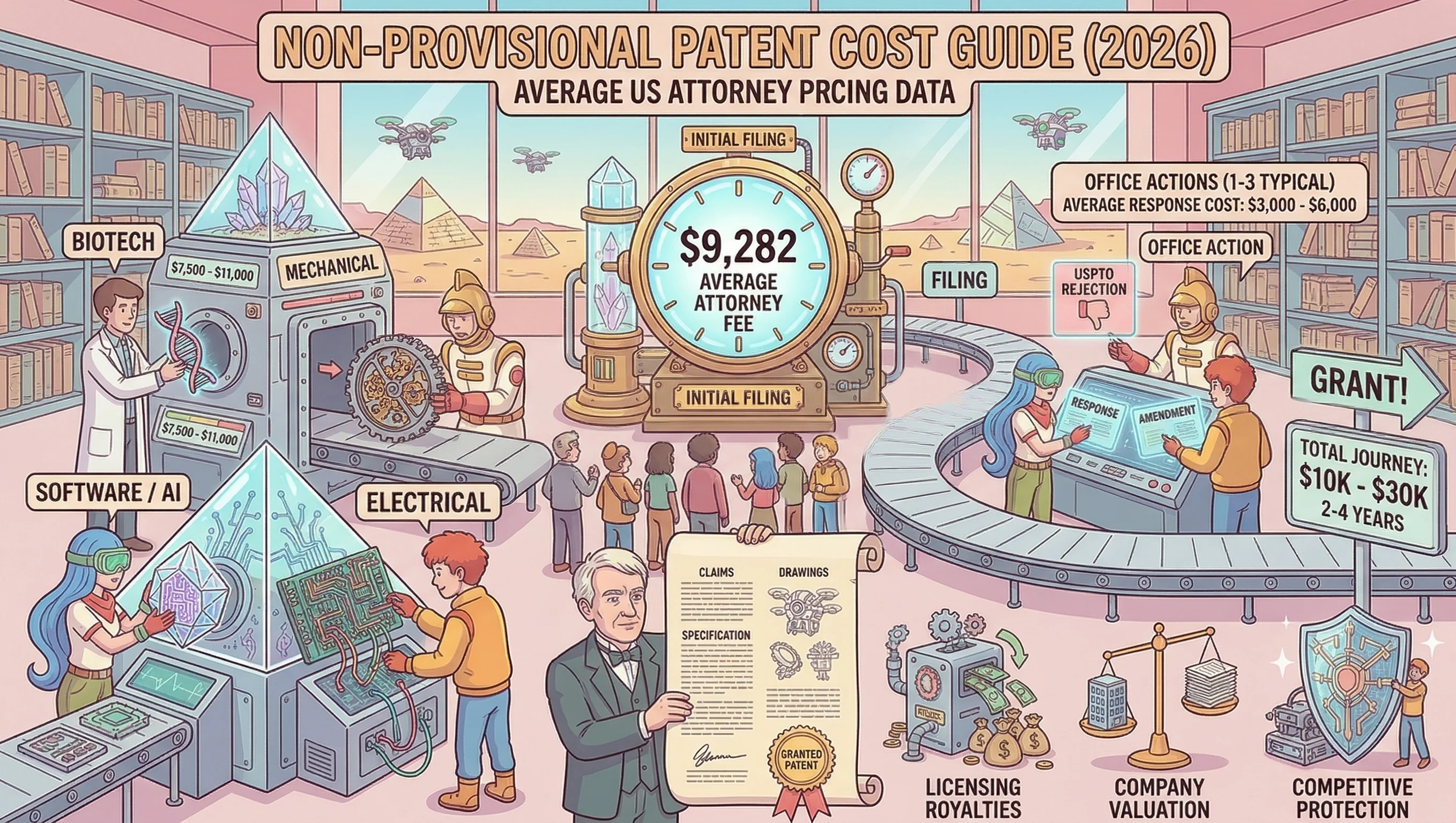
Office actions add up. About 86% of patent applications receive at least one office action from the USPTO examiner. That’s basically the examiner saying “I have issues with this.” Each response costs $1,000 to $4,000. Some applications go through two or three rounds.
Your entity size affects government fees. The USPTO charges micro entities 75% less than large entities on most fees. More on this below.
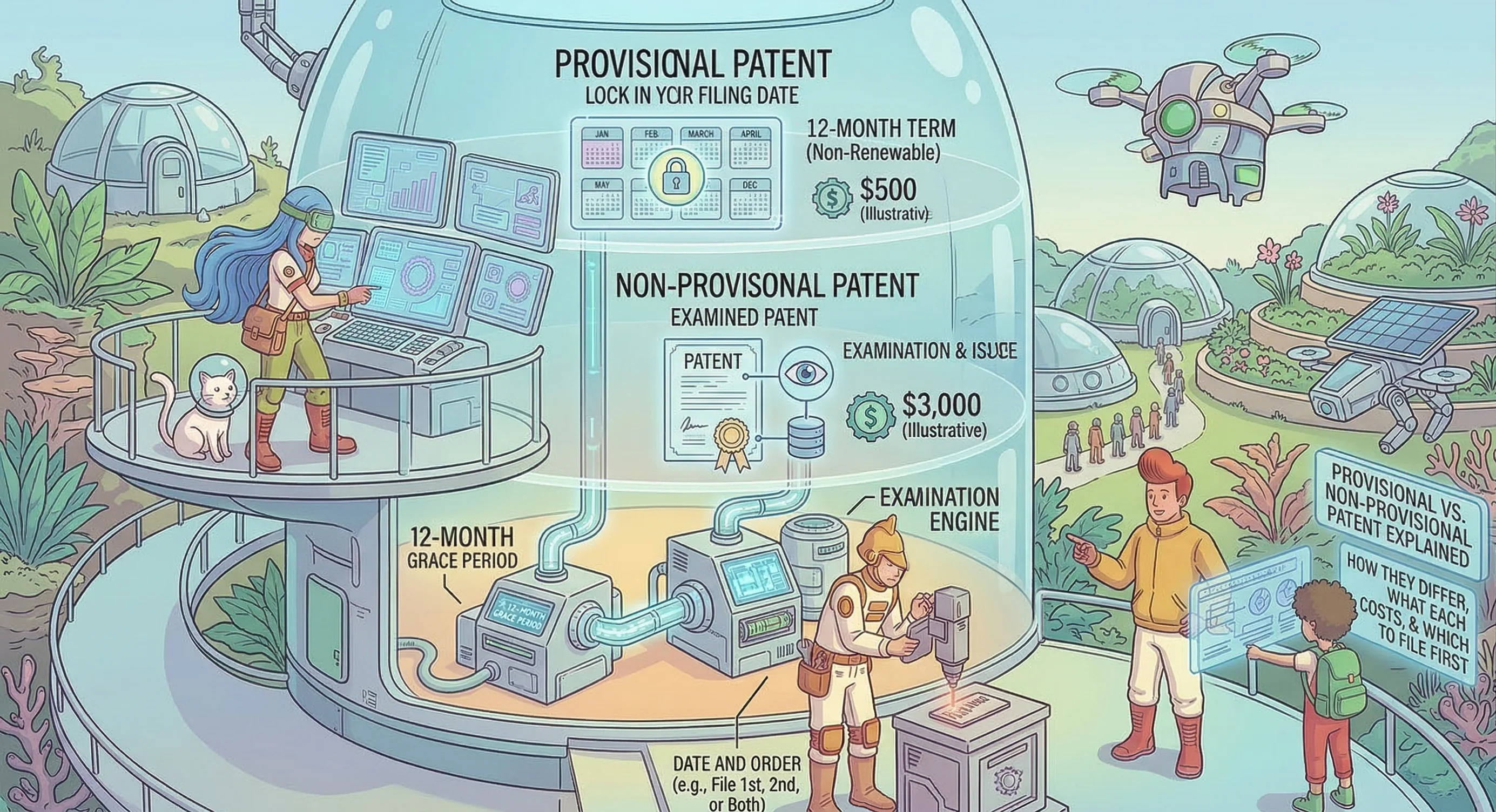
Provisional Patent: $2,000 to $6,000
A professionally drafted provisional patent application runs $2,000 to $6,000 including the USPTO filing fee.
What does a provisional actually do? It locks in your filing date. You get 12 months of “patent pending” status. During that time, you can sell your product, pitch investors, or keep developing. Your date is secure.
What a good provisional includes
A detailed written description of the invention. A claims outline that maps to the non-provisional you’ll eventually file. A review of your drawings or sketches. And the filing receipt from the USPTO confirming your date.
The $300 provisional trap
You’ll see services advertising provisionals for $300 to $500. What you get at that price is almost always a “cover sheet provisional.” Someone uploads your notes behind a standard USPTO form. There’s minimal professional drafting.
The problem is subtle and dangerous. When you file the non-provisional 12 months later, every claim has to be supported by what was written in the provisional. That’s the law (35 U.S.C. § 112). If the provisional was vague or skipped important details, the claims you care about most may not get the benefit of that earlier filing date.
Meanwhile, prior art published during that gap can be used against you.
The filing receipt looks identical whether the application behind it is 30 pages of detailed technical writing or 2 pages of rough notes. That’s what makes this risky. You feel protected. The question is whether you actually are.
USPTO filing fees for provisionals
| Entity Size | Filing Fee |
|---|---|
| Micro entity | $80 |
| Small entity | $160 |
| Large entity | $320 |
Most independent inventors qualify as micro entities. The requirements: you’ve been named as inventor on no more than 4 previously filed patent applications, and your gross income is under roughly $240,000.
Utility Patent: $5,000 to $15,000+
The non-provisional (utility) patent is the one that gets examined. It’s what produces an actual granted patent with enforceable claims. Protection lasts 20 years from the filing date. For a deep dive into non-provisional costs by invention type, office actions, and total cost through grant, see our non-provisional patent cost guide. For the full lifecycle cost including maintenance fees and claims strategy, see our utility patent cost guide.
Most patent attorneys and agents charge $5,000 to $15,000+ for drafting and filing. Mechanical devices and consumer products land on the lower end. Pharma, biotech, and software-heavy inventions push higher.
Solo practitioners and small firms typically charge $5,000 to $8,000 for inventions of moderate complexity. Large firms in major cities regularly charge $10,000 to $15,000+.
USPTO government fees for utility patents
These are paid directly to the USPTO on top of professional fees:
| Fee | Micro Entity | Small Entity | Large Entity |
|---|---|---|---|
| Filing fee | $70 | $140 | $350 |
| Search fee | $154 | $308 | $770 |
| Examination fee | $176 | $352 | $880 |
| Total at filing | $400 | $800 | $2,000 |
After the patent is granted, you pay an issue fee ($300 to $1,200 depending on entity size). Then there are maintenance fees at 3.5, 7.5, and 11.5 years to keep the patent alive.
Entity size qualification
Micro entity: Named as inventor on 4 or fewer previously filed applications. Gross income under 3x the US median household income (roughly $240,000 in 2026). Most first-time solo inventors qualify here.
Small entity: Individual inventors who don’t qualify as micro, businesses with fewer than 500 employees, universities, nonprofits.
Large entity: Organizations with 500+ employees.
The current fee schedule lives at uspto.gov. Fees typically adjust each year.
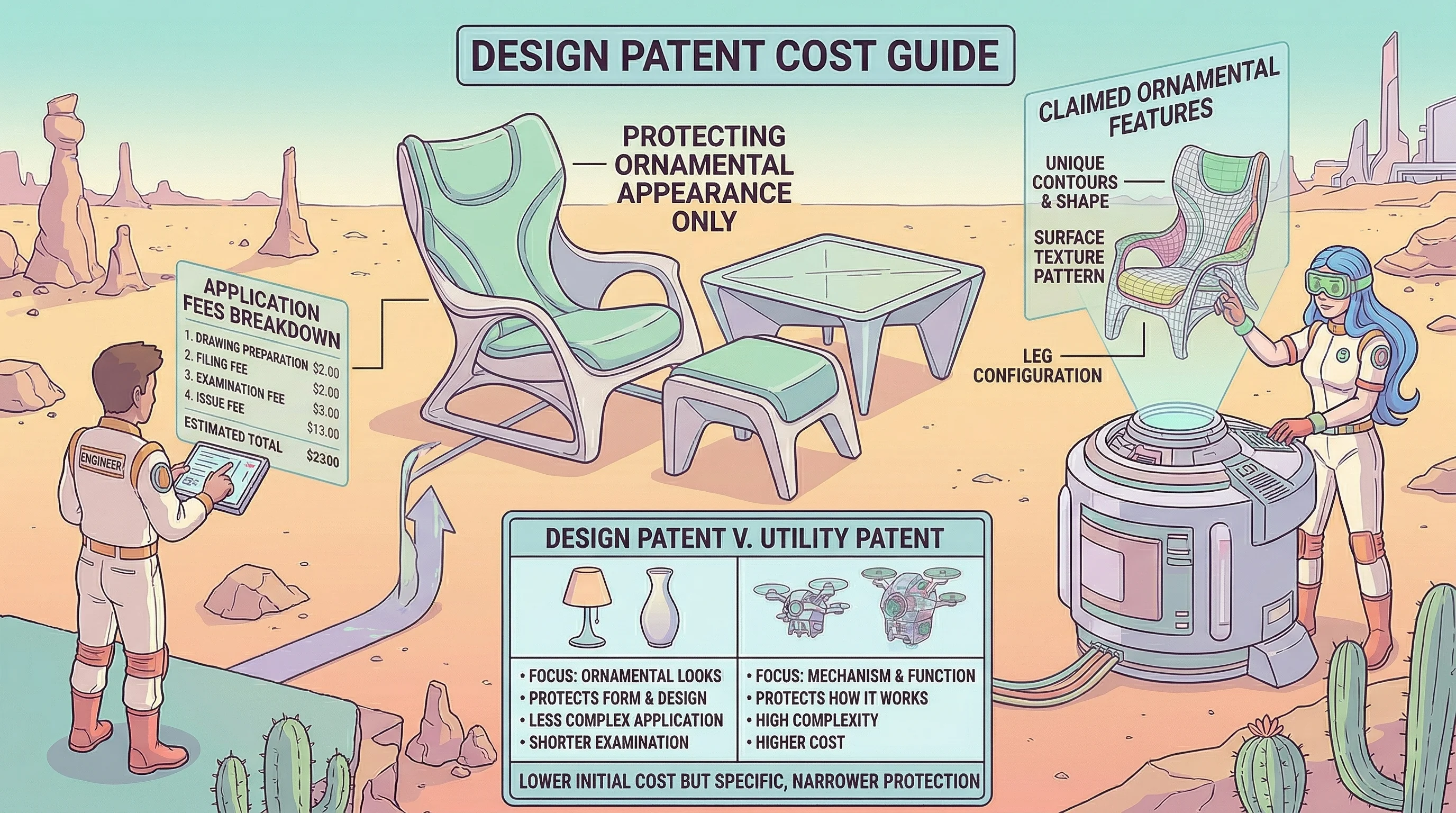
Design Patent: $1,500 to $5,000
Design patents protect how a product looks, not how it works. Professional fees typically run $1,500 to $5,000 plus USPTO government fees. For a complete breakdown of design patent costs, timeline, and strategy, see our design patent cost guide.
They last 15 years from grant and require no maintenance fees. That makes them cheaper to maintain over their lifetime than utility patents.
The Coca-Cola contour bottle has been design-patent protected since 1915. Crocs holds a design patent on the Classic Clog (US Design Patent No. D517,789). Apple uses design patents extensively for iPhone, iPad, and iMac appearances.
If the visual design of your product is part of why people buy it, a design patent is worth looking into. Sometimes filing both a design patent and a utility patent gives the most complete coverage.
Patent Search and Drawing Costs
Patent search: $500 to $1,500
A professional prior art search looks through the USPTO database, published applications, and other sources to find existing patents relevant to your invention. You get a written report with an honest assessment of patentability.
A search isn’t required before filing. But it helps the person drafting your application write claims that clearly distinguish your invention from what already exists. That reduces the chance of getting blindsided during examination.
Patent drawings: $300 to $1,000
The USPTO requires drawings that show every feature described in the claims. Professional patent drawings typically include front, side, top, perspective, and exploded views. Bad drawings lead to objections and delays. Our patent drawings guide covers USPTO format requirements, DIY options, and per-sheet pricing.
If you have CAD files or detailed sketches, those are the starting point. Rough hand drawings work too, but they’ll need to be converted to USPTO-compliant formal drawings.
Why the price range is so wide
You can spend $300 on a patent filing or $15,000 on a patent filing. The difference is real.
At the low end, you’re getting a cover sheet filing with no substantive drafting. At the high end, you’re paying for a large firm’s overhead: associates, office space, administrative staff, partner billing rates.
The important thing is understanding what you’re paying for. How much drafting time goes into the application. Who’s doing the work. Whether the claims are written to hold up during examination.
Free and Reduced-Cost Patent Help
If cost is a barrier, two USPTO programs can help. The Patent Pro Bono Program matches qualifying inventors with volunteer patent attorneys who work for free. The Law School Clinic Certification Program offers free or reduced-rate services through supervised law school clinics. Both require financial need and an independently owned invention. Search “USPTO pro bono” or “patent clinic near me” to find programs in your area.
Is a patent worth it?
A patent turns an invention into a legal asset. Without one, anyone can copy a product the moment they see it on the market.
Here’s what a patent actually gives you:
- Competitive protection. Competitors can’t legally copy a patented product. For anyone selling products in markets where knockoffs show up fast, this is the whole game.
- Investor confidence. Investors take a business more seriously when it owns IP. A patent means the product has been vetted and the company has a defensible position.
- Licensing revenue. Other companies can pay you for the right to use your invention.
- Higher valuation. Patents increase business value if you ever sell or get acquired.
One thing worth knowing: the US patent system is first-to-file. If two people independently invent the same thing, the one who files first wins. Every day without a filing date is a day someone else could file before you.
Patent attorney fees also vary significantly by state. Since patent attorneys are federally licensed, hiring in a lower-cost market can save thousands. Small businesses qualify for additional USPTO fee discounts of 50-80%.
Use the patent cost calculator to estimate costs for your specific invention. Browse patent attorneys in the directory to compare pricing.
Sources
- USPTO Fee Schedule : Current filing, search, examination, and issue fees by entity size
- 35 U.S.C. 111 : Patent application filing requirements
- 35 U.S.C. 119(e) : Provisional application priority rules
- Yale Law School : Patent Office Action Statistics : 86% of applications receive at least one office action
- MadePatents attorney pricing survey, 2026 : Direct pricing data from 200+ patent attorneys across all 50 states