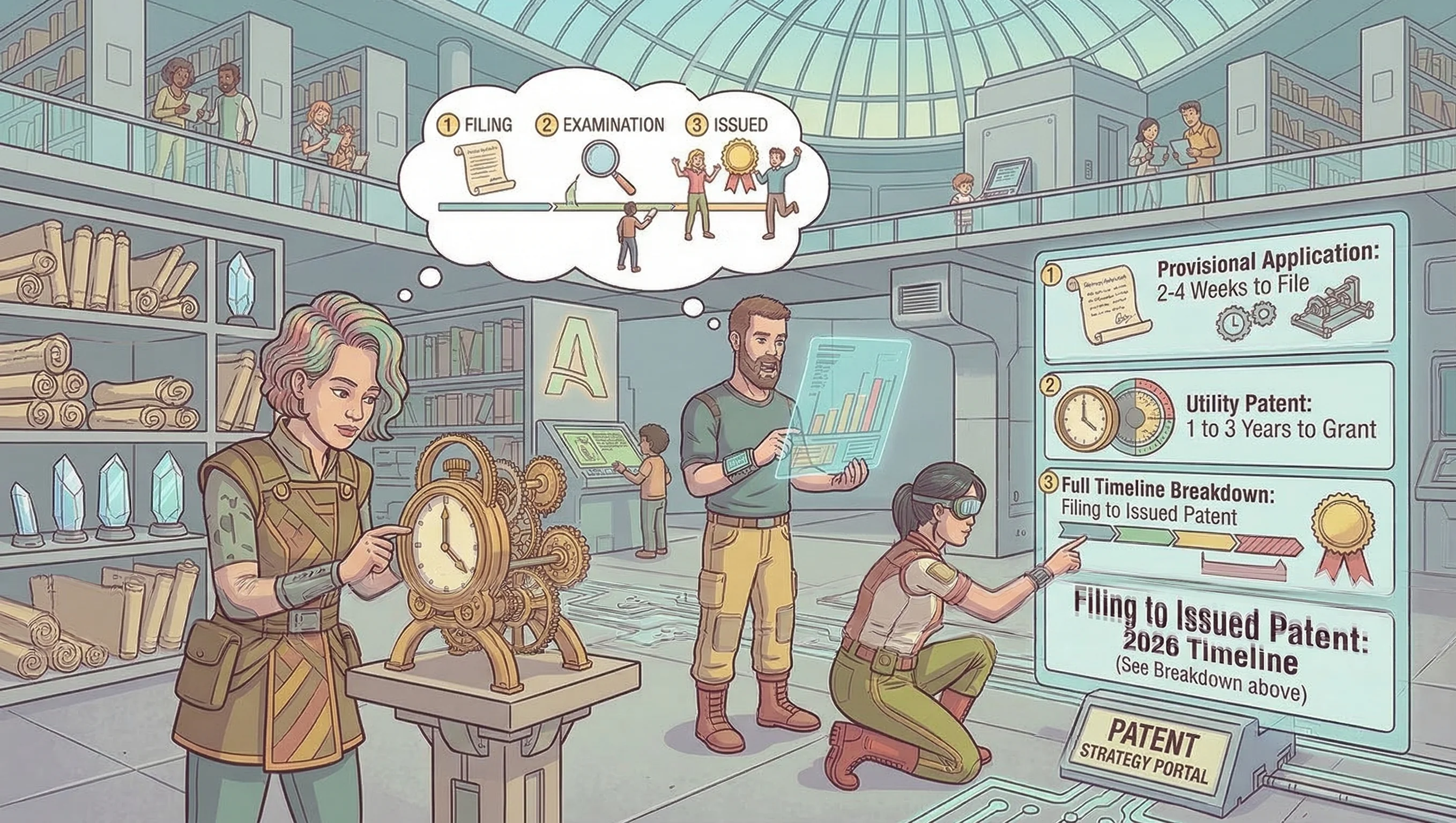
A provisional patent takes about 2 to 4 weeks to draft and file. You get patent pending status immediately. A non-provisional (utility) patent also takes about 2 to 4 weeks to draft, but after filing, the USPTO examination process takes 1 to 3 years before you hold an actual granted patent.
The total depends on your technology area, the current USPTO backlog, and how many times the examiner pushes back on your claims.
Timeline at a Glance
| Stage | Timeline | What Happens |
|---|---|---|
| Patent search (optional) | 1 week | Research prior art and assess patentability |
| Provisional drafting and filing | 2-4 weeks | Lock in your filing date, get patent pending status |
| Go-to-market window | Up to 12 months | Sell, test, pitch investors with patent pending |
| Non-provisional drafting and filing | 2-4 weeks | File the full utility patent for examination |
| USPTO examination | 1 to 3 years | Examiner reviews, office actions, final decision |
| Total (provisional path) | ~1.5 to 4 years | From first filing to granted patent |
Filing a Provisional: 2 to 4 Weeks
Drafting and filing a provisional takes about 2 to 4 weeks once the practitioner has everything they need from you: your invention description, sketches or CAD files, and notes about how it works.
During that time, the practitioner writes a detailed description, prepares a claims outline, reviews drawings, and files with the USPTO. Once filed, you get a receipt and can start using “patent pending.”
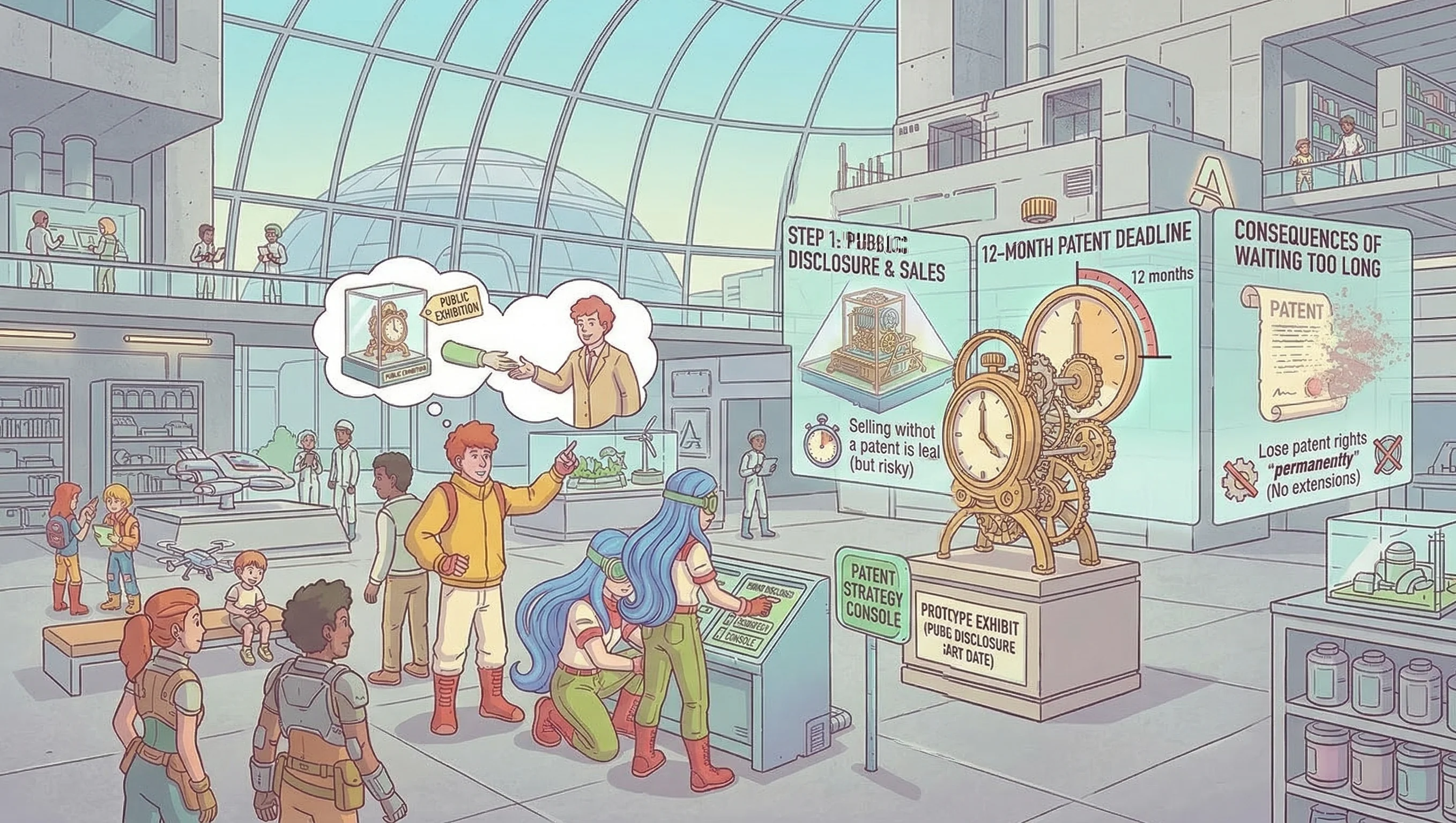
After filing, you have a 12-month window before the non-provisional is due. Most inventors use this time to sell, test the market, and refine the invention.
For more on what a provisional includes and why it matters, read What Is a Provisional Patent Application?
Filing a Non-Provisional: 2 to 4 Weeks
Drafting the non-provisional also takes about 2 to 4 weeks. This is the full utility patent that the USPTO will actually examine.
If you filed a provisional first, the non-provisional has to go in within 12 months to claim the benefit of that earlier date. The drafting is more involved because it includes the complete specification, formal patent claims, an abstract, and all drawings. The claims are the most important part. They define exactly what your patent protects.
USPTO Examination: 1 to 3 Years
After the non-provisional is filed, the USPTO assigns it to an examiner in the relevant technology area. This is where most of the waiting happens.
First office action wait: 12 to 18 months. Your application sits in a queue. The average wait for a first response is currently around 15 months, though it varies a lot by technology center. Some areas move faster. Others can take over 2 years for the first response.
Office action response cycle: 3 to 12 months per round. Most applications are initially rejected at least once. This is normal. An office action is a letter from the examiner explaining objections or rejections. You typically have 3 months to respond (extensions available for additional fees). After you respond, the examiner reviews everything again, which takes another 3 to 6 months. Most applications go through this cycle at least once or twice before a final determination. For more on what this process looks like from the applicant’s side, see what happens after filing.
Total examination: 1 to 3 years. If the application gets one office action and your response resolves the issues, figure 1.5 to 2 years. If it goes through multiple rounds, expect 3 years or more.
Your application keeps patent pending status throughout the entire examination period.
Duty to disclose. Throughout the entire process, you have a legal obligation to disclose relevant information to the USPTO via information disclosure statements. If you become aware of prior art or other references that might affect the examination, you must submit them. Failing to disclose known relevant information can invalidate your patent later, even after it’s been granted.
What Affects Speed
Technology area. The USPTO organizes applications by technology center. Mechanical devices and consumer products tend to move faster. Software, AI, and telecom often have longer backlogs.
Application quality. A well-drafted application with clear claims, thorough descriptions, and solid drawings moves through examination more smoothly. When the examiner can clearly understand your invention and how it’s different from existing patents, there’s less back and forth. Investing in a strong initial application saves time later.
Prior art landscape. If your invention is in a crowded field with lots of existing patents, the examiner will have more to compare against. That can mean more detailed office actions and longer cycles. A patent search before filing helps you understand the landscape so claims can be written to clearly stand apart.
Number of office actions. Each one adds 6 to 12 months to the total. Fewer office actions means a faster grant. Strong applications with well-researched claims tend to get fewer.
Your response time. You have 3 months to respond to an office action, extendable to 6 months for extra fees. Responding quickly keeps things moving.
Ways to Speed It Up
The USPTO offers a few options to accelerate examination:
Track One prioritized examination. For an additional government fee ($1,000 for micro entities, $2,000 for small entities), the USPTO targets a final decision within 6 to 12 months. Your application goes to the front of the queue. This is the most straightforward acceleration option. Track One has claim limits: a maximum of 4 independent claims and 30 total claims. If your application exceeds these limits, you must reduce claims before entering the program.
Age-based acceleration. If any inventor on the application is over 65, you can petition for accelerated examination at no extra cost.
Patent Prosecution Highway (PPH). If a corresponding application was allowed in a partner country’s patent office, you can use PPH to fast-track examination in the US. There is no extra fee. The USPTO has PPH agreements with over 30 patent offices. PPH is most useful for companies filing in multiple countries simultaneously.
Petition to Make Special. In certain cases (inventor’s health, environmental significance), the USPTO will expedite examination without extra fees.
After Final Consideration Pilot (AFCP 2.0). This program gives you a faster path after a final rejection. Instead of filing a full RCE, you submit a response with at least one claim amendment. The examiner gets extra time to consider your changes. There is no fee for the program itself. AFCP 2.0 is worth trying before committing to the cost of an RCE ($480 to $960) or an appeal.
What If You Skip the Provisional?
If you file a non-provisional directly without a provisional first:
| Stage | Timeline |
|---|---|
| Non-provisional drafting and filing | 2-4 weeks |
| Wait for first office action | 12 to 18 months |
| Office action response cycle | 3 to 12 months per round |
| Total to granted patent | ~1 to 3 years |
The total time to a granted patent is roughly the same either way. The difference: with a provisional, you get patent pending status and a locked-in date within 2 to 4 weeks at a lower initial cost. Without one, you start the examination clock immediately but pay the full amount upfront. For a full breakdown of costs at each stage, see our patent cost guide.
After the Patent Is Granted
Once the USPTO approves your patent, you pay an issue fee and the patent is officially granted. You have enforceable rights for 20 years from your non-provisional filing date.
One ongoing requirement: maintenance fees. The USPTO requires payments at 3.5, 7.5, and 11.5 years. Missing a deadline can expire your patent early. Fees start around $400 for micro entities at the 3.5-year mark and increase over time.
Design patents are different. They last 15 years from grant and have no maintenance fees at all.
The Bottom Line on Timing
The patent process takes years. There’s no way around that. But the first step is fast. A provisional goes in within a few weeks and locks in your date from day one. Everything after that is the USPTO working through its queue.
The sooner you file, the sooner your date is secured and the sooner the clock starts moving toward a granted patent. Find a patent attorney in the directory or estimate costs with the patent cost calculator.