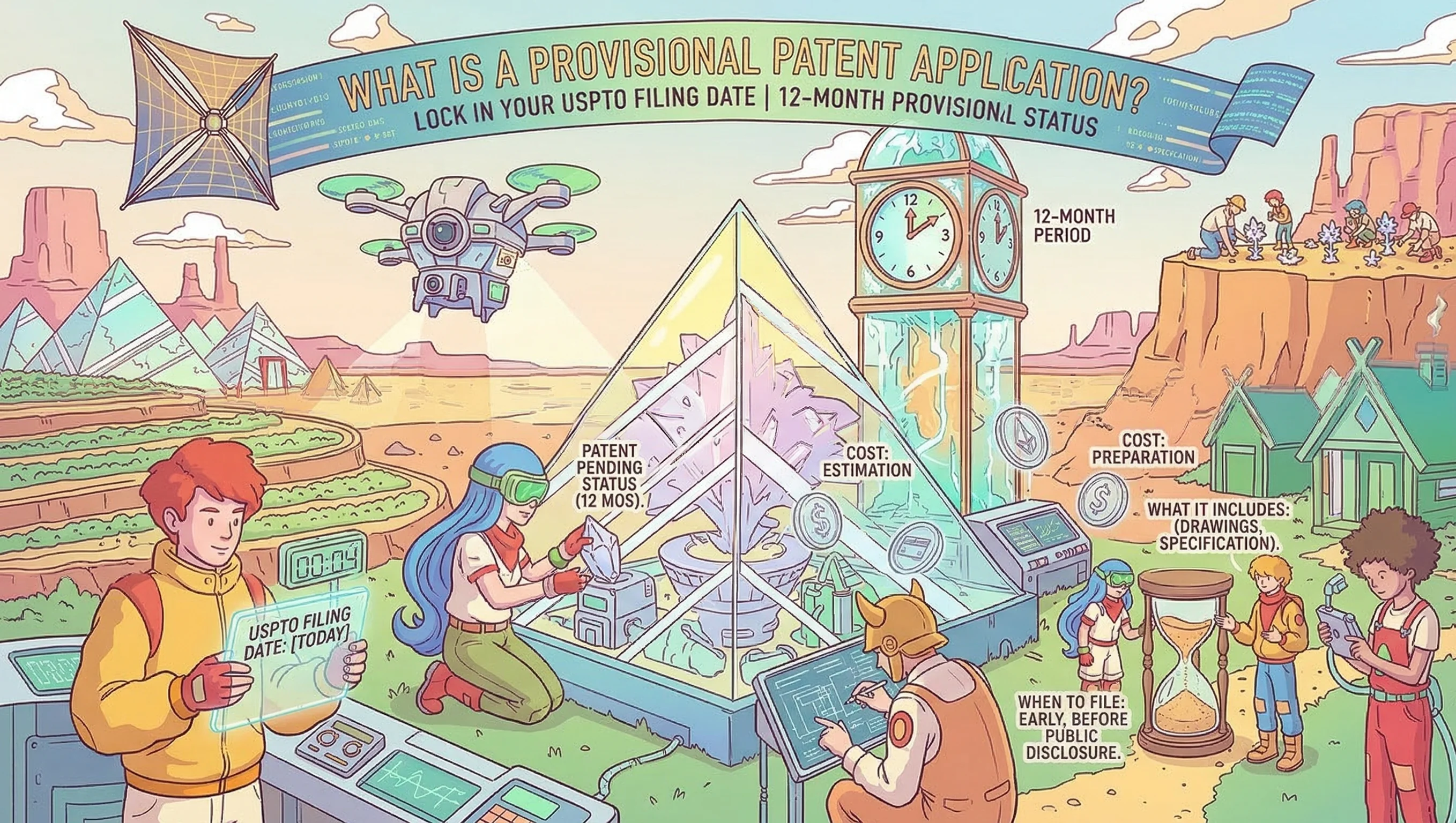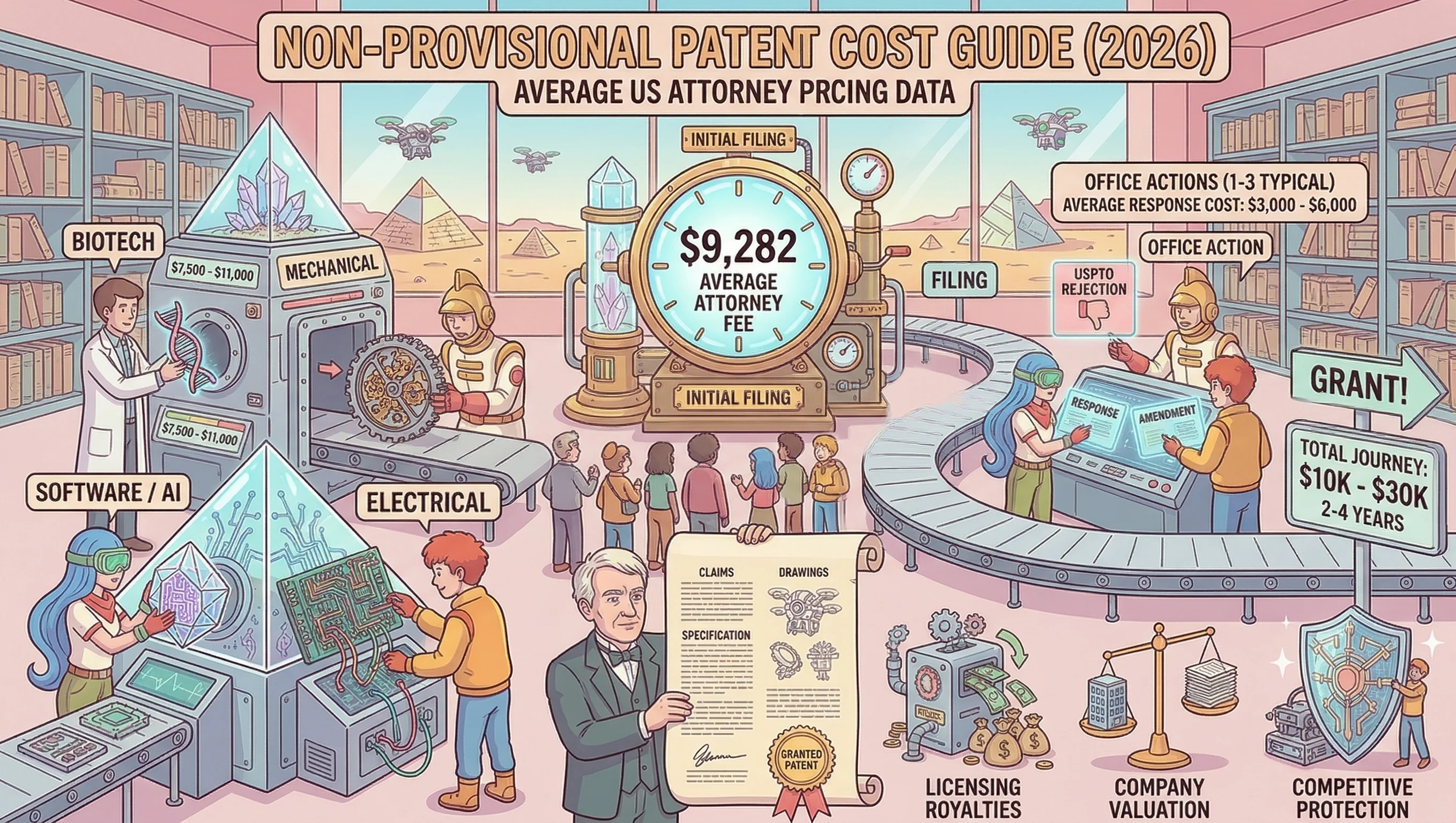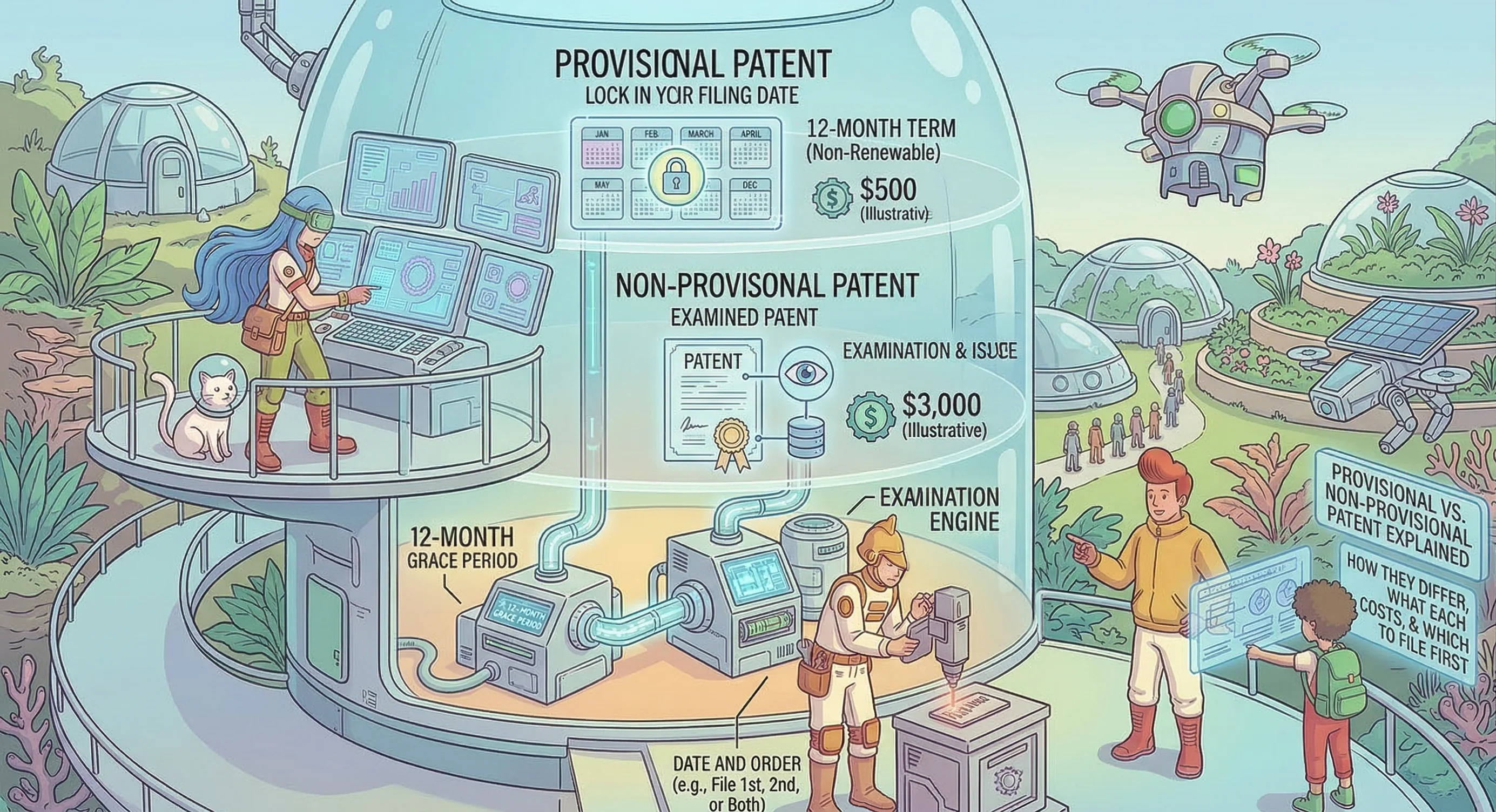
A provisional patent costs $2,000 to $6,000 and gives you 12 months of patent pending status. A non-provisional (also called a “full patent” application) costs $6,000 to $15,000+ and is the application the USPTO actually examines. The provisional is not examined and does not become a granted patent on its own. The non-provisional is what results in enforceable patent protection for 20 years.
Most inventors file a provisional first, then convert to a non-provisional within 12 months.
How They Compare
| Feature | Provisional | Non-Provisional |
|---|---|---|
| Purpose | Locks in filing date, patent pending status | Gets examined, can become a granted patent |
| Examined by USPTO? | No | Yes |
| Results in granted patent? | No (must convert within 12 months) | Yes, if approved after examination |
| Patent pending status? | Yes, for 12 months | Yes, until granted or abandoned |
| Duration of protection | 12 months (then expires if not converted) | 20 years from filing date |
| Formal claims required? | No (but recommended) | Yes |
| USPTO filing fee (micro entity) | $80 | $400 |
| Typical professional fee | $2,000 - $4,000 | $4,000 - $8,000+ |
| Drafting timeline | 2-4 weeks | 2-4 weeks |
| Time to grant | N/A (not examined) | 1 to 3 years after filing |
What Goes in a Provisional
A provisional application includes:
- A detailed written description of your invention (the bulk of the drafting work)
- Drawings or sketches showing how it works
- A cover sheet identifying the inventor(s) and the invention title
A provisional does not require formal claims, an abstract, a background summary, or a brief description of drawings. But a good practitioner will include a claims outline anyway because it strengthens the eventual non-provisional.
The key thing to understand: a provisional is only as strong as what is written inside it. Your non-provisional claims must be fully supported by the content in your provisional. If the provisional was vague or skipped details, those gaps can cost you your filing date. And a defective provisional cannot be fixed after the fact. If you described only a narrow implementation (say, a specific bolt-and-nut fastener), you likely cannot later claim broader scope (all types of fastener connections). The scope of your future claims is limited by the scope of what the provisional enables.
What Goes in a Non-Provisional
A non-provisional includes:
- A complete written specification describing the invention in detail
- Formal patent claims that define the legal boundaries of your protection
- An abstract summarizing the invention
- Patent drawings that show every feature described in the claims
- An inventor declaration
After filing, the USPTO places your application in an examination queue. An examiner reviews the application, searches for prior art, and issues office actions if there are objections or rejections. Most applications receive at least one office action before the patent is granted. See what happens after filing for the full process.
Which Should You File First?
File a provisional first if:
- You want to establish a filing date quickly while you continue developing your product
- You plan to test the market, pitch investors, or start selling and want patent pending protection
- You need time to raise funds for the full non-provisional application
- Your invention is still being refined but the core concept is clear
- You want to lock in your date before a trade show, product launch, or crowdfunding campaign
File a non-provisional directly if:
- Your invention is fully developed and you are ready for examination
- You have already validated the market and know you want full patent protection
- You want to start the examination clock as soon as possible
- Budget is not a constraint and you do not need the 12-month bridge
The US patent system is first to file. A provisional is the fastest and most affordable way to establish your filing date.
The 12-Month Provisional Window
Once your provisional is filed, you have 12 months to file a non-provisional that claims the benefit of your provisional filing date. During that window:
- Sell your product. Go to market with patent pending marked on your product.
- Pitch investors. A filed provisional shows you have taken steps to protect your IP.
- Refine your invention. Improvements can be included in the non-provisional filing. New features get the non-provisional filing date, not the provisional date.
- Run a patent search. Understanding prior art helps write stronger claims for the non-provisional.
If you do not file a non-provisional within 12 months, the provisional expires and you lose the benefit of that filing date.
Converting a Provisional to Non-Provisional
When the 12-month window approaches, you file a non-provisional application that “claims the benefit of” the provisional’s filing date. This is not an automatic conversion. You must prepare and file a complete non-provisional application, including formal claims, that is supported by the provisional’s description.
The non-provisional can include additional material beyond what was in the provisional. But any claims that rely on the new material only get the non-provisional’s filing date, not the provisional’s. Claims fully supported by the provisional get the earlier date.
You can also file multiple non-provisional applications from a single provisional if they cover different aspects of the invention. Each must be filed within the 12-month window.
Why Cheap Provisionals Are Risky
You may see services advertising provisional applications for $300 to $500. At that price, what you are getting is almost always a cover sheet provisional: someone takes your notes or rough sketches and uploads them behind a standard cover sheet with minimal professional drafting.
The filing receipt looks the same. You can say “patent pending.” But when your non-provisional is filed 12 months later, every claim must be supported by the content in the provisional. If it was vague, incomplete, or missing details about how your invention works, the examiner can reject the claim to your earlier filing date.
That means any prior art published during those 12 months could be used against you. The filing date you thought you secured may not protect you at all.
Cost Breakdown
Provisional path (most common):
| Step | Typical Cost |
|---|---|
| Provisional application | $2,000 - $4,000 |
| Patent search (optional) | $500 - $1,500 |
| Non-provisional application | $4,000 - $8,000+ |
| USPTO government fees (micro entity) | $400+ |
| Total | $6,500 - $14,000+ |
Direct non-provisional path:
| Step | Typical Cost |
|---|---|
| Non-provisional application | $4,000 - $8,000+ |
| USPTO government fees (micro entity) | $400+ |
| Patent search (optional) | $500 - $1,500 |
| Total | $4,900 - $10,000+ |
The provisional path costs more because you are paying for two filings. But it gives you patent pending status and locks in your date before committing to the full application. For most inventors, the extra cost is worth the flexibility.
For a full cost breakdown, see the patent cost guide. For detailed non-provisional pricing by invention type and total cost through grant, see the non-provisional patent cost guide. For provisional-specific costs, see the provisional patent cost guide. Find a patent attorney in the directory or estimate costs with the patent cost calculator.