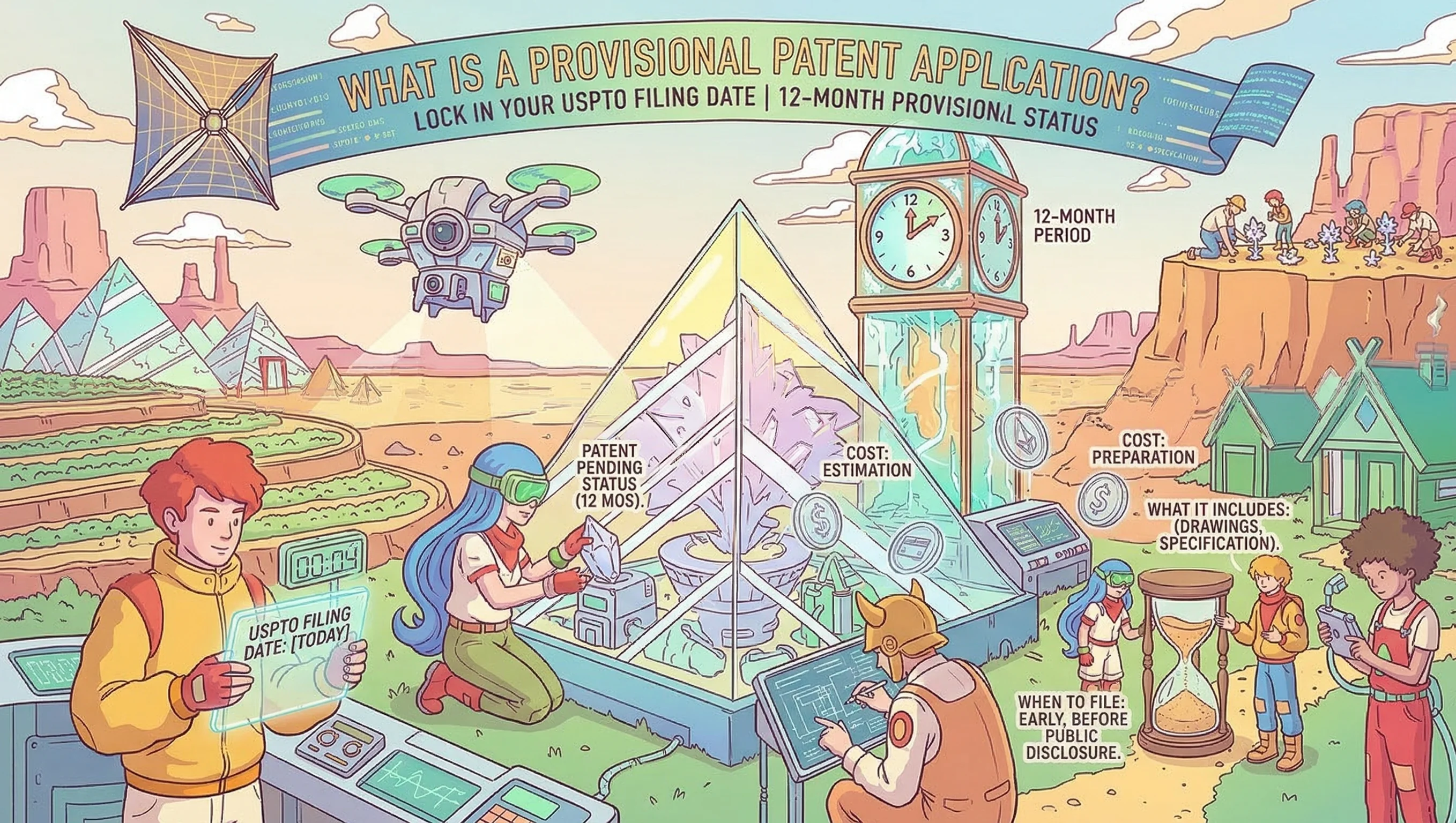
A provisional patent application is a filing with the USPTO that locks in your filing date and gives you 12 months of patent pending status. It doesn’t get examined by a patent examiner. It doesn’t turn into a granted patent on its own. Its job is to hold your place in line while you prepare the full application.
Think of it as planting a flag. You’re telling the patent office: this is my invention, this is the date I described it, and I’m coming back with the complete filing within a year.
One thing to understand upfront: a provisional establishes patent pendency, not enforceable rights. You cannot sue anyone based on a provisional. Enforceable patent rights only exist when a patent application matures into a granted patent. The provisional’s job is to lock in your priority date for the information it contains.
How It Works
When you file a provisional, the USPTO assigns a filing date and sends you a receipt. From that moment, you can mark your product “patent pending.”
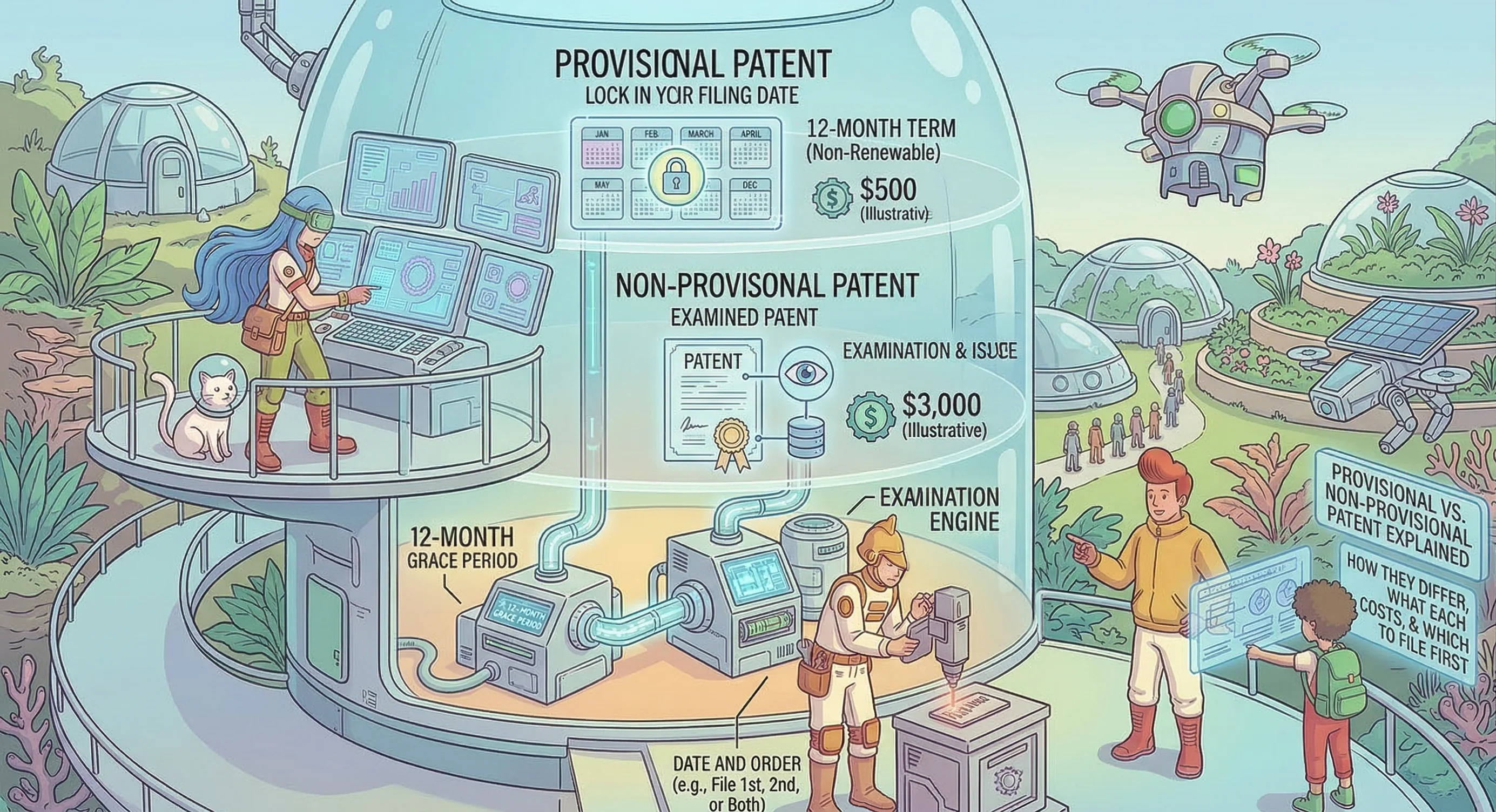
You then have 12 months to file a non-provisional patent application that claims the benefit of the provisional’s filing date. If you file within that window, your patent protection reaches back to the provisional date. This matters because the US patent system is first-to-file. If someone else files on a similar invention after your provisional date, your earlier date takes priority.
If you don’t file the non-provisional within 12 months, the provisional expires. You lose the filing date. Any prior art published during those 12 months can be used against you. For a detailed comparison of what each filing type involves, see provisional vs. non-provisional patents.
What Goes Into a Provisional
A well-drafted provisional includes four things:
A detailed description of the invention. This is the heart of the filing and where the bulk of any patent practitioner’s time goes. It explains how the invention works, what it’s made of, how the parts fit together, and any variations. The description has to be thorough enough that someone in the field could build it from what’s written (the enablement requirement under 35 U.S.C. § 112).
One critical point about enablement scope: the provisional must describe the invention broadly enough to support the claims you eventually want. If your provisional only describes a mechanical nut-and-bolt fastener, you likely cannot later claim all types of fastener connections (electromagnets, adhesives, welding). The scope of your future claims is limited by the scope of what the provisional enables. A defective provisional cannot be fixed after the fact.
Drawings or sketches. The USPTO doesn’t require formal drawings in a provisional, but clear illustrations strengthen the filing. Drawings show features that are hard to describe in words alone.
A claims outline. Claims aren’t technically required in a provisional. Neither is an abstract, background summary, or brief description of drawings. But a good patent practitioner will include a claims outline anyway. It identifies the key patentable features and creates a roadmap for the formal claims that go into the non-provisional. This is one of the biggest differences between a professionally drafted provisional and a cheap one.
A cover sheet identifying the inventor(s) and invention title.
When to File
You’re about to sell, launch, or publicly show your product. Any public sale or disclosure starts a clock. In the US, you have a one-year grace period. In most other countries, there’s no grace period at all. Filing before any public activity is the safest move.
You want to lock in a date fast. A provisional is quicker and cheaper to prepare than a non-provisional. If you’re worried about someone filing first, a provisional gets your stake in the ground.
Your product is still in development. The core invention is defined but you’re still tweaking details, testing materials, or making design changes. A provisional protects what you have right now.
You need time to raise funds. A provisional runs $2,000 to $6,000 compared to $5,000 to $15,000+ for a non-provisional. Filing provisional first spreads the cost over a longer period.
You’re preparing for a crowdfunding campaign, trade show, or investor pitch. Patent pending status before these events protects your rights and signals that you’re serious about your IP.
What Makes a Good One vs. a Bad One
A provisional is only as strong as what’s written inside it. Every claim in your future non-provisional has to be supported by the content in the provisional. If the provisional was vague, those gaps can cost you your filing date when you convert.
A strong provisional has detailed descriptions of how the invention works. Multiple variations described. A claims outline. Clear drawings showing all components. Written by someone who understands patent claims.
A weak one is your notes or sketches uploaded behind a standard cover sheet. Little professional drafting. No claims outline. Vague descriptions. Written without thinking about what the non-provisional will eventually need.
The filing receipt looks the same either way. That’s the trap.
The $300 Provisional Problem
You’ll see services advertising provisional patent applications for $300 to $500. At that price, you’re getting a cover sheet provisional. Someone takes your notes and uploads them behind a standard USPTO form.
The filing receipt looks official. You can say “patent pending.” Everything feels fine.
But when the non-provisional goes in 12 months later, every claim has to be supported by what’s in the provisional (35 U.S.C. § 112). If the provisional was incomplete, the important claims won’t get the benefit of that earlier date. Any prior art from during the gap can be used against you.
The difference between a $500 provisional and a $3,000 provisional isn’t just the price tag. It’s whether the filing actually does its job.
What Happens During the 12-Month Window
Once the provisional is filed, you have a year before you need to file the non-provisional. During that time, you can:
- Sell your product with patent pending status
- Pitch investors with proof you’ve taken steps to protect your IP
- Refine the invention based on testing and feedback
- Run a patent search to understand what prior art exists
- Test the market to validate demand before spending more on the full application
If you make improvements during that window, the new features can be included in the non-provisional. Just know that anything new will only get the non-provisional filing date, not the earlier provisional date.
One important clarification: patent pending status does not prevent copying. It serves as notice that a patent application has been filed. Once a patent is granted, you may be able to collect damages back to the date when competitors were on notice of your pending application. But until grant, you cannot enforce patent rights.
Common Provisional Pitfalls
These are the mistakes that cost inventors the most:
| Mistake | Consequence |
|---|---|
| Filing a vague or incomplete description | Claims in the non-provisional that go beyond what the provisional describes will not get the earlier priority date. Prior art published during the gap can be used against you. |
| Missing the 12-month deadline to file non-provisional | The provisional goes abandoned. Your priority date is lost. If you disclosed publicly during that window, you may have permanently lost international patent rights. |
| Claiming “patent pending” on features not in the provisional | False patent marking is illegal and subject to fines under 35 U.S.C. 292. Only features actually described in the filed application are covered. |
| Not documenting the conception date | If an inventorship dispute arises, having a clear record of when you conceived the invention strengthens your position. Keep dated notes, emails, and sketches. |
How Much Does a Provisional Cost?
Professionally drafted provisionals typically cost $2,000 to $6,000 depending on the complexity of the invention and who prepares it. Large firms charge more because of overhead. Solo practitioners and small firms charge less.
The USPTO filing fee is separate: $80 for micro entities, $160 for small entities, $320 for large entities. Most independent inventors qualify as micro entities.
For a complete cost breakdown across all patent types, read How Much Does a Patent Cost in 2026?. Find a patent attorney in the directory or estimate costs with the patent cost calculator.