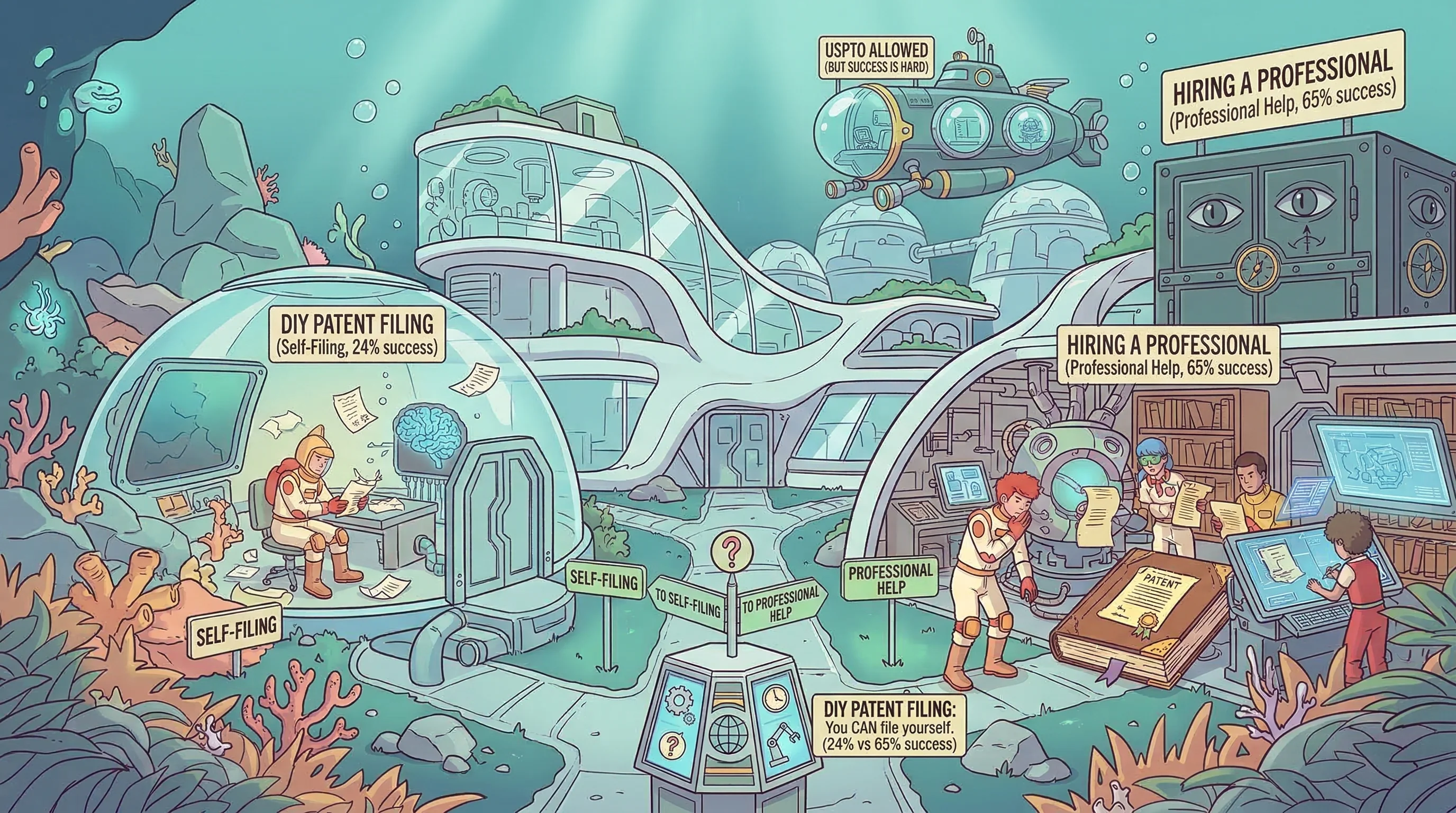
You can file a patent application yourself. The USPTO does not require a patent agent or attorney. But self-filers have a 24% success rate, while applicants with professional representation succeed 65% of the time (PLOS One study). That is a 2.7x difference.
The gap does not come from the filing process itself. Filing is paperwork. It comes from how the application is drafted: the specification detail and the claim strategy.
At a Glance
| DIY Filing | Patent Professional | |
|---|---|---|
| Cost | USPTO fees only ($320 provisional, micro entity) | $2,000 - $15,000+ depending on provider (varies by state) |
| Success rate | 24% (PLOS One) | 65% (PLOS One) |
| Claim drafting | Written by inventor | Written by trained practitioner |
| Specification depth | Varies widely | Engineering-level detail |
| Office action handling | Inventor must respond to examiner | Professional handles examination |
| Time investment | Significant time learning the process | Inventor focuses on their product |
| Risk level | High risk of weak or narrow claims | Lower risk of fatal drafting errors |
Where DIY Goes Wrong
The filing process is not the hard part. The USPTO website walks you through the forms. You can figure out the paperwork.
The hard part is drafting the application. Specifically, writing claims that are broad enough to protect against design-arounds but narrow enough to survive examination. That calibration is a skill that takes years of practice to develop.
DIY filers tend to write functional descriptions: “a device that holds things” or “a tool that makes cooking easier.” Those descriptions tell the examiner what the invention does, not what it is. Structural claims look different: “a housing comprising a first wall, a second wall perpendicular to the first wall, and a retaining clip positioned at the junction of the first and second walls.” That level of structural specificity is what separates claims that protect you from claims that a competitor can design around in an afternoon.
The specification has the same problem. DIY applications tend to describe the invention in general terms. A professional specification describes every component, every connection point, every alternative embodiment. That detail is not optional padding. It is the material you draw from when you need to amend your claims during examination.
The Office Action Problem
86% of patent applications receive at least one office action from the USPTO (Yale/USPTO data). An office action means the examiner has found a reason to reject some or all of your claims. It is a normal part of the process, not a sign that your invention is unpatentable.
Responding to an office action is harder than drafting the original application. You need to understand the prior art the examiner cited, figure out how your invention differs from it, amend your claims to address the rejection without giving up too much scope, and write a persuasive argument for why the amended claims should be allowed.
This is where most self-filers get stuck. The rejection letter reads like a legal document (because it is one), and the strategy for responding depends on the type of rejection, the quality of the cited prior art, and the claim structure you started with. If your original claims were vague or your specification was thin, you have fewer options for amendment. You cannot add new information to a patent application after it is filed.
When DIY Can Work
DIY filing is not always a mistake. There are situations where it makes sense.
Design patents. If you are seeking protection for the ornamental appearance of a product (not how it works, how it looks), the format is simpler. Design patents rely on drawings rather than written claims. The drafting skill that matters most for utility patents is less of a factor here.
Prior patent experience. If you worked in a patent-adjacent role in a previous career, or if you have filed before and understand the process, you have a head start that most first-time filers do not.
Provisional as a placeholder. If you are filing a provisional purely to establish a filing date and you plan to hire a professional for the non-provisional, the provisional can serve as a starting point. Make sure it includes enough structural detail to support the claims you will want later. A one-page provisional with a sketch is not enough.
Budget constraints. If a professional is genuinely out of reach right now, a self-filed provisional is better than no filing at all, especially if you are about to disclose your invention publicly. Go in with your eyes open about the limitations. See our patent cost guide for what to budget at each stage.
The Bottom Line
The question is not whether you can file a patent yourself. You can. The question is whether the patent you get will be strong enough to protect your invention when it matters.
A patent with weak claims or a thin specification is technically a patent. But it may not stop a competitor who copies your product with minor modifications. And by the time you discover that your claims are too narrow, it is too late to fix them.
For most inventors with a commercially valuable invention, the cost of professional help is small compared to the cost of a patent that does not do its job.
Common Questions
Can I file a provisional patent myself? Yes. The USPTO does not require professional representation. But a thin provisional creates problems later. You cannot add new information to your non-provisional that was not in the provisional. What you file on day one is what you have to work with.
How much does it cost to file a patent yourself? USPTO government fees are $320 for a provisional application (micro entity) and $1,600 for a non-provisional (micro entity). But cost is not the only variable. A failed application costs more than the filing fee. If weak claims or a thin specification lead to a final rejection, you lose the filing fees, the time you invested, and potentially the ability to refile if your public disclosure clock has run out.
Is a patent agent or patent attorney better for first-time filers? Both are licensed by the USPTO to draft and file patent applications. They do the same core job. Attorneys can also handle patent litigation (courtroom work), but most inventors never need that. The key factor is finding someone with relevant technical expertise in your type of invention. See our patent agent vs attorney guide for a full comparison.
Find a patent attorney in the directory or estimate costs with the patent cost calculator.