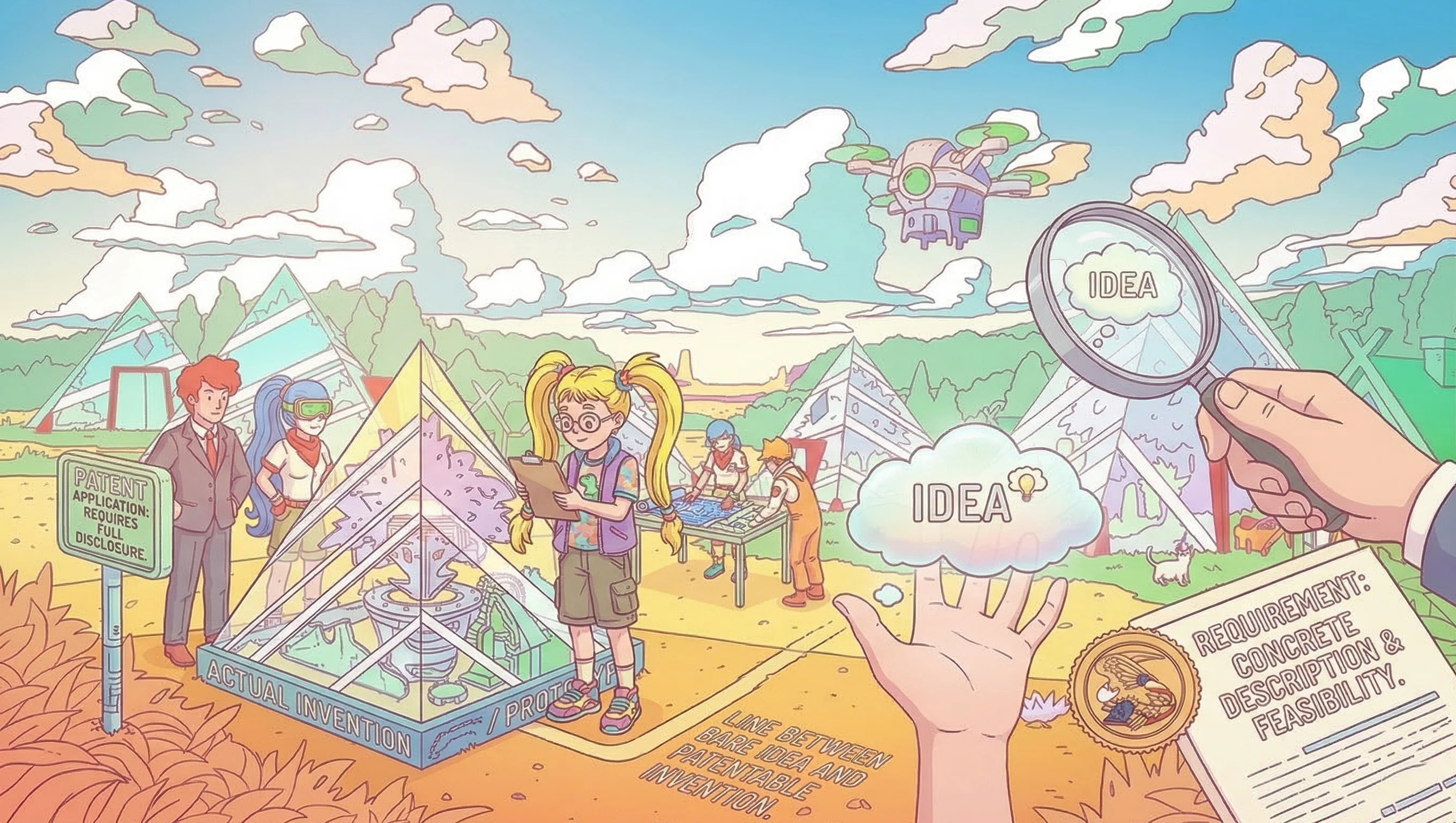
The short answer: you can patent an invention you haven’t built yet. You cannot patent a bare idea.
The difference matters, and it’s more specific than most people think.
Ideas vs. Inventions
The USPTO doesn’t care whether you’ve built a prototype. They care whether you can describe exactly how your invention works in enough detail that someone skilled in the field could build it. This is called the enablement requirement under 35 U.S.C. 112.
Here’s the distinction:
Bare idea: “A cup that keeps drinks cold longer.”
Patentable invention: “A double-walled vacuum-insulated cup with a copper lining between the inner and outer walls. The vacuum layer eliminates conductive heat transfer. The copper lining reflects radiant heat back toward the liquid. The lid uses a gasket seal to prevent convective heat loss through the opening.”
The bare idea describes a goal. The patentable invention describes a specific structure and how it works. The cup could be patented without ever building it, because the description is specific enough that a manufacturing engineer could build it from the patent application alone.
What the USPTO Requires
You do not need a prototype. You need three things:
1. A Detailed Written Description
Describe what your invention is, how it works, and how to make it. Be specific about materials, dimensions, steps, and relationships between components. The goal is that someone reading your application could reproduce your invention without guessing.
2. Drawings or Sketches
Patent drawings show the structure and operation of your invention. They don’t need to be professional CAD files at the provisional stage. Clear hand sketches with labeled parts work fine. For a non-provisional filing, formal patent drawings are typically required.
3. An Explanation of What Makes It Different
Your application needs to explain how your invention differs from what already exists (called “prior art”). This doesn’t have to be a formal patent search at the provisional stage, but you should be able to articulate what’s new about your approach.
The Provisional Patent Path
If your invention isn’t fully developed yet, a provisional patent application is usually the right move.
A provisional gives you a filing date and 12 months to refine your invention before filing the full non-provisional application. It costs less, has fewer formal requirements, and locks in your priority date under the first-to-file system.
This matters because the US patent system awards patents to whoever files first, not whoever invents first. If someone else files a patent on a similar invention before you, your earlier filing date from the provisional protects your position.
During the 12-month provisional window, you can:
- Build and test a prototype
- Refine the design
- Talk to manufacturers
- Show the invention to potential buyers or investors (your filing date is already secured)
- File the full non-provisional application incorporating everything you’ve learned
The provisional application itself never becomes a patent. It’s a placeholder that preserves your date while you develop the full application.
For more details, see the provisional patent guide.
What Level of Detail Is Enough?
More than you think. The most common mistake inventors make is being too vague.
A patent examiner will reject your application under Section 112 if the description doesn’t enable someone to build the invention. They’ll also reject it if the written description doesn’t show that you actually possessed the invention at the time you filed.
Think about it from the examiner’s perspective. They need to verify that you’ve invented something specific, that you’ve described more than a goal. Every functional claim needs a corresponding explanation of how it works. The patent application must allow another person to make and use your invention. It is not a checklist or a brief summary.
Watch out for enablement scope, too. If you describe only a narrow implementation, your future claims are limited to that narrow scope. Describing a specific mechanical nut-and-bolt fastener will not let you later claim all types of fastener connections (electromagnets, adhesives, welding). The broader the protection you want, the more variations and implementations you need to describe.
For mechanical inventions, this means dimensions, materials, and assembly relationships. For software, it means algorithms, data structures, and process flows. For chemical inventions, it means formulas, concentrations, and reaction conditions.
What About Software and App Ideas?
Software patents have an extra hurdle. After the Supreme Court’s 2014 decision in Alice Corp. v. CLS Bank, the USPTO applies stricter scrutiny to software inventions. Abstract ideas implemented on a computer are generally not patentable.
To patent software, you typically need to show that your invention improves the functioning of the computer itself or provides a technical solution to a technical problem. “An app that does X” is usually too abstract. “A method that processes data using Y algorithm to achieve Z technical result” has a better chance.
Software patents are still granted regularly, but the claims need to be drafted carefully to survive Alice scrutiny. This is an area where the patent professional’s skill matters a lot.
Can You Add to Your Application Later?
Sort of.
Under the “no new matter” rule (35 U.S.C. 132), you cannot add new technical content to a non-provisional patent application after it’s filed. If you discover a better version of your invention after filing, you’d need to file a new application (called a “continuation-in-part”) to cover the new material.
The exception is the provisional-to-non-provisional transition. Because the provisional is just a priority placeholder, you can add new material when you file the full non-provisional application. The new material gets the non-provisional filing date, while the original material retains the earlier provisional date.
This is another reason the provisional path works well for inventions that aren’t fully baked. File what you have now, keep developing, then include everything in the non-provisional.
Do You Need a Patent Search First?
It’s not required, but it’s smart.
A patent search costs $500 to $1,500 and takes about a week. It tells you whether someone has already patented something similar. If they have, you can adjust your approach before spending $5,000+ on a full application. If the search comes back clean, you file with more confidence.
Some inventors skip the search and go straight to the provisional filing. That’s a reasonable choice if you’re confident your invention is novel and want to lock in a filing date quickly. But if you’re spending serious money on a non-provisional application, a search is good insurance.
See the patent cost guide for a full breakdown of what each step costs.
Common Questions
Can I file a patent on something I haven’t tested? Yes. The USPTO requires a description that enables someone to build the invention, not proof that it works. That said, if your invention relies on a principle that defies known science, the examiner may require evidence that it actually functions.
What if someone else is already selling something similar? Existing products on the market are prior art. If your invention is identical to what’s already out there, it’s not patentable. But if your version works differently or solves the problem in a new way, you may still have a patentable invention even if the end result looks similar.
Can I patent a business method? Business method patents face the same Alice scrutiny as software. A pure business process (“a method of selling insurance by doing X”) is usually too abstract. If the method involves a specific technical implementation, it has a better chance.
Do I have to disclose prior art I know about? Yes. Applicants have a duty to disclose relevant information to the USPTO. If you know about existing patents, products, or publications that are relevant to your invention, you must submit them. This obligation continues throughout the entire examination process. Failure to disclose can render your patent unenforceable even after it’s granted.
Should I file myself or hire a professional? You can file a patent application yourself. The USPTO allows it. But patent applications are legal documents with specific formatting, claim structure, and prosecution strategy requirements. Poorly written claims can result in a patent that’s easy to design around or too narrow to be useful. Most inventors benefit from working with a patent agent or attorney.