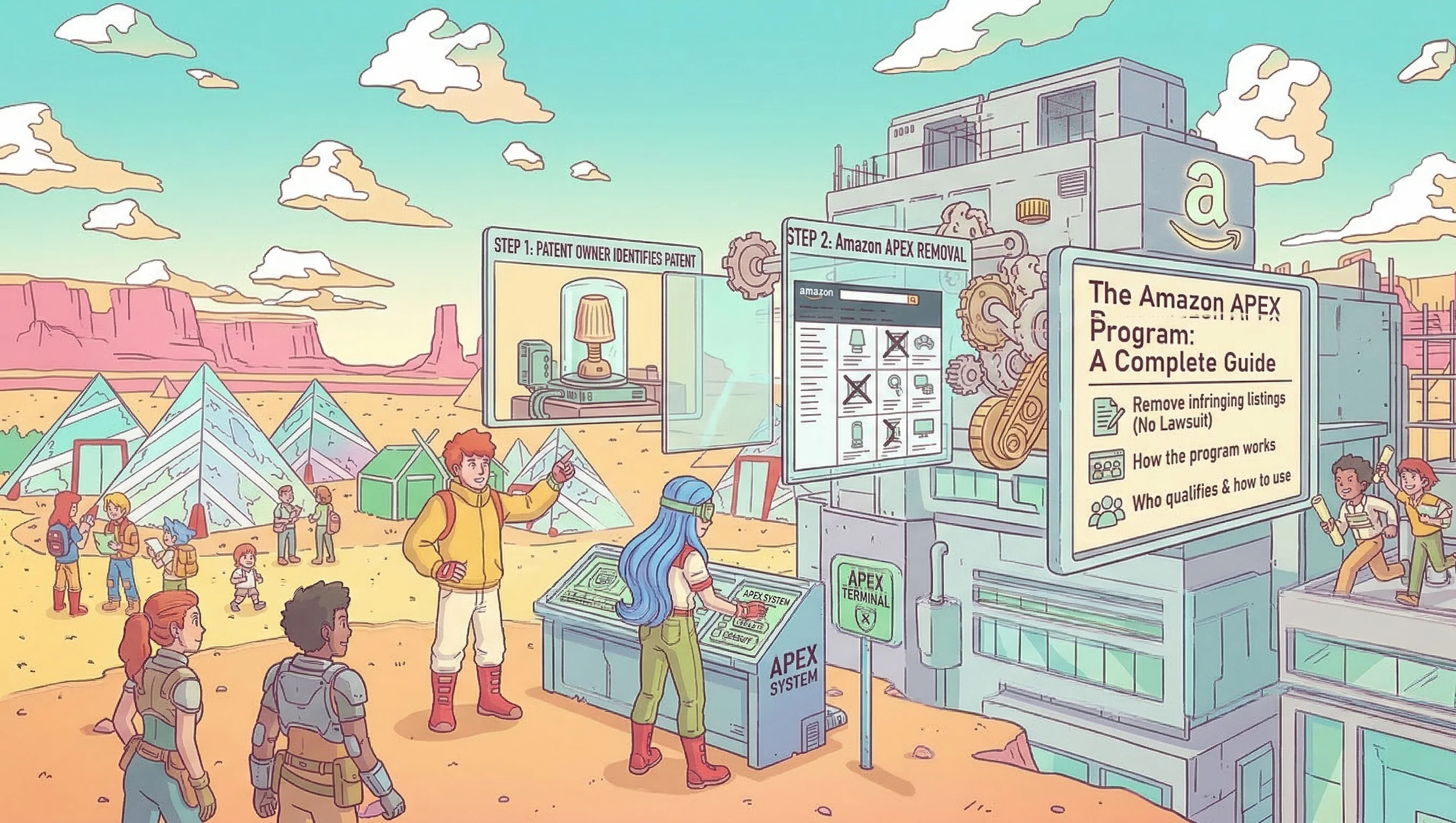
If you sell a patented product on Amazon, the APEX program (Amazon Patent Evaluation Express) is the most powerful enforcement tool you have. It lets you get infringing listings removed without going to court, without filing a lawsuit, and without spending six figures on litigation.
What Is APEX?
APEX is Amazon’s internal patent dispute resolution system. When a patent holder believes another seller is listing a product that infringes their patent, they file a claim through APEX. Amazon hires a neutral patent evaluator (a patent attorney) to review the claim. If the evaluator finds infringement, Amazon removes the listing.
The process takes about 8-12 weeks. Compare that to federal patent litigation, which takes 2-3 years and costs $500,000 or more. APEX costs around $4,000 total (split between the parties), and Amazon covers some of that cost.
Who Qualifies
To use APEX, you need:
-
A granted U.S. utility patent. Pending applications do not qualify. Design patents do not qualify for APEX (though they can be enforced through Amazon’s separate Report a Violation tool). The patent must be issued by the USPTO.
-
An active Amazon seller account. You need to be enrolled in Amazon Brand Registry.
-
Evidence of infringement. You identify the specific ASIN that infringes your patent and explain which claims are infringed and why.
This is one of the most important reasons to get your patent granted. Patent pending status gives you a filing date, but APEX requires an issued patent with granted claims.
How the Process Works
Step 1: Identify the infringing listing. Buy the competing product and compare it to your patent claims. Document which claims the product infringes (photos, measurements, functional testing).
Step 2: File the APEX petition. Through Amazon’s Brand Registry portal, submit a petition identifying your patent, the infringing ASIN, and your infringement analysis. Amazon charges the petitioner approximately $2,000.
Step 3: Amazon notifies the respondent. The accused seller can respond and argue non-infringement. They also pay a fee. If they do not respond within the deadline, Amazon removes the listing by default.
Step 4: Neutral evaluation. Amazon’s appointed evaluator reviews both submissions, examining whether the accused product falls within the scope of your patent claims.
Step 5: Decision. If the evaluator finds infringement, Amazon removes the listing. If not, the listing stays. The decision is final within APEX, though you can still pursue federal litigation separately.
How Claim Quality Affects Outcomes
APEX evaluations live and die on claim interpretation. The evaluator compares the accused product to the specific language of your patent claims, feature by feature.
If your claims are vague or functionally described, it is harder to show a clear match. If your claims describe specific structural features that are clearly visible in the accused product, the case is stronger.
This is where the investment in a quality patent application pays off years later. Structural claims that describe measurable, visible features are both easier to get through USPTO examination and more effective in APEX proceedings.
Broad claims matter too. If your claims are so narrow that the competitor made a minor design change to avoid them, the evaluator will find non-infringement. Broad claims that cover the core structural concept give you better enforcement coverage.
APEX vs. Other Amazon Enforcement Options
Report a Violation (RaV). Available through Brand Registry. Lets you report listings that infringe your trademark or design patent. Faster than APEX (days to weeks) but less rigorous. Works for design patents but not utility patents.
Amazon Brand Registry. The foundation for all IP enforcement on Amazon. Requires a registered trademark. Gives you access to RaV, APEX, and other protection tools.
Federal litigation. The nuclear option. Expensive, slow, but provides the strongest remedies (injunctions, damages). APEX’s advantage is speed and cost.
For most sellers, the sequence is: Brand Registry first, then RaV for clear-cut cases, then APEX for utility patent disputes. Federal litigation is reserved for large-scale infringement.
Preparing Your Patent for APEX
If you sell on Amazon and expect to use APEX in the future, here is what matters during the patent drafting phase:
Draft claims that map to visible product features. Claims should describe things you can see, measure, and photograph on the competing product.
Include multiple claim scopes. Your broadest claim catches the widest range of knockoffs. Your narrower claims survive if the evaluator narrows the broad claim. See broad vs. narrow claims for the strategy.
Use precise language. Specific claim language makes it easier for the evaluator to match it to the accused product. Vague functional language leaves room to argue non-infringement.
For more on how AI is changing the Amazon competitive dynamic, see How AI Is Changing Amazon. For the full filing process and costs, see the patent cost guide.