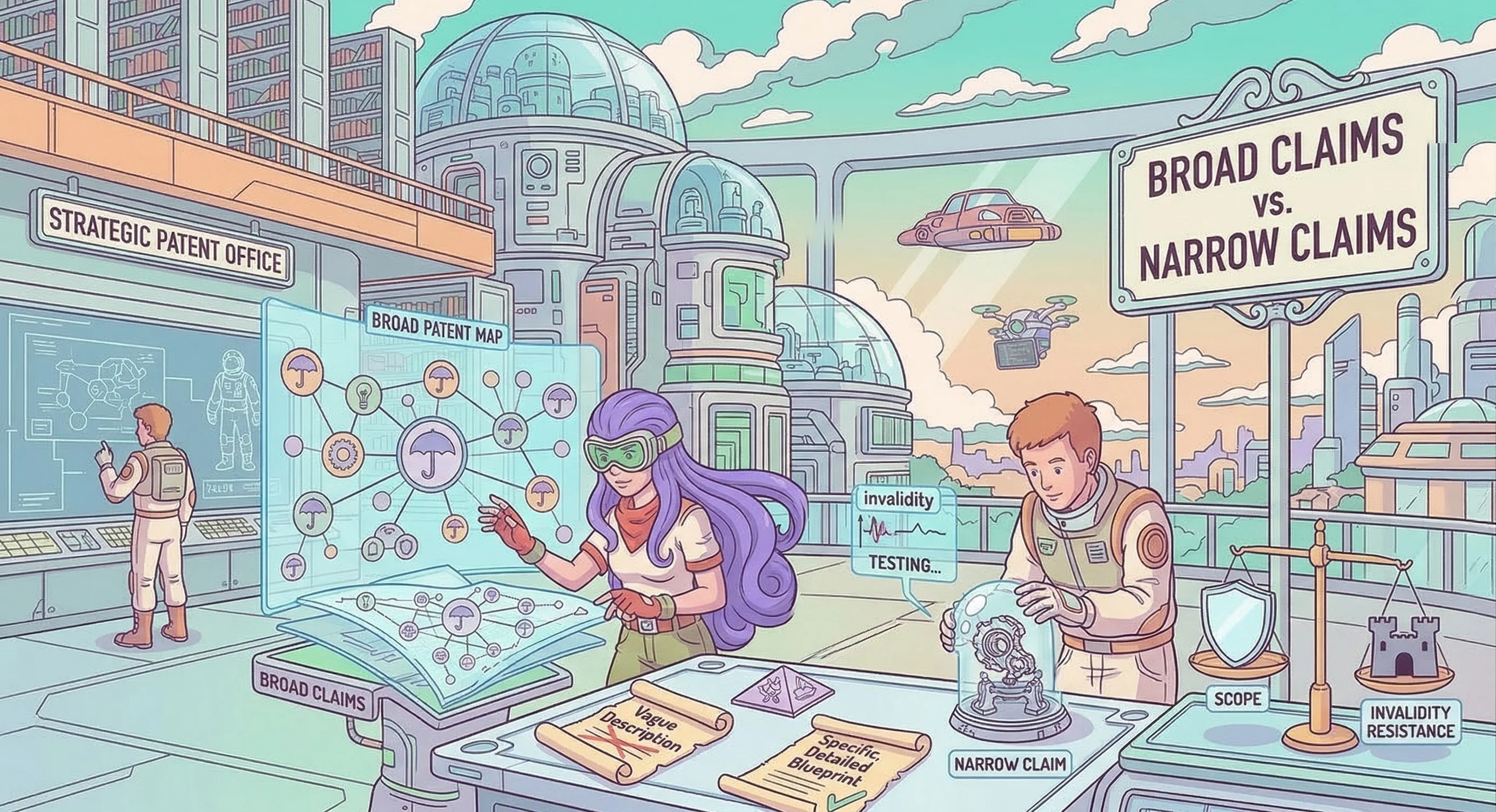
Every patent application involves a tradeoff between scope and defensibility. Broad claims cover more ground but are easier to challenge. Narrow claims are harder to knock down but cover less territory. The best applications use both, creating a layered protection strategy that gives you width and depth.
What Are Broad Claims?
A broad claim describes your invention using the fewest essential features. It captures the core concept without specifying details like exact dimensions, materials, or configurations.
Example for a foldable phone stand:
A support device comprising a base member and an angled support arm pivotally connected to the base, wherein the support arm folds flat against the base for storage.
This claim covers any foldable phone stand with a base and a pivoting support arm. It does not specify the material, the pivot mechanism type, or the angle. A competitor who makes a foldable stand out of aluminum with a friction hinge at 60 degrees infringes this claim. So does one made from plastic with a snap hinge at 45 degrees.
Broad claims are your first line of defense. They catch the widest range of potential copycats.
What Are Narrow Claims?
A narrow claim adds specific details that limit the scope but make the claim harder to invalidate.
The support device of Claim 1, wherein the angled support arm includes a ratcheting pivot joint with at least three locking positions between 30 degrees and 75 degrees relative to the base member.
This claim only covers foldable stands with a ratcheting pivot that has three or more locking positions in a specific angular range. A competitor who uses a friction hinge would not infringe this claim. But a USPTO examiner would have a much harder time finding prior art that matches this specific combination of features.
Narrow claims are your backup defense. If your broad claim gets challenged by prior art, your narrow claims survive.
Why You Need Both
Here is what happens in practice. You file a patent with both broad and narrow claims. During examination, the examiner searches for prior art and finds an existing patent for a foldable tablet stand with a pivoting arm. The examiner argues that your broad claim is anticipated by this prior art.
You have two options:
-
Argue the differences. Maybe the prior art’s pivot mechanism works differently, or the base member has a different configuration. If you can distinguish your claim, the examiner may allow it.
-
Narrow the claim. You amend the broad claim to incorporate features from your narrow dependent claims, like the ratcheting pivot with specific locking positions. The prior art does not have those features, so the amended claim is allowable.
Without narrow claims, option 2 does not exist. You are stuck arguing, and if the examiner disagrees, you lose the claim entirely.
This is why 86% of patent applications receive at least one office action. The back-and-forth between applicant and examiner is normal, and your dependent claims give you ammunition for the negotiation.
How the Cascade Works
A well-drafted application starts with the broadest defensible claim and works inward:
First, identify the minimum set of structural features that distinguish your invention from prior art. That becomes your broadest independent claim.
Then add layers of specificity through dependent claims. Each one describes your invention with more detail: specific geometries, material choices, component relationships, dimensional ranges.
The goal is to have 3 to 5 layers of depth for each independent claim. If the examiner pushes back on the broadest version, you fold in one layer of detail. If they push back again, you fold in another. Each step narrows the scope slightly but keeps the patent alive.
Structural Claims Beat Functional Claims
A functional claim like “a mechanism for adjusting the viewing angle” is broad but vague. An examiner can cite any angle-adjusting mechanism as prior art.
A structural claim like “a ratcheting pivot joint with detent balls engaging notches along an arc” is specific enough to survive examination but still covers meaningful territory.
The distinction matters because structural claims describe concrete physical configurations, not abstract goals. They give the examiner less room to cite unrelated prior art.
What This Means for Filing Budget
The USPTO allows 20 claims (3 independent + 17 dependent) before charging extra fees. Going beyond 20 adds $100 per extra claim for small entities. Going beyond 3 independent claims adds $480 per extra independent.
For most consumer product patents, 20 claims provide enough room to build a strong broad-to-narrow cascade. A good patent professional structures those 20 claims to place your broadest protection where it matters most and builds specific fallback positions underneath.
For more on how patent applications get examined, see what happens after filing.