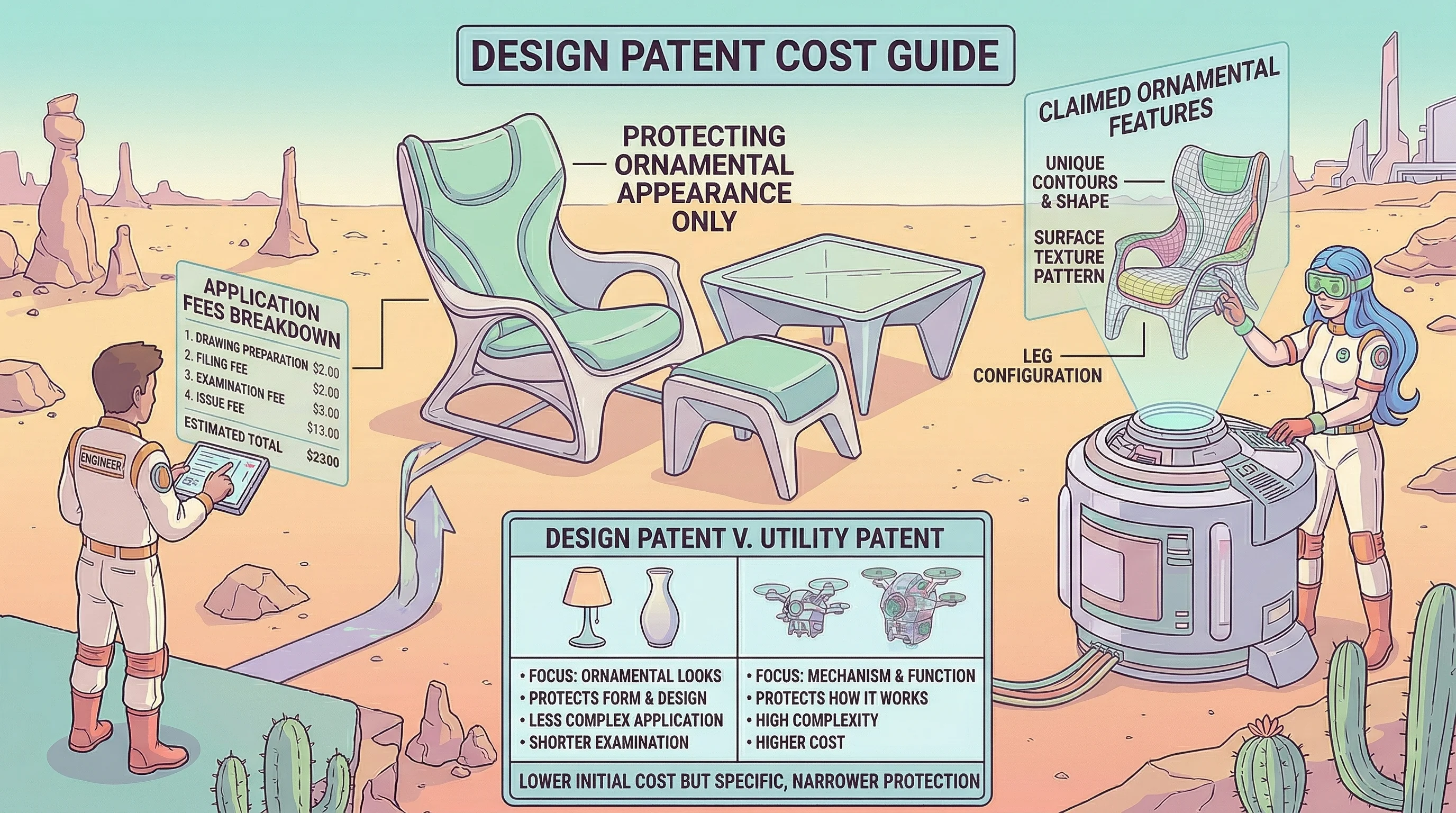
A design patent protects how a product looks. Not how it works, not what it does, just the ornamental appearance. It is the simplest, cheapest, and fastest type of patent to get.
Most inventors spend $1,500 to $3,000 total for a design patent, from filing through grant. That covers attorney fees, professional drawings, and all USPTO government fees. There are no maintenance fees after grant. Once issued, a design patent lasts 15 years with zero additional cost.
For comparison, a utility patent costs $10,000 to $30,000 through grant and requires three maintenance payments totaling $3,150 to $12,600 over the following 12 years. Design patents are a different animal entirely.
Design Patent Cost Breakdown
| Stage | Typical Cost | When |
|---|---|---|
| Attorney fees (filing through grant) | $870 - $1,500 | At filing |
| Professional patent drawings | $300 - $600 | At filing |
| USPTO filing fees | $260 - $1,040 | At filing |
| USPTO issue fee | $190 - $760 | At grant |
| Office action response (if needed) | $500 - $1,500 | During examination |
| Total without complications | $1,500 - $3,000 | 12-20 months |
These numbers are for a single design with one set of drawings. If you have multiple distinct designs for the same product (different variations of the same look), each requires its own application.
Cost by Entity Size
Entity size determines your USPTO government fees. The attorney fee stays the same regardless.
| Component | Micro Entity | Small Entity | Large Entity |
|---|---|---|---|
| Filing fee | $65 | $130 | $260 |
| Search fee | $42 | $84 | $168 |
| Examination fee | $152 | $304 | $608 |
| Total filing fees | $259 | $518 | $1,036 |
| Issue fee | $190 | $380 | $760 |
| Total USPTO fees | $449 | $898 | $1,796 |
Add $870 to $1,500 in attorney fees plus $300 to $600 for drawings, and you get the full picture. Small entity total: roughly $2,000 to $3,000. Micro entity total: roughly $1,500 to $2,500.
Vic Lin at Innovation Capital Law Group publishes an all-in small entity price of approximately $2,900 for a design patent without rejections. That is a reasonable benchmark for what most inventors should expect.
What Design Patents Protect
A design patent covers the ornamental appearance of a manufactured article. That includes:
- Product shape and contour: The physical form of a consumer product, tool, device, or container
- Surface ornamentation: Patterns, textures, and decorative elements applied to a product surface
- Graphical user interfaces: Screen layouts, icon arrangements, and UI elements (Apple, Google, and Samsung hold thousands of design patents on interface designs)
- Font designs: Typeface designs can be protected as design patents
- Packaging: Distinctive bottle shapes, box designs, product packaging
A design patent does not protect:
- How the product functions (that is a utility patent)
- The underlying technology or mechanism
- Colors alone (design patent drawings are typically in black and white)
- Purely functional shapes that are dictated by the product’s purpose
The legal standard is the “ordinary observer” test: would an average consumer, looking at your design and an accused product, consider them substantially similar? If yes, the design patent is infringed.
The Drawings Are Everything
Unlike utility patents where written claims define the scope of protection, in design patents the drawings are the claims. What appears in the patent drawings is what is protected. Nothing more, nothing less.
This is why the quality of patent illustrations matters enormously for design patents. The drawings must:
- Show the design from six standard views: front, rear, left side, right side, top, and bottom
- Include at least one perspective (isometric) view
- Meet strict USPTO formatting requirements (black-and-white line drawings, consistent shading, proper line weights)
- Use solid lines for the claimed design features and broken (dashed) lines for unclaimed context
The solid-line versus broken-line distinction is critical. Solid lines define what is protected. Broken lines show the environment or portions of the article that are not part of the design claim. A skilled patent attorney uses this distinction strategically to get the broadest possible protection for the distinctive elements of your design.
If you have 3D CAD files, the drawing process is straightforward. The illustrator renders views directly from the model. If you only have physical prototypes or photographs, the illustrator works from photos taken from each required angle. Either way, budget $300 to $600 for professional patent illustrations.
The Filing Process
Design patent prosecution is simpler than utility patent prosecution. There are no written claims to argue over, no Section 101 eligibility questions, and fewer grounds for rejection.
Step 1: Prepare drawings. Your attorney or a patent illustrator creates the formal drawings from your CAD files, prototypes, or photos. This takes 1-2 weeks.
Step 2: File the application. The attorney files the application electronically with the USPTO. You immediately get a filing date and can mark the product “patent pending.”
Step 3: Wait for examination. The average wait for an examiner’s first review is about 15 months. During this time, you do nothing.
Step 4: Respond to any office actions. About 17% of design patent applications receive a rejection. This is much lower than utility patents, where 86% get at least one office action. When design patent rejections happen, they typically involve drawing corrections or prior art references. These are usually resolvable for $500 to $1,500 in additional attorney fees.
Step 5: Pay the issue fee and receive your patent. Once the examiner allows the application, you pay the issue fee ($190 to $760 depending on entity size) and the patent is granted.
The overall allowance rate for design patents is approximately 83%. That is significantly higher than utility patents. The combination of simpler examination and high allowance rate is why design patents cost less and take less time.
Timeline
| Stage | Timeline |
|---|---|
| Drawing preparation | 1-2 weeks |
| Filing | Same day as drawing approval |
| Wait for first examiner action | ~15 months average |
| Office action response (if needed) | 1-3 months |
| Issue fee and grant | 2-3 months after allowance |
| Total to grant | 12-20 months |
Design patents move through the USPTO faster than utility patents (which average 1.5 to 4 years). There is no Track One option for design patents because the timeline is already relatively short.
No Maintenance Fees
This is one of the biggest practical advantages of design patents. Once granted, a design patent lasts 15 years from the issue date. No maintenance payments. No renewal fees. No deadlines to track. No risk of accidental expiration.
For comparison, a utility patent requires three maintenance payments over 12 years totaling $3,150 for micro entities or $12,600 for large entities. Miss one payment and the patent dies.
If you are a solo inventor who does not want to manage ongoing patent obligations, design patents are significantly easier to maintain. You get the patent, you put it in a drawer, and it protects your design for 15 years with zero ongoing cost.
Design Patent vs. Utility Patent
| Design Patent | Utility Patent | |
|---|---|---|
| Protects | Ornamental appearance | Function, method, process |
| Term | 15 years from grant | 20 years from filing |
| Cost through grant | $1,500 - $3,000 | $10,000 - $30,000 |
| Maintenance fees | None | $3,150 - $12,600 |
| Examination time | 12-20 months | 1.5-4 years |
| Office action rate | ~17% | ~86% |
| Allowance rate | ~83% | Lower, varies by tech area |
| Claims | Drawings only | Written claims (complex) |
File a design patent if:
- Your competitive advantage is the look of the product, not the underlying mechanism
- You want fast, cheap protection that does not require ongoing maintenance
- Your product’s visual design is what consumers recognize and competitors copy
- Budget is limited and you need the most protection per dollar
- You sell on Amazon or similar platforms where design copycats are common
File a utility patent if:
- Your invention’s value is in how it works, not how it looks
- Competitors could replicate the function with a completely different visual design
- You want licensing leverage (utility patents are more licensable)
- You need the broadest possible protection
File both if:
- Your product has a distinctive look AND a novel function
- You want layered protection: utility claims cover the mechanism, design claims cover the appearance
- The product is consumer-facing where form and function both drive purchases
- You can afford the combined cost ($12,000 to $33,000 total)
Design Patents for Amazon Sellers
Design patents have become particularly valuable for Amazon sellers. When counterfeiters copy your product’s appearance (which happens constantly on Amazon), a design patent gives you enforcement tools:
- Amazon Brand Registry: A design patent strengthens your brand registry application and gives you access to reporting tools
- APEX program: Amazon’s patent evaluation program lets you submit design patent claims against infringing listings. Amazon reviews and can remove the infringing product within weeks, not months
- Cease and desist leverage: A granted design patent carries legal weight that a copyright claim alone does not
For Amazon sellers, a $2,000 to $3,000 design patent can protect revenue worth far more than the filing cost. If your product has a distinctive visual design that counterfeiters replicate, a design patent is one of the most cost-effective defensive tools available.
The One-Year Filing Deadline
US patent law gives you a one-year grace period from the first public disclosure of your design. Public disclosure includes:
- Selling the product (including Amazon, Etsy, or any online listing)
- Showing the product at a trade show
- Publishing photos of the design on your website or social media
- Offering the product for sale, even before shipping
After one year from the earliest public disclosure, you lose the right to file a design patent on that design in the US. Most foreign countries have no grace period at all, meaning international rights are lost the moment you go public.
File before you launch if possible. If you already launched, count backward from your first public listing and make sure you are within the 12-month window.
When Design Patents Are Not Enough
Design patents have real limitations:
- Easy to design around. A competitor can change the appearance enough to avoid infringement while keeping the same functionality. If function is what matters, you need a utility patent.
- Narrow scope. The protection extends only to what the drawings show. Variations that look substantially different to an ordinary observer are not covered.
- No protection for internal features. If the novel part of your product is hidden inside (a circuit board layout, an internal mechanism), a design patent on the exterior does not help.
- International coverage requires separate filings. A US design patent only protects in the US. International design protection through the Hague Agreement or individual country filings adds cost.
For many products, a design patent is a starting point, not the entire strategy. It provides fast, affordable protection for the visual design while you decide whether a utility patent is worth the additional investment.
Bottom Line
A design patent costs most inventors $1,500 to $3,000 total, with no maintenance fees and a 15-year term. It protects the ornamental appearance of your product and has an 83% allowance rate. The entire process from filing to grant takes 12-20 months.
Design patents are the most affordable way to get patent protection. They work best when the visual design is what makes your product distinctive and what competitors would copy. For functional innovations, you need a utility patent. For many consumer products, filing both gives you the strongest position.
Before hiring an attorney, ask:
- What is included in the flat fee? Confirm whether drawings, filing fees, and issue fee are all covered or billed separately.
- Do you handle design patent office actions? They are rare (17% of applications), but you want to know the cost if one comes.
- Can you file both a design and utility patent on the same product? If your product has both visual and functional novelty, ask about combined filing strategy and any discounts.
- How do you handle the drawing strategy? A good attorney thinks carefully about solid lines versus broken lines to maximize the scope of your design claim.