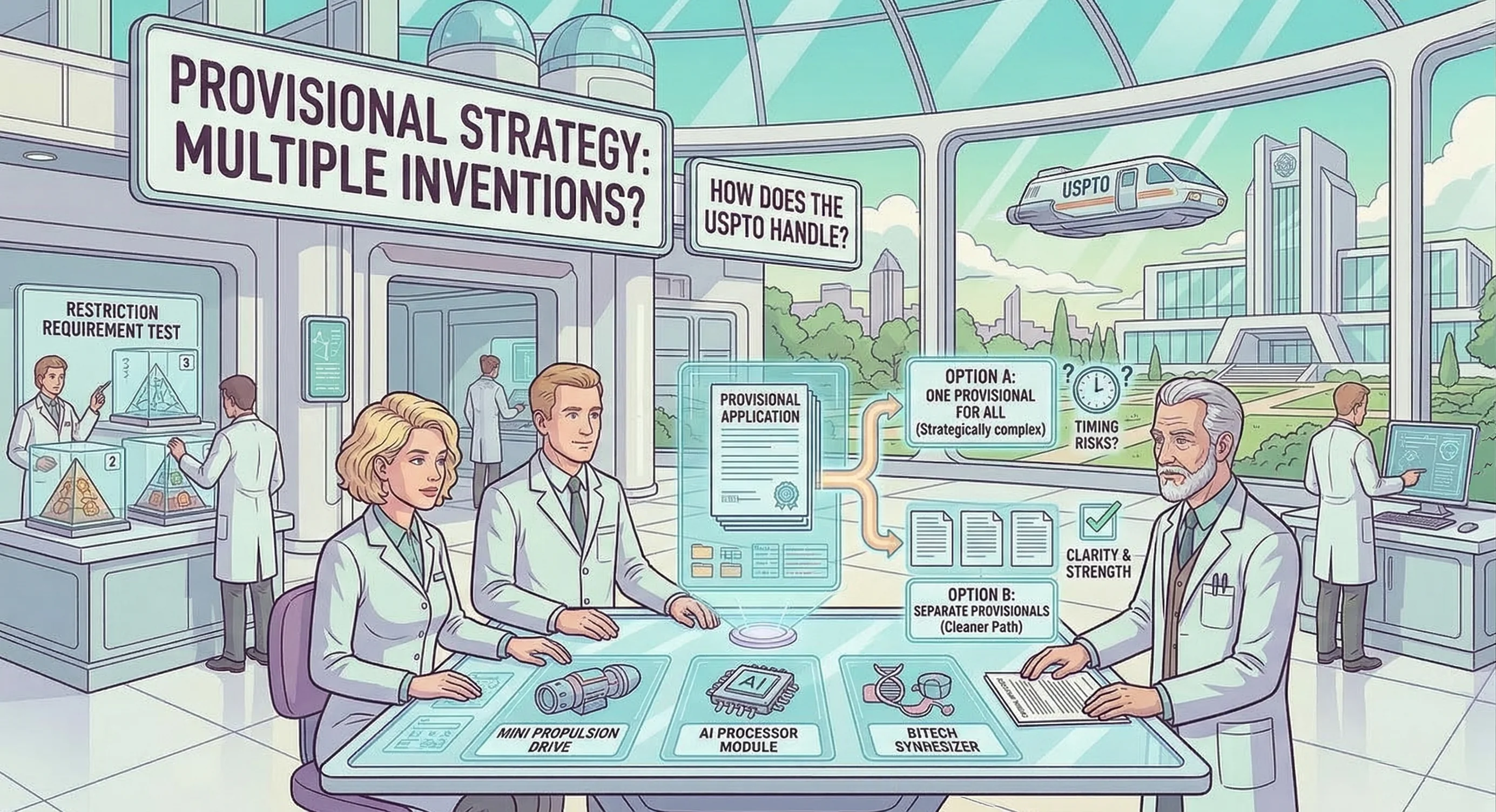
There is no legal limit on the number of inventions you can include in a single provisional. The USPTO does not examine provisionals for content, format, or claim structure. You could file a provisional that describes five different products and the USPTO would accept it.
But the filing rules and the strategy are two different things.
The Restriction Requirement Problem
When you file the non-provisional, the USPTO examiner reviews the claims. If the examiner determines that the claims cover more than one distinct invention, they issue a “restriction requirement.” This forces you to choose which invention to prosecute in that application. The other inventions get split into separate continuation applications, each with its own filing fee and examination process.
You save money filing one provisional, but you pay more later when the non-provisional gets split. The total cost often ends up higher than filing separate provisionals and non-provisionals from the start.
Example: An inventor files one provisional covering a new bottle cap design and a new bottle base design. These are related products but structurally independent inventions. When the non-provisional is filed with claims covering both, the examiner issues a restriction requirement. The inventor must choose one for the original application and file (and pay for) a continuation for the other.
When One Provisional Makes Sense
The inventions are variations of the same core concept. If you have one product with three design variations (different hinge mechanisms, for example), those variations likely fall within a single inventive concept. The examiner is less likely to restrict them because they share the same structural foundation.
You are testing the market and unsure which version to pursue. A provisional buys you 12 months. If you are still deciding between product variations, describing all of them preserves your filing date for whichever direction you choose.
Budget is extremely tight. If you can only afford one filing right now, a single provisional covering multiple inventions is better than not filing at all.
When Separate Provisionals Make Sense
The inventions are structurally independent. If each product has its own unique mechanism that does not depend on the others, they are likely distinct inventions. Separate provisionals map cleanly to separate non-provisionals without restriction headaches.
You want to build a patent portfolio. Multiple provisionals leading to multiple non-provisionals creates a portfolio of patents, each covering a specific product. This is more valuable for licensing, enforcement, and investor conversations than a single patent covering multiple products.
Different products have different timelines. If one product is ready to sell now and another is still in development, separate provisionals let you manage each timeline independently. The 12-month deadline runs separately for each filing.
The Quality Rule Still Applies
Whether you file one provisional or five, the description needs enough structural detail to support strong claims in the non-provisional. Listing multiple inventions in a single provisional does not change this requirement. Each invention needs the same level of detail it would get in a standalone filing.
Pay attention to enablement scope for each invention. If your provisional describes only a narrow implementation of an invention, your future claims are limited to that narrow scope. For example, if you describe a mechanical nut-and-bolt fastener, you likely cannot later claim all types of fastener connections (electromagnets, adhesives, welding). Each invention in a multi-invention provisional needs to be described broadly enough to support the claims you eventually want.
A multi-invention provisional is not cheaper per invention to draft. Each invention still requires a thorough specification with structural details, drawings, and enough description for someone to understand and reproduce it. Combining them saves a filing fee but does not save drafting time.
For the fundamentals of how provisionals work, see What Is a Provisional Patent Application?. For cost details, see the patent cost guide.