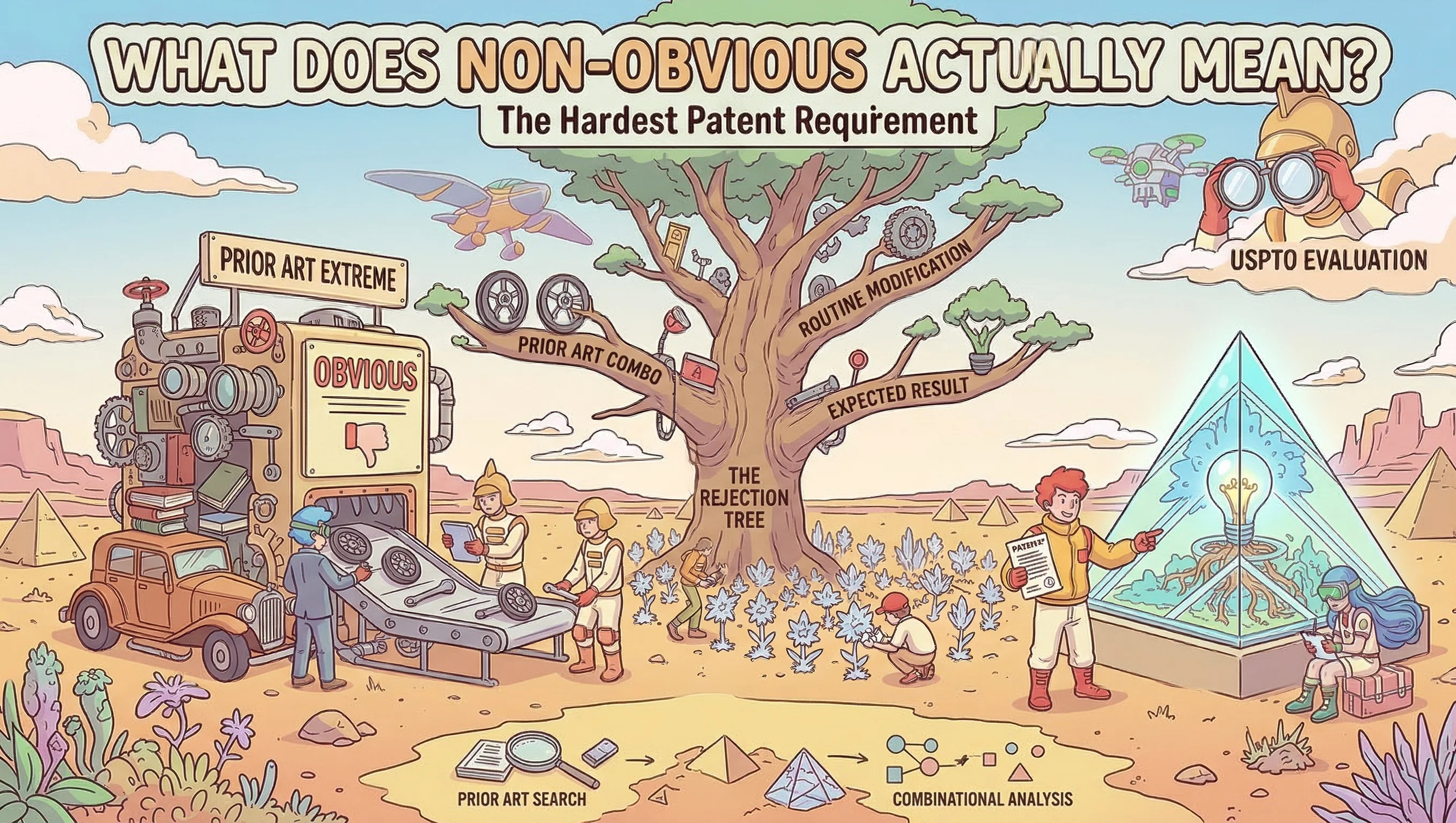
Of the three requirements for patentability, non-obviousness is the one that matters most. Novelty is binary: either prior art describes your exact invention or it does not. Utility is almost always met for physical products. Non-obviousness is where the real judgment happens, and it is the reason most patent applications get rejected or narrowed during examination.
The Legal Standard
Non-obviousness is defined in 35 U.S.C. 103. The test: would the claimed invention have been obvious to a person of ordinary skill in the art (POSITA) at the time of filing?
POSITA is a hypothetical person. Think of them as a competent engineer or designer in your product’s field who knows all the prior art but lacks creative insight. They can combine known elements in predictable ways, but they do not make inventive leaps.
If POSITA would look at existing products and think, “obviously, I should do it this way,” your invention fails the test.
KSR v. Teleflex: The Key Case
The most important Supreme Court case on non-obviousness is KSR International v. Teleflex (2007). Before KSR, the test was rigid: the examiner had to find a specific “teaching, suggestion, or motivation” in the prior art to combine references.
KSR loosened that standard. The Court said obviousness can be established by:
- Common sense. Combining A and B in a predictable way to produce a predictable result may be obvious even if no prior art document suggested the combination.
- Design incentives. If market pressures or known problems would lead a skilled person to try the combination, it may be obvious.
- Finite identified solutions. If there are only a few options to choose from and your invention picks one of them, the selection may be obvious.
But KSR also said that unexpected results, solving a problem that others tried and failed to solve, or combining elements in a way that changes how they function can all support non-obviousness.
How to Evaluate Your Own Invention
Four questions to ask:
Does it solve a problem that existing products ignored? If current products in your category all have the same limitation and your invention addresses it in a way nobody tried before, that is strong evidence. The fact that the problem existed for years without this solution suggests it was not obvious.
Does the combination produce an unexpected result? If you combined two known elements and got a surprising outcome that a skilled person would not predict, that supports non-obviousness.
Did others try and fail? If competitors attempted to solve the same problem and came up with different approaches, your solution was not obvious to them. This is powerful evidence.
Would a skilled person need creative insight to arrive at your design? Routine engineering choices (swapping materials, scaling dimensions, adding standard fasteners) are usually obvious. Changing the spatial relationship between components, creating a new mechanism, or reimagining how parts interact typically requires creative thinking.
What the Examiner Actually Does
The examiner searches prior art databases for references that relate to your invention. They look for:
- A single reference that covers your entire claim (this is a novelty rejection under 102, not an obviousness rejection)
- Two or more references that, when combined, cover your claim (this is the 103 obviousness rejection)
When making an obviousness rejection, the examiner must explain why a person of ordinary skill would have been motivated to combine the references. After KSR, this motivation can come from common sense or market incentives.
86% of patent applications receive at least one office action. A large percentage of those include obviousness rejections. The response involves arguing why the examiner’s combination would not have been obvious, or narrowing the claims to add features the combined references do not cover. This is exactly why applications should include both broad and narrow claims.
Structural Claims Help Beat Obviousness
Structural claims describe concrete physical configurations. Functional claims describe goals. The difference matters for examiner rejections.
Functional claim: “A tool configured to reduce user fatigue during extended use.”
Structural claim: “A tool comprising a handle with an elliptical cross-section having a major axis of 30mm to 40mm, a palm swell offset 15 degrees from the longitudinal axis of the tool head, and a compressible elastomer overmold with a Shore A durometer of 40 to 60.”
The functional claim invites an examiner to cite any ergonomic handle as prior art. The structural claim requires them to find that specific combination of geometry, offset, and material hardness. That combination is far less likely to appear in prior art.
What If Your Invention Seems Too Simple?
There is an important difference between simple to understand and obvious to invent. A solution can be elegant and easy to explain while still being non-obvious at the time nobody had thought of it.
If you changed one feature of an existing design and that change produced a result that was not predictable from the prior art, you have a non-obvious improvement. Simple does not mean obvious.