We surveyed patent attorneys and agents across all 50 states in early 2026 and asked what they charge for a non-provisional (utility) patent application.
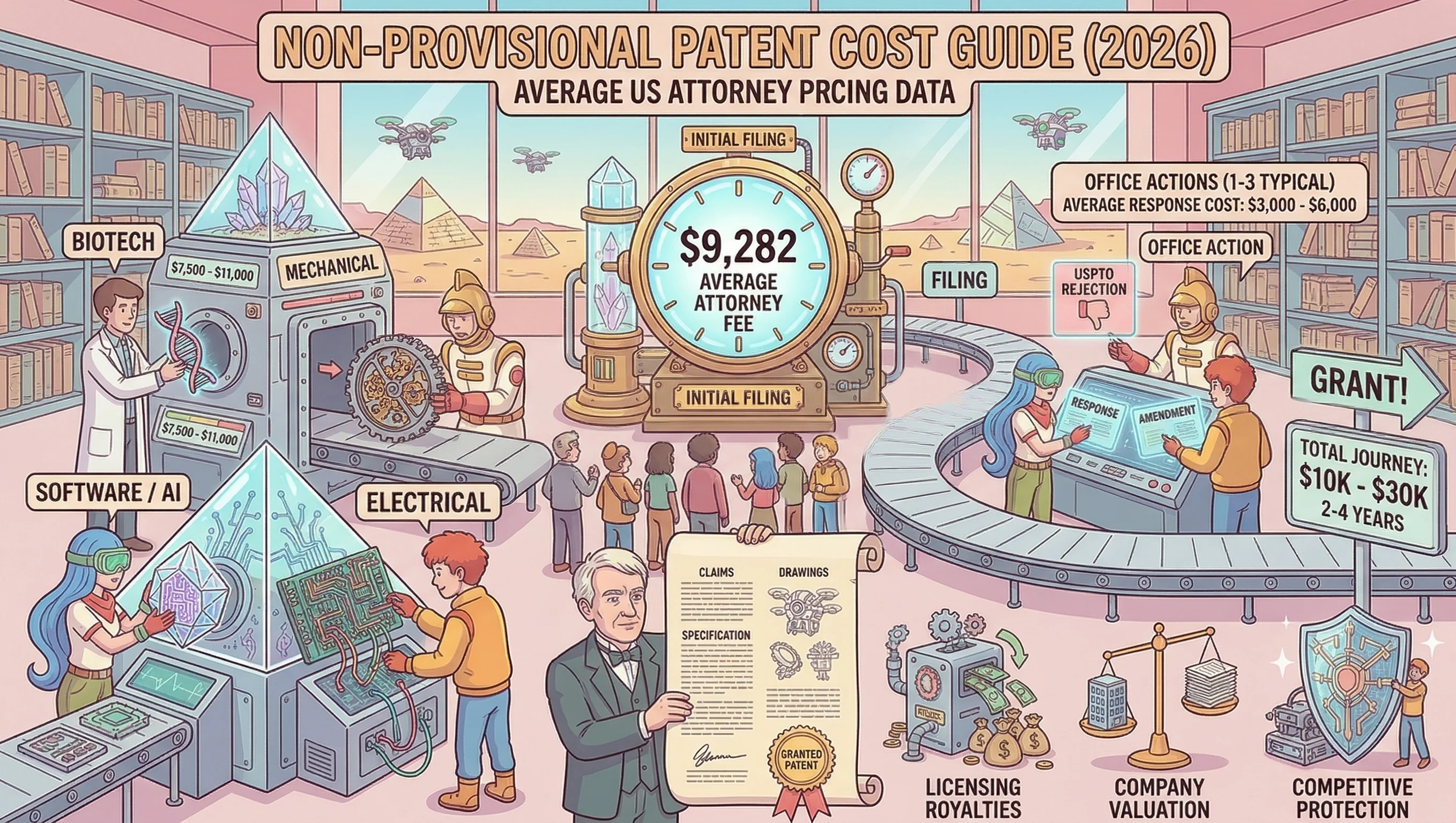
The average: $9,086.
Most inventors will pay between $6,000 and $12,000 for the attorney drafting and filing alone. But the non-provisional is not the only cost. Office action responses, USPTO government fees, and maintenance fees add to the total. Here is the full picture.
Non-Provisional Patent Costs by the Numbers
These numbers come from our nationwide research on patent attorneys, not published rate cards or estimates.
| Metric | Amount |
|---|---|
| Lowest quote received | $3,500 |
| Highest quote received | $20,000 |
| Average | $9,086 |
| Most common range | $6,000 - $12,000 |
The range is wider than provisional patent pricing because non-provisional applications vary more in complexity. A straightforward mechanical device with a handful of claims is a different project than a software system with layered dependent claims and Section 101 hurdles.
Cost by Invention Type
Invention type drives the price more than anything else. Our research on attorneys across the country shows a clear pattern.
| Invention Type | Average Non-Provisional Cost | Why |
|---|---|---|
| Mechanical / consumer product | $7,600 | Simpler claim structures, physical features are easier to describe |
| Electrical / hardware | $8,200 | More technical specification, circuit-level detail |
| AI and Software | $8,800 | Section 101 eligibility analysis, abstract idea rejections common |
| Biotech / pharma | $10,550 | Dense technical writing, extensive prior art, longer specifications |
| Combination (hardware + software) | $9,000 | Claims need to cover both physical and software components |
Software and AI patents cost more because the USPTO applies extra scrutiny under 35 U.S.C. 101 after the Alice v. CLS Bank decision. Your attorney needs to draft claims that frame the software as a specific technical solution rather than an abstract idea. That takes more skill and more time.
Biotech and pharma patents sit at the top because the specifications are longer, the prior art landscape is denser, and the claims often require precise chemical or biological language that cannot be approximated.
What You Get for That Price
A non-provisional patent application is the full utility patent that the USPTO examines. Unlike a provisional (which just locks in your filing date), the non-provisional is what actually results in enforceable patent protection for 20 years.
A properly drafted non-provisional includes:
- Complete written specification describing your invention in enough detail that someone skilled in the field could build it
- Formal patent claims that define the legal boundaries of your protection
- Abstract summarizing the invention in 150 words or less
- Patent drawings showing every feature referenced in the claims
- Inventor declaration and all required USPTO forms
The specification is the foundation. Under 35 U.S.C. 112, every claim must be fully supported by the written description. If the spec is thin, the examiner will reject claims for lack of written description support. Good attorneys front-load the drafting work in the specification so the claims have a solid base.
Office Action Costs
Getting the non-provisional filed is not the end of the spending. About 86% of patent applications receive at least one office action from the USPTO examiner. An office action is the examiner saying they have issues with your claims. It is a normal part of the process, not a rejection of your patent.
Our research on attorneys across the country found office action response costs ranging from $950 to $2,950 per response. Most applications go through one to three rounds before the patent is granted or the claims reach final form.
| Scenario | Estimated Office Action Cost |
|---|---|
| One office action, minor amendments | $950 - $1,500 |
| Two office actions, claim narrowing | $2,000 - $4,000 |
| Three rounds with prior art arguments | $3,000 - $6,000+ |
The quality of the original application directly affects how many office actions you face and how expensive they are. A well-drafted non-provisional with strong claims and a thorough specification tends to get through examination with fewer rounds. A thin application generates more rejections and costs more in the long run.
Total Cost from Filing Through Grant
The non-provisional attorney fee is the largest single expense, but it is not the only one. Here is what the full path looks like for most inventors.
| Stage | Typical Cost | When |
|---|---|---|
| Patent search (optional but recommended) | $500 - $3,500 | Before filing |
| Provisional patent application (if filing first) | $2,500 - $5,000 | Before non-provisional |
| Non-provisional patent application | $6,000 - $12,000 | At filing |
| USPTO government fees (filing + search + exam) | $400 - $2,000 | At filing |
| Office action responses (1-3 rounds) | $950 - $6,000+ | During examination |
| Issue fee | $300 - $1,200 | At grant |
| Total through grant | $10,000 - $30,000 | Over 2-4 years |
After grant, maintenance fees keep the patent alive. These are due at 3.5, 7.5, and 11.5 years after the grant date.
| Maintenance Fee | Micro Entity | Small Entity | Large Entity |
|---|---|---|---|
| 3.5 years | $400 | $800 | $1,600 |
| 7.5 years | $900 | $1,800 | $3,600 |
| 11.5 years | $1,850 | $3,700 | $7,400 |
Miss a maintenance fee and the patent expires. There is a late payment window with surcharges, but once that closes, the patent is gone. Set calendar reminders years in advance.
USPTO Government Fees
On top of attorney fees, the USPTO charges several fees at different stages.
| Fee | Micro Entity | Small Entity | Large Entity |
|---|---|---|---|
| Filing fee | $80 | $160 | $320 |
| Search fee | $165 | $330 | $660 |
| Examination fee | $190 | $380 | $760 |
| Total at filing | $435 | $870 | $1,740 |
Most solo inventors qualify for micro entity status if they have not been named on more than four previously filed patent applications and their gross income is below the threshold (roughly $229,000 in 2026). Small businesses with fewer than 500 employees qualify as small entities.
The savings are substantial. Micro entities pay 75% less than large entities on most USPTO fees.
Flat Fee vs. Hourly Billing
Our research found that roughly 70% of patent attorneys use flat fees for non-provisional work. The rest bill hourly.
Hourly rates from our research ranged from $325/hr to $550/hr. At those rates, a non-provisional for a mechanical invention might take 30-50 hours, putting the cost at $9,750 to $27,500. For software or biotech, 40-80 hours pushes the total even higher.
Flat fees are better for inventors. You know the total cost before work starts. No surprise invoices. No hesitation about calling your attorney with a question because you are worried about the clock running.
When an attorney quotes hourly, ask for a flat-fee alternative. Most will offer one. If they will not, that is worth knowing before you commit.
Provisional First or Straight to Non-Provisional?
Most inventors file a provisional patent application first. A provisional costs $2,500 to $5,000 and locks in your filing date for 12 months while you test the market, refine the product, or raise funds.
File a provisional first if:
- You need patent pending status quickly (before a launch, demo day, or pitch)
- Your invention is still being refined
- You want to test market demand before committing $10,000+
- You need time to raise funds for the full application
Go straight to non-provisional if:
- Your invention is final and you are ready for examination
- You have validated the market and want the examination clock ticking
- Budget is available and you want to skip the two-filing cost
- You already have strong documentation (detailed specs, CAD drawings, prior art analysis)
One thing to ask any attorney: do they credit the provisional fee against the non-provisional cost when you convert? Several attorneys in our research offer this. If you paid $3,000 for the provisional and the non-provisional is $8,000, you pay $5,000 at conversion. That saves real money over the two-filing path.
The Business Case for Non-Provisional Patents
Filing a non-provisional is not cheap. But the question is not whether the patent costs money. The question is whether the business value it creates justifies the expense.
Competitive Protection
A granted utility patent gives you the legal right to exclude competitors from making, using, or selling your invention for 20 years. In markets where products can be reverse-engineered (consumer products, hardware, tools), that exclusion is what prevents a competitor from buying your product, copying it, and undercutting your price.
For Amazon sellers, patents unlock enforcement tools like Brand Registry and the APEX program. These are the most effective ways to take down counterfeit listings and protect your buy box.
Licensing Revenue
If you hold a granted patent, you can license it to other companies. Licensing means granting permission to use your patented technology in exchange for royalty payments.
Royalty rates typically run 2-5% of net sales for consumer products and can go higher for specialized technology. If your patent covers a feature that multiple companies want to use in their products, licensing creates recurring revenue without manufacturing a single unit.
Licensing works best after the patent is granted, not while the application is pending. Companies are more willing to negotiate and pay royalties when they can see the actual claims that issued. A strong non-provisional with broad claims and a clean prosecution history is the foundation of any licensing deal.
Company Valuation
Patents are intangible assets that directly increase company valuation. For startups raising investment, a patent filing signals that the company has a defensible position. Investors ask about IP because they want to know whether someone else can build the same thing.
At the seed stage, a provisional filing is the minimum bar. By Series A, investors expect at least a non-provisional in the examination queue. By Series B, a granted patent or a portfolio of related filings is increasingly expected for hardware companies.
The math is straightforward. Patent costs for a startup at the pre-seed to seed stage run around $8,000 to $12,000 (provisional plus non-provisional). That is a fraction of a percent of a $1M raise. But the absence of any patent filing raises questions about defensibility that are harder to answer than the filing cost.
A portfolio of 3-5 related patents covering different aspects of your product line is significantly more valuable than a single patent. It creates interlocking protection that makes design-arounds harder, reduces risk if any single patent is challenged, and signals strategic thinking about IP to acquirers and investors.
Patent Sales
You can sell (assign) a patent outright. Patent sales happen when companies get acquired, when inventors exit an industry, or when a patent covers technology that is more valuable to someone else. A granted patent with broad, enforceable claims and remaining term is a sellable asset.
How Long Does It Take?
The non-provisional itself takes about 2-4 weeks to draft. After filing, the USPTO examination process takes 1 to 3 years.
| Stage | Timeline |
|---|---|
| Drafting and filing | 2-4 weeks |
| USPTO assigns examiner | Immediate to a few months |
| Wait for first office action | 12-18 months average |
| Office action response cycle | 3-12 months per round |
| Total to grant | 1.5 to 4 years |
Technology area matters. Mechanical and consumer product applications tend to move through the USPTO faster. Software, AI, and telecommunications centers often have longer backlogs.
If you need to speed things up, the USPTO offers Track One prioritized examination. For an extra fee ($1,000 for micro entities, $2,000 for small entities), the USPTO aims to reach a final decision within 12 months. Track One is worth considering if you need a granted patent quickly for licensing, enforcement, or investment purposes.
What Makes a Non-Provisional Application Strong
Not all non-provisional applications are created equal. The quality of the drafting directly determines how well the application survives examination and how valuable the resulting patent is.
Layered claim strategy. The best applications start with broad independent claims that cover the core invention, then add layers of narrower dependent claims that provide fallback positions during examination. If the examiner rejects a broad claim, your attorney can narrow it using features from the dependent claims rather than starting over.
Detailed specification. Under 35 U.S.C. 112, every claim must be supported by the written description. A thorough spec with multiple embodiments and implementation details gives your attorney more material to work with during office action responses.
Professional drawings. Patent drawings are not illustrations. They are legal documents that must show every feature described in the claims. Missing or unclear drawings create 112 rejections that are avoidable with proper draftsmanship.
Prior art awareness. An attorney who has reviewed the relevant prior art before drafting can position your claims to avoid known references. This reduces the number of office actions and the total cost of prosecution.
Bottom Line
A non-provisional patent application costs most inventors $6,000 to $12,000 for the attorney drafting and filing, with an average of $9,086 based on our nationwide research. Total cost through grant, including office actions and USPTO fees, typically runs $10,000 to $30,000 spread over 2-4 years.
Before hiring an attorney, ask these questions:
- Is the fee flat or hourly? Flat fees protect you from cost overruns. If hourly, ask for a cap or estimate.
- What is included? Some fees cover drawings, some do not. Some include one round of revisions, others charge extra. Get specifics.
- Do you credit the provisional fee if I convert with you? If you already filed a provisional, this can save thousands.
- How do you handle office actions? Ask whether office action responses are included or billed separately, and what a typical response costs.
The non-provisional is the most expensive step in the patent process, but it is also the step that produces the actual enforceable patent. The provisional locks in your date. The non-provisional is what gives you 20 years of legal protection, licensing power, and business value.