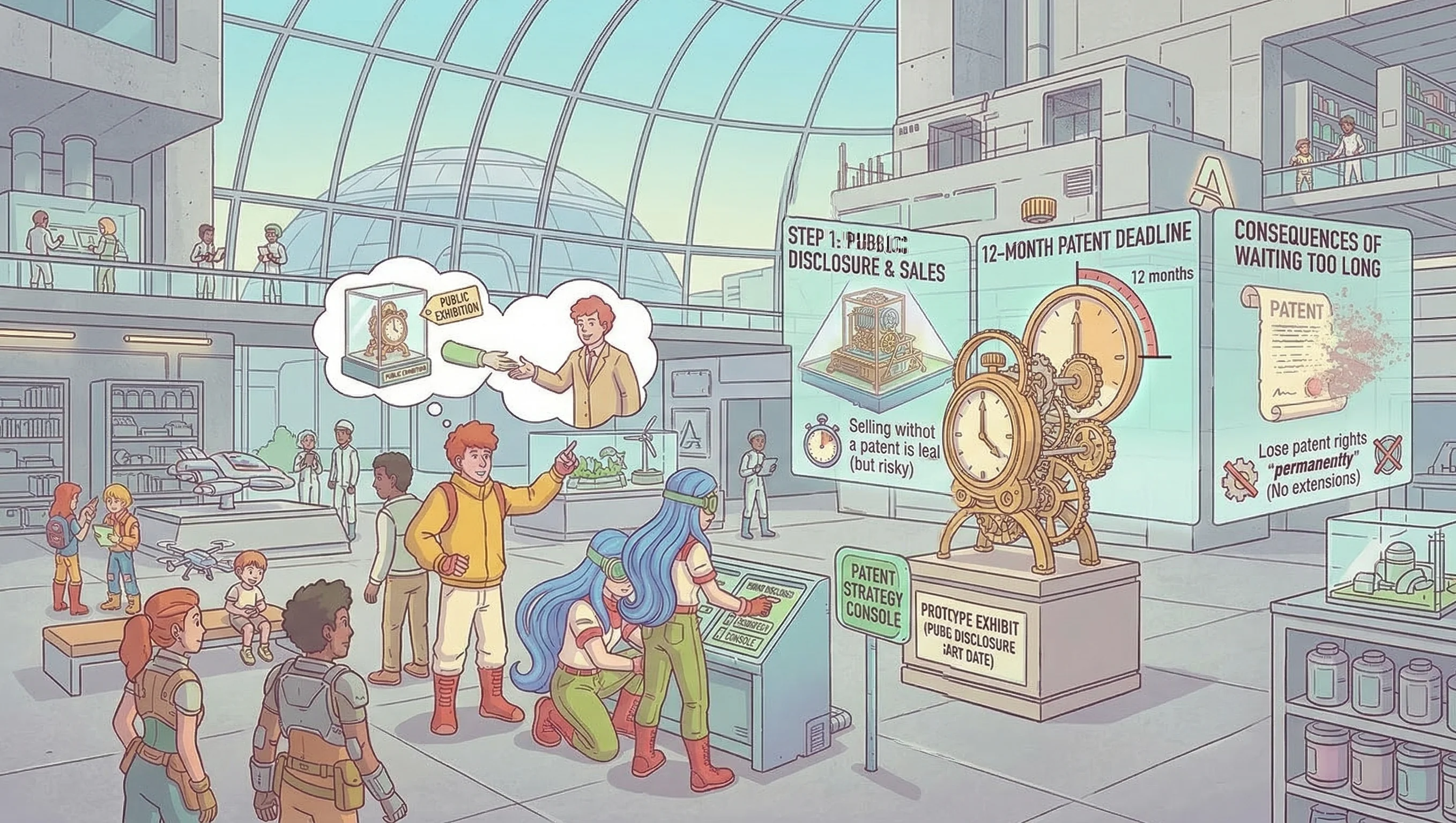
No. You do not need a granted patent before you start selling. But you should file at least a provisional patent application before your first public sale, disclosure, or offer for sale. Filing first protects your right to patent the invention later and gives you patent pending status while you go to market.
Why File Before Selling?
The United States patent system is first to file. If two people independently create the same invention, the person who files first wins. Every day you sell without a filing date is a day someone else could see your product, file a patent on the same concept, and claim it before you do.
Filing a provisional patent application before your first sale gives you three things:
- An official filing date. Your place in line at the USPTO is locked in.
- Patent pending status. You can legally mark your product as “patent pending,” which signals to competitors that you are protecting your IP.
- 12 months of runway. You have a full year to sell, test the market, pitch investors, and refine your product before filing the full non-provisional application.
The On-Sale Bar
Under 35 U.S.C. 102(a)(1), if your invention was “on sale, or otherwise available to the public” before your filing date, that activity counts as prior art against your own patent application.
In the United States, there is a one-year grace period. If you are the one who sold or publicly disclosed the invention, you have up to one year from that date to file. After one year, you permanently lose the right to patent that invention in the US.
Relying on the grace period is risky:
- It only applies in the United States. Most other countries have no grace period. If you sell publicly before filing and later want international protection, you may already be disqualified.
- Competitors can file first. During that one-year window, anyone who sees your product and files before you could claim priority.
- Proving dates gets complicated. The cleaner approach is to file before any sale and avoid the issue entirely.
What Counts as Public Disclosure?
The on-sale bar is broader than putting a product on a store shelf:
- Selling or offering to sell, even a single unit on Amazon, Etsy, or at a trade show
- Crowdfunding campaigns on Kickstarter or Indiegogo where you describe how the product works
- Trade shows and expos where you demonstrate a working prototype
- Social media posts that describe the invention in enough detail for someone to recreate it
- Conversations without an NDA where you explain how the invention works
- Published product listings with detailed descriptions or feature images
Posting “I’m working on something cool” without details is generally not a disclosure. The moment you share how your invention works, what it does, or how it is built, the clock may start.
Can You Sell While Patent Pending?
Yes. Once your provisional or non-provisional application is filed, you can sell immediately. Patent pending means your application is in the USPTO system.
Many inventors use the 12-month provisional window as their go-to-market phase:
- Launch on Amazon, Shopify, or your own website
- Run a Kickstarter or Indiegogo campaign
- Pitch to retailers and distributors
- Test pricing and market demand
- Refine the product based on customer feedback
If you make improvements during this window, those updates can be included in the non-provisional when you file. New features added in the non-provisional only receive the non-provisional filing date, not the earlier provisional date.
What Happens If You Sell Without Filing?
You start the one-year clock. Miss the deadline and you are permanently barred from patenting the invention in the US.
You lose international options immediately. Most countries outside the US have an absolute novelty requirement. Any sale before filing eliminates your ability to get a patent abroad.
Competitors can copy freely. Without a filed application, there is no patent pending deterrent and no legal mechanism to stop copying.
Your negotiating position weakens. Investors, manufacturers, and potential acquirers all evaluate intellectual property. Without a filing, your product is unprotected.
Does Patent Pending Actually Protect You?
Patent pending is not the same as a granted patent. You cannot sue for infringement while pending. But it serves important purposes:
- Deterrence. Competitors who see “patent pending” know a patent may be granted and infringement claims could follow.
- Retroactive damages. Once granted, you may be entitled to royalties from anyone who infringed your published claims during the pending period.
- Credibility. Buyers, retailers, and investors take your product more seriously with an active application.
The Best Filing Strategy
Step 1: File a provisional patent application before any public disclosure or sale. This locks in your filing date and gives you 12 months of patent pending status. See patent costs for typical pricing.
Step 2: Launch and sell your product with patent pending status.
Step 3: Optionally, run a patent search during the 12-month window to understand what exists and strengthen your non-provisional claims.
Step 4: File the non-provisional patent application within 12 months. It claims the benefit of your provisional filing date, so protection reaches back to the day you originally filed.
For a detailed look at how provisionals and non-provisionals work together, see the provisional patent guide.