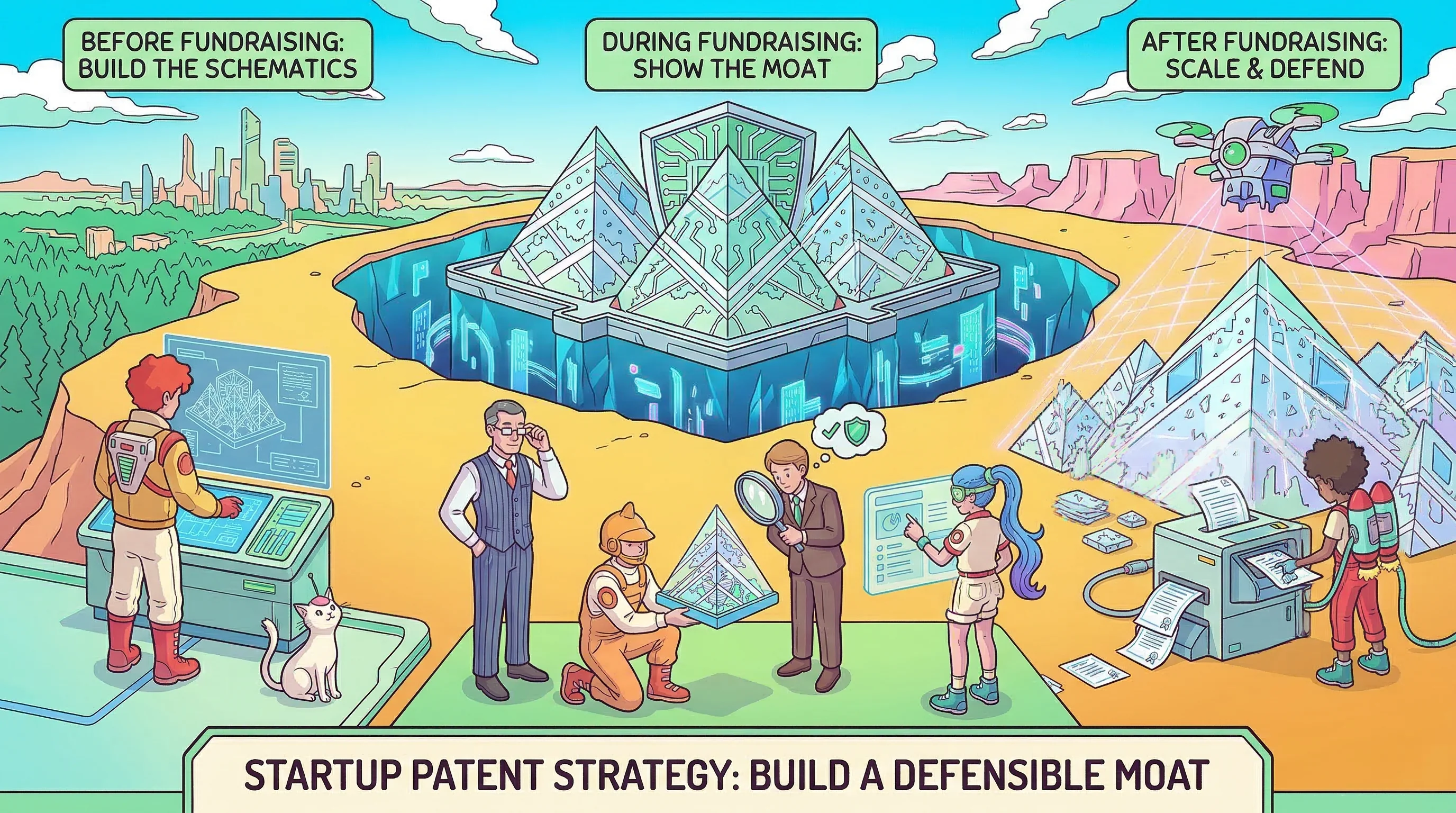
Investors ask about patents. Not always directly, and not always first, but it comes up. “What’s your IP position?” is a polite way of asking “Can someone else build this?”
If you are building a hardware startup or a company around a physical product, your answer matters. A patent filing signals that you have something defensible. No patent filing signals that your competitive advantage depends entirely on execution speed, and investors know that execution speed is not a moat.
Before You Raise: File Something
The best time to file a patent is before you talk to investors. Even better, before you publicly disclose the product at all.
A provisional patent application gives you:
- A filing date. This establishes your priority over anyone who files after you.
- Patent pending status. Signals to the market (and to investors) that the IP is being protected.
- 12 months of flexibility. Time to decide whether to file the full non-provisional while you iterate on the product.
Filing before fundraising also avoids a timing trap. Once you pitch investors, demo at a conference, or post on social media, the 12-month disclosure clock starts running. If you wait until after a seed round to think about patents, you may have already burned months of that deadline.
What Investors Want to See
Investors are not patent lawyers. They do not read claims. What they want is assurance that the company has a defensible position:
Patent pending (provisional filed). The minimum bar. Shows you have initiated the process.
Patent pending (non-provisional filed). Stronger. The application is in the USPTO examination queue with actual claims.
Patent granted. The strongest signal. The USPTO has examined your claims and determined your invention qualifies.
Patent portfolio (multiple filings). Multiple filings covering different aspects of your product shows strategic IP thinking.
Most startups at the seed stage have a provisional filing. By Series A, investors expect at least a non-provisional. By Series B, a granted patent or portfolio is increasingly expected for hardware companies.
Patent Costs in Context
| Stage | Typical Raise | Patent Costs (provisional + non-provisional) |
|---|---|---|
| Pre-seed | $250K - $1M | ~$6,000 - $12,000 |
| Seed | $1M - $3M | Same, plus optional patent search |
| Series A | $3M - $15M | Same, plus potential additional filings |
$6,000 to $12,000 to protect the IP of a company raising $1M or more is not a material expense. But the absence of any filing raises questions that are harder to answer than the cost of filing.
Common Mistakes Startups Make
Filing too late. The product is already selling, the 12-month window is ticking, and the startup scrambles to file before the deadline. Filing early produces better applications.
Filing only a design patent. Design patents protect how a product looks, not how it works. They are cheaper and faster but provide narrow protection. A competitor who changes the visual design can sell a functionally identical product. For investor purposes, utility patents are far more valuable.
Using a cheap filing service. A cover-sheet provisional may not contain enough structural detail to support strong non-provisional claims. If investors or their lawyers review the application and find it thin, it undermines confidence rather than building it.
Not budgeting for office actions. 86% of applications receive at least one office action. This is normal. But responding has costs, and startups should budget for this in their IP spending plan.
How to Position IP in Your Pitch
One slide, three things:
- What is patented (or patent pending). Describe the core innovation in plain language.
- What it prevents. Explain what a competitor would have to do differently to avoid infringing.
- Where you are in the process. Provisional filed, non-provisional filed, patent granted, additional filings planned.
If investors want to dig deeper, they can review the application or have their IP counsel review it. Your job in the pitch is to demonstrate that you take IP seriously and have taken concrete steps.
For a full breakdown of costs at each stage, see the patent cost guide.