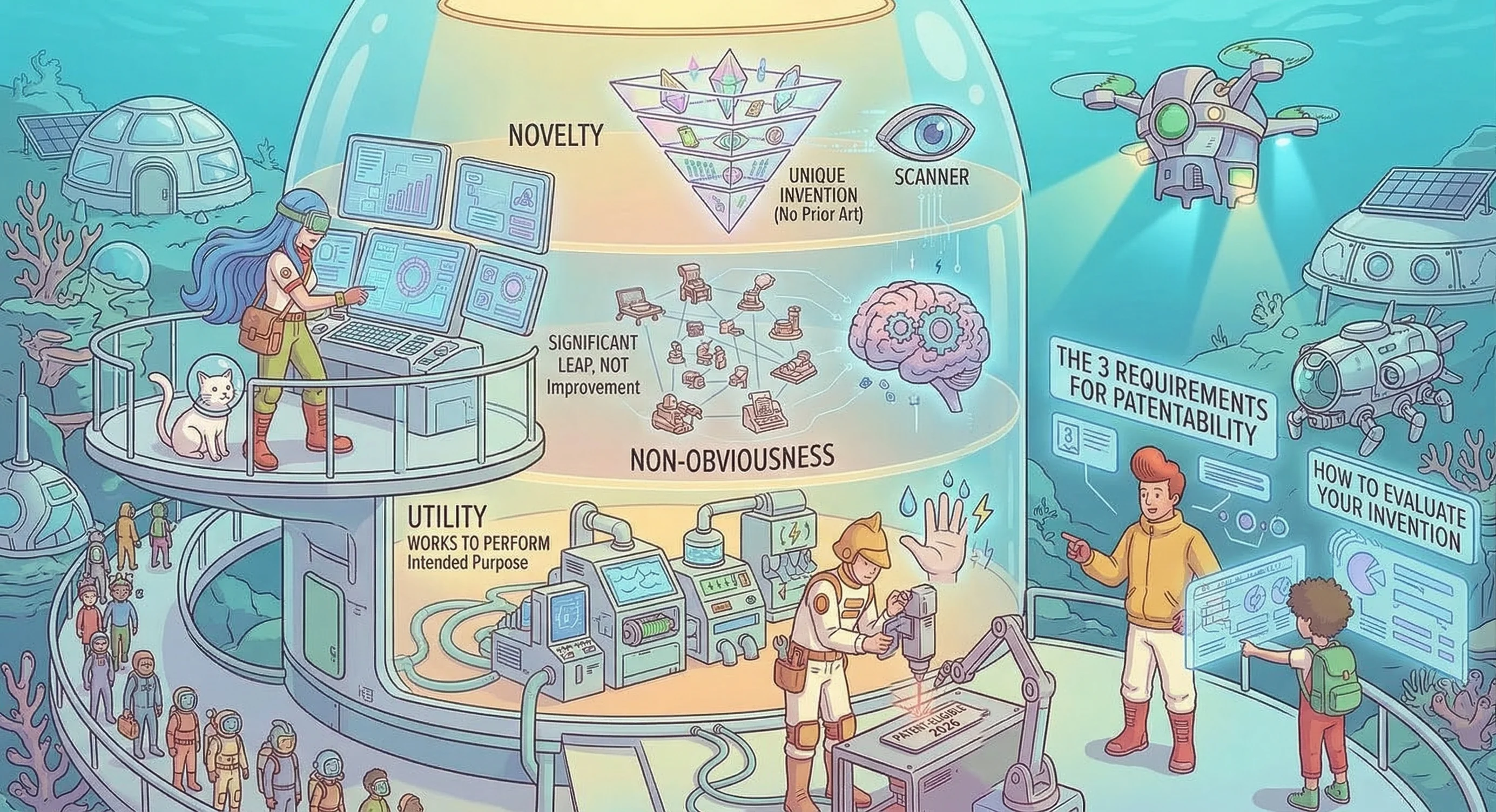
Before spending money on a patent application, you need to know whether your invention qualifies for one. The USPTO applies three tests to every application. Miss any of them and your application gets rejected.
The three requirements are novelty, non-obviousness, and utility.
Requirement 1: Novelty
Your invention must be new. The USPTO calls this “novel,” which means no single piece of prior art describes your exact invention.
Prior art is anything that existed before your filing date: existing patents, published patent applications, products on store shelves, YouTube videos, academic papers, even your own social media posts. If someone already disclosed the same invention, yours is not novel.
The key word is “same.” Your invention does not need to be completely unlike anything ever made. It needs to differ in at least one structural or functional way from every individual prior art reference. A kitchen tool with a new hinge mechanism is novel even if kitchen tools have existed for centuries. The question is whether that specific hinge configuration appeared before.
This is why a patent search matters. It finds the closest prior art before you file, so you know where your invention stands and can position your claims around the differences.
Requirement 2: Non-Obviousness
This is where most rejections happen. Your invention must not be obvious to a “person of ordinary skill in the art” (POSITA). Think of POSITA as a competent engineer or designer in your product’s field who knows all the existing solutions but lacks creative spark.
The test: would this hypothetical person look at the existing products and naturally arrive at your invention? If yes, it is obvious. If no, you have something patentable.
A concrete example. Say someone patents a mousetrap with a spring-loaded bar. You come along and make the bar out of stainless steel instead of carbon steel. Is that non-obvious? Probably not. Any competent designer knows stainless steel resists corrosion. That substitution is routine.
But what if you redesigned the trigger mechanism so the bar releases from the side instead of the top, allowing the trap to work in tight spaces where a top-release trap cannot fit? That changes the spatial relationship between components. A POSITA would not necessarily arrive at that configuration from looking at existing traps. That is likely non-obvious.
The Supreme Court case KSR v. Teleflex (2007) clarified that combining known elements in a predictable way is usually obvious. But combining them in a way that produces an unexpected result or solves a problem people were not trying to solve tilts toward non-obvious.
For a deeper look, see What Does Non-Obvious Actually Mean?
Requirement 3: Utility
Your invention must do something useful. This is the easiest requirement to meet. If your product serves any practical purpose, it passes.
The USPTO rarely rejects applications for lack of utility unless the invention claims to do something physically impossible (perpetual motion machines, for example) or has no apparent use. If your invention is a physical product that people would actually use, you are fine here.
How the Three Requirements Work Together
All three must be satisfied. An invention that is novel and useful but obvious will be rejected. An invention that is non-obvious and useful but anticipated by prior art will also be rejected.
The good news: most physical product inventions pass the utility test automatically, and novelty is usually addressable through careful claim drafting. Non-obviousness is the real battleground, and it is where the quality of your patent application matters most.
This is where the difference between a professionally drafted application and a DIY filing shows up. According to a PLOS One study, inventors who work with a patent professional are 2.7 times more likely to receive a patent than those who file on their own (65% success rate vs. 24%). Much of that gap comes down to how well the application establishes non-obviousness through strong, structure-focused claims.
What Should You Do Before Filing?
Start with a patent search. It costs far less than a full application and tells you whether prior art is likely to block your filing. For a full breakdown of what each step costs, see the patent cost guide.