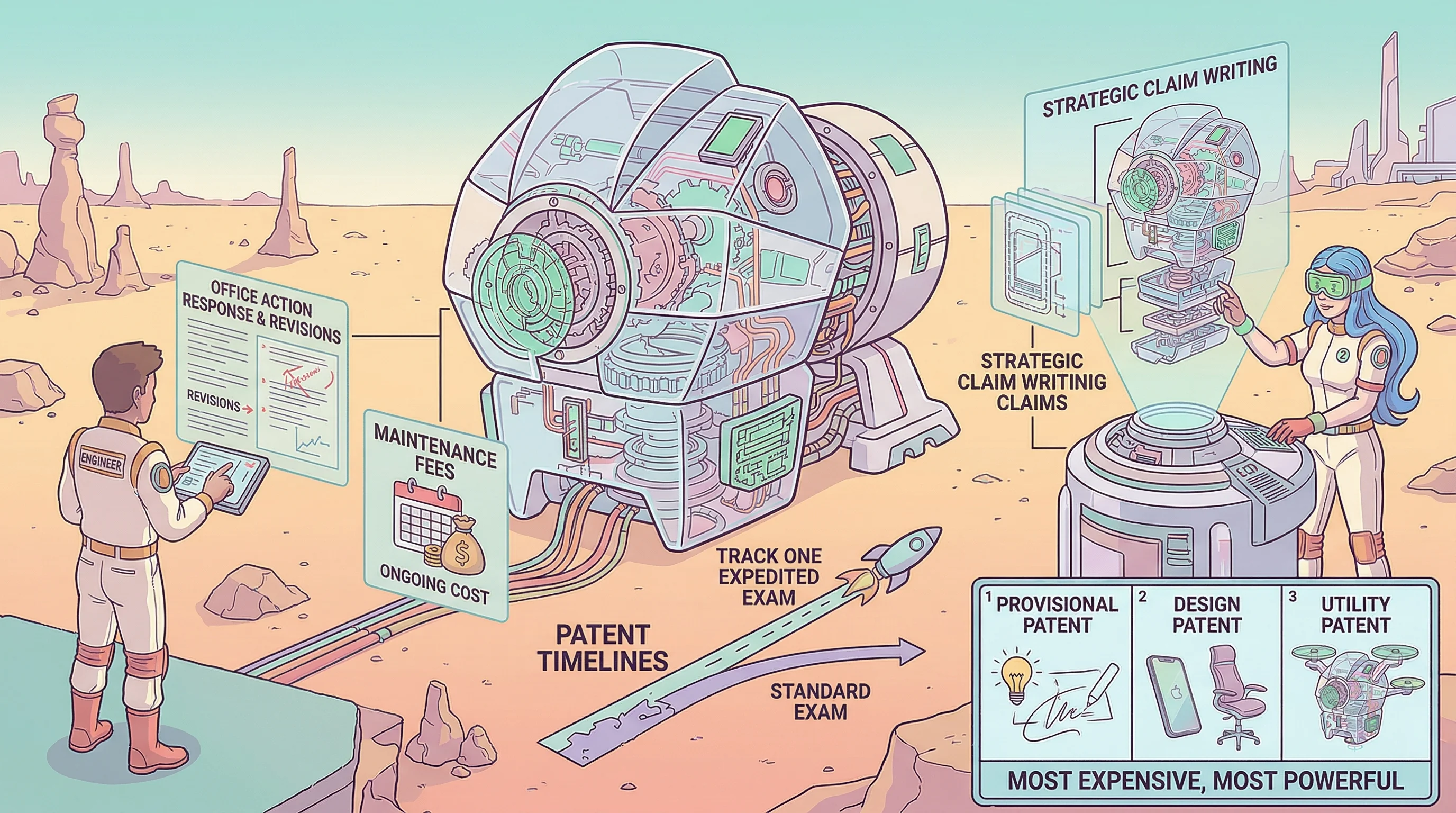
A utility patent protects how an invention works. It is the most common patent type, covering roughly 90% of all patents granted by the USPTO. It is also the most expensive, because the process involves drafting, filing, examination, office action responses, and maintenance fees that span the full 20-year patent term.
Most inventors spend $10,000 to $15,000 to get a utility patent granted. That covers attorney drafting, USPTO fees, and office action responses during examination. Over the full 20-year life of the patent, maintenance fees add another $3,150 to $12,600 depending on your entity size.
Here is the full cost picture, from first filing through the last maintenance payment.
Total Cost Overview
| Stage | Typical Cost | When |
|---|---|---|
| Patent search (optional) | $500 - $3,500 | Before filing |
| Provisional application (optional) | $2,500 - $5,000 | Before utility filing |
| Utility patent drafting and filing | $6,000 - $12,000 | At filing |
| USPTO filing fees | $400 - $2,000 | At filing |
| Office action responses (1-3 rounds) | $950 - $6,000+ | During examination |
| Issue fee | $300 - $1,200 | At grant |
| Maintenance fees (3 payments over 12 years) | $3,150 - $12,600 | After grant |
| Total through full patent term | $12,000 - $40,000+ | Over 20 years |
The range is wide because invention complexity drives everything. A simple mechanical gadget with straightforward claims sits at the low end. A biotech invention with dense specifications and multiple rounds of prosecution sits at the high end.
Attorney Fees by Complexity
Invention complexity is the single biggest cost driver. More complex inventions require longer specifications, more claims, and more back-and-forth with the patent examiner.
| Complexity Tier | Examples | Typical Attorney Fee | Why |
|---|---|---|---|
| Low | Simple mechanical devices, hand tools, furniture | $6,000 - $8,000 | Fewer claims, straightforward drawings, shorter specification |
| Medium | Consumer electronics, electromechanical devices | $8,000 - $10,000 | Technical detail, circuit diagrams, more dependent claims |
| High | Software/AI, biotech, semiconductor, complex systems | $10,000 - $15,000+ | Section 101 hurdles for software, dense prior art for biotech, longer prosecution |
These numbers align with flat-fee pricing from patent firms we surveyed. Vic Lin at Innovation Capital Law Group publishes flat rates starting at $6,800 for low complexity, $8,900 for medium, and $12,000+ for high complexity utility patents. Most firms land in similar ranges.
About 70% of patent attorneys use flat fees for utility patent work. The rest bill hourly at $325 to $550 per hour. At those rates, a medium-complexity utility patent taking 40-60 hours of attorney time costs $13,000 to $33,000. Flat fees are better for inventors because the total is known upfront.
What a Utility Patent Actually Covers
A utility patent gives you the right to exclude others from making, using, selling, or importing your invention for 20 years from the filing date. That is the key distinction: it does not give you the right to make the invention. It gives you the right to stop others from doing so.
A utility patent application includes:
- Specification: A written description detailed enough that someone skilled in the field could build your invention. This is the foundation. Under 35 U.S.C. 112, every claim must be supported by the specification.
- Claims: The legal boundaries of your protection. Claims define exactly what is patented. Everything else in the application exists to support the claims.
- Drawings: Technical illustrations showing every feature described in the claims. Required by the USPTO, not optional.
- Abstract: A 150-word summary of the invention.
The claims are what matter most. Your specification can describe an invention in beautiful detail, but your patent rights extend only as far as the claims. This is why claim strategy is worth the investment.
Claims Strategy and Why It Matters
The biggest cost mistake in utility patents is not spending too much. It is filing without a claims strategy. Your claims determine what competitors can and cannot do. Broad claims give you wider protection but face higher rejection rates. Narrow claims are easier to get granted but easier to design around.
A good attorney drafts layered claims:
- Independent claims define the core invention in the broadest defensible terms
- Dependent claims add specific features as fallback positions during examination
- Multiple claim sets cover different aspects (method claims, system claims, apparatus claims)
The USPTO includes 3 independent claims and 20 total claims in the base filing fee. Additional claims cost extra ($100 per excess independent claim for small entities, $50 per excess dependent claim). Most inventions fit within the base allotment.
Filing continuation applications later lets you pursue additional claim scope without starting over. This is how companies build patent portfolios: one initial filing that spawns multiple continuations covering different angles of the same technology.
Office Actions: The Hidden Cost
About 86% of utility patent applications receive at least one office action. An office action means the examiner found issues with your claims, usually prior art that overlaps or claim language that is too broad or unclear. This is standard. It is not a rejection of your invention.
| Scenario | Attorney Cost | Total with USPTO Fees |
|---|---|---|
| 1 office action, minor amendments | $950 - $1,500 | $1,500 - $3,500 |
| 2 office actions, claim narrowing | $2,000 - $4,000 | $3,500 - $6,500 |
| 3+ rounds with examiner interview | $3,000 - $6,000+ | $6,500 - $10,000+ |
| RCE (Request for Continued Examination) | $3,000 - $5,000+ | Additional $5,000+ |
Over half of granted patents go through up to four office actions. The quality of the original application directly affects how many rounds you face. A well-drafted utility patent with strong claims and a thorough specification gets through with fewer rejections. A thin application generates more rounds and costs more in the long run.
If prosecution stalls, an examiner interview can break the logjam. Your attorney schedules a call with the examiner to discuss the claims directly. These interviews have a high success rate and are worth the additional cost.
USPTO Government Fees
The USPTO charges fees at multiple stages. Entity size determines how much you pay.
Filing Fees
| Fee | Micro Entity | Small Entity | Large Entity |
|---|---|---|---|
| Filing fee | $80 | $160 | $320 |
| Search fee | $165 | $330 | $660 |
| Examination fee | $190 | $380 | $760 |
| Total at filing | $435 | $870 | $1,740 |
Issue Fee (at grant)
| Entity Size | Issue Fee |
|---|---|
| Micro entity | $300 |
| Small entity | $600 |
| Large entity | $1,200 |
Entity Size Qualifications
Micro entity: Gross income below roughly $229,000 (2026 threshold), not named on more than four previous patent applications, and not obligated to assign the patent to an entity that does not qualify.
Small entity: Companies with fewer than 500 employees, independent inventors, and nonprofit organizations.
Large entity: Everyone else.
Micro entities pay 75% less than large entities. Small entities pay 50% less. If you qualify for micro entity status, use it. The savings add up across filing fees, issue fees, and all three maintenance payments.
Maintenance Fees: The 20-Year Cost
Utility patents require three maintenance payments after grant. Miss one and the patent expires. There is a six-month grace period with surcharges, but once that closes, the patent is gone.
| Payment Due | Micro Entity | Small Entity | Large Entity |
|---|---|---|---|
| 3.5 years after grant | $400 | $800 | $1,600 |
| 7.5 years after grant | $900 | $1,800 | $3,600 |
| 11.5 years after grant | $1,850 | $3,700 | $7,400 |
| Total maintenance | $3,150 | $6,300 | $12,600 |
The fees escalate. The third payment is nearly four times the first. This is intentional: the USPTO is asking whether the patent is still worth maintaining. Many patents get abandoned at the 11.5-year mark because the technology has moved on or the product is no longer on the market.
Set calendar reminders years in advance. Patent management software handles this automatically if you have a portfolio. For a single patent, a recurring reminder works fine.
Maintenance fees are unique to utility patents. Design patents have no maintenance fees at all, which is one reason they cost less over the full patent term.
Timeline: How Long Does It Take?
| Stage | Timeline |
|---|---|
| Drafting and filing | 2-4 weeks |
| USPTO assigns examiner | Immediate to a few months |
| Wait for first office action | 12-22 months average |
| Office action response cycle | 3-12 months per round |
| Total to grant | 1.5 to 4 years |
Technology area affects wait times. Mechanical and consumer product applications move faster. Software, AI, and telecom have longer examiner backlogs.
Track One Prioritized Examination
If you need a granted patent fast, the USPTO offers Track One. For an extra fee ($1,000 micro, $2,000 small, $4,000 large), the USPTO targets a final decision within 12 months of filing. First office action typically comes within 2 months instead of 12-22 months.
Track One is worth it when you need the granted patent for licensing negotiations, investor due diligence, or enforcement against a known infringer. It does not change examination standards, just the speed.
Free expedited examination is also available for inventors age 65 and older.
Utility Patent vs. Other Patent Types
| Utility Patent | Design Patent | Provisional | |
|---|---|---|---|
| Protects | How it works (function) | How it looks (appearance) | Nothing (placeholder filing date) |
| Term | 20 years from filing | 15 years from grant | 12 months, then expires |
| Maintenance fees | Yes (3 payments) | No | N/A |
| Cost through grant | $10,000 - $30,000 | $2,000 - $5,000 | $2,500 - $5,000 |
| Examination time | 1.5 - 4 years | 12 - 20 months | No examination |
| Claims required | Yes (define legal scope) | No (drawings are the claims) | No (informal) |
If your invention has both a novel function and a distinct appearance, you can file both a utility patent and a design patent on the same product. This gives you layered protection: utility claims cover how it works, design claims cover how it looks. The two patent types are independent and do not conflict.
When a Utility Patent Makes Sense
File a utility patent if:
- Your invention solves a problem in a new way (function, method, process, or composition)
- Competitors could replicate the functionality even with a different design
- You want licensing leverage (utility patents are easier to license because they cover function, not just appearance)
- You are building a patent portfolio for investor confidence or acquisition
Consider a design patent instead if:
- Your competitive advantage is the visual design, not the underlying mechanism
- Budget is tight and the appearance is what makes your product distinctive
- You want faster, cheaper protection with no maintenance fees
Consider both if:
- Your product has a novel mechanism AND a distinctive appearance
- You want maximum protection against copycats
- The product is consumer-facing where both form and function drive purchasing decisions
Reducing Utility Patent Costs
File a provisional first. A provisional patent application costs $2,500 to $5,000 and buys you 12 months of patent pending status. Use that time to validate the market before committing $10,000+ to the utility filing. Several attorneys credit the provisional fee against the utility application when you convert with them.
Choose flat-fee attorneys. Fixed pricing protects you from cost overruns. If an attorney only bills hourly, ask for a flat-fee alternative. Most will offer one.
Qualify for micro entity status. The filing fee savings alone are $1,305 compared to large entity. Over the full patent term including maintenance, micro entity saves $9,450 versus large entity.
Invest in the initial draft. A well-drafted application reduces office actions. Each avoided round of prosecution saves $1,500 to $3,000 in attorney fees plus months of delay.
Ask about office action pricing upfront. Some attorneys include one office action response in their flat fee. Others charge separately. Know the deal before you sign.
Bottom Line
A utility patent costs most inventors $10,000 to $15,000 to get granted, including attorney fees, USPTO fees, and office action responses. Over the full 20-year term, add $3,150 to $12,600 in maintenance fees.
The utility patent is the most powerful form of patent protection. It covers function, not just appearance. It lasts 20 years. It is licensable, enforceable, and sellable. The total cost is real, but so is the value: a granted utility patent is the only way to legally stop a competitor from copying how your invention works.
Before hiring an attorney, ask:
- Is the fee flat or hourly? Flat fees are better for budgeting. If hourly, ask for a cap.
- What complexity tier does my invention fall into? This determines the base fee.
- Are office action responses included? Know whether prosecution costs are separate.
- Do you credit the provisional fee if I convert? This can save thousands if you already filed a provisional.
- What is your strategy for claims? An attorney who talks about claim layering and continuation strategy is thinking about the long game.