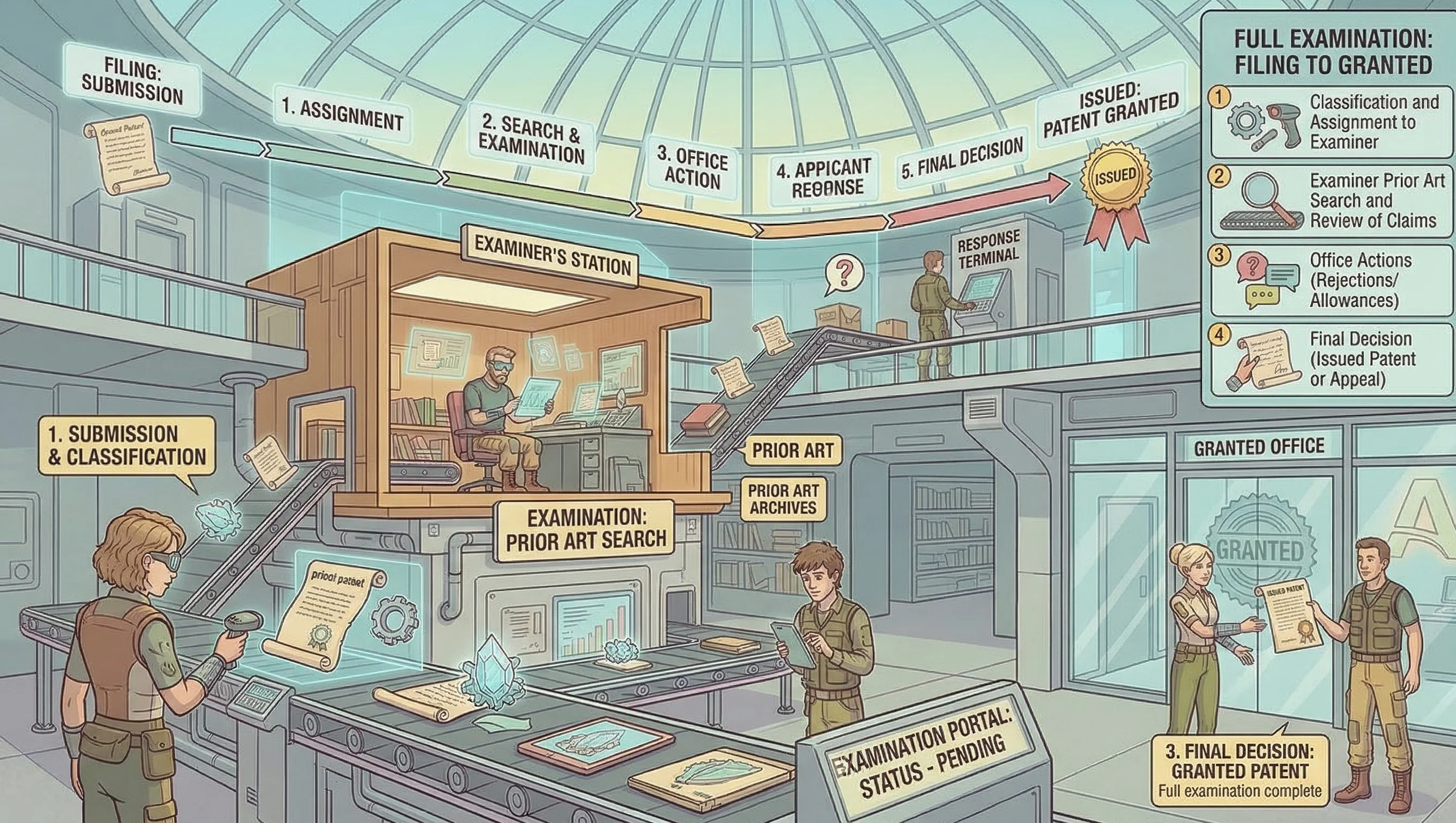
After you file a non-provisional patent application, the USPTO assigns it to a patent examiner who specializes in your technology area. The examiner reviews your specification and claims, searches for prior art, and determines whether your invention meets the patentability requirements. Most applications receive at least one office action before the patent is granted.
Here is what happens at each stage.
Step 1: Filing Confirmation
Within a few days of filing, the USPTO issues a filing receipt. This confirms your application number, filing date, and the information you submitted. Your filing date is locked in, and your application has patent pending status.
If you previously filed a provisional patent application, the non-provisional claims the benefit of that earlier filing date, as long as it was filed within the 12-month window.
Step 2: Examiner Assignment
The USPTO classifies your application by subject matter and assigns it to one of its technology centers. Each center handles a specific area: mechanical engineering, electrical systems, biotechnology, software. Within the center, your application goes to an individual examiner.
You do not get to choose your examiner. The assignment is based on your invention’s classification and the examiner’s workload.
Step 3: The Wait
After assignment, your application enters the examiner’s queue. The average time from filing to the first communication from the examiner is around 15 months, but it varies by technology area.
Mechanical inventions and consumer products tend to have shorter wait times. Software and telecommunications applications often wait longer. See the patent timeline guide for a full breakdown.
During this waiting period, the USPTO publishes most applications 18 months after the earliest filing date. Once published, anyone can see your application, but you retain your patent pending status.
Throughout the entire examination process, you have a duty to disclose any relevant information to the USPTO. If you become aware of prior art, publications, or other references that could affect the examination of your claims, you must submit them via an information disclosure statement (IDS). This is a continuing obligation. It does not end when you file. If you learn about relevant prior art at any point before the patent is granted, you must disclose it. Failure to disclose known relevant information can render your patent unenforceable later.
Step 4: First Office Action
Most patent applications receive a first office action. This is a written communication from the examiner explaining any issues. An office action is not a denial. It is part of the normal examination process.
Office actions typically contain one or more of these:
102 rejection (anticipation). The examiner found prior art that describes your invention or something very similar. They are saying your claimed invention is not novel.
103 rejection (obviousness). The examiner found multiple pieces of prior art that, when combined, would make your invention obvious to someone in the field. This is the most common type of rejection.
112 rejection (indefiniteness or lack of enablement). The examiner found problems with how your claims are written. The claims may be too vague, contain undefined terms, or lack support in the specification.
101 rejection (patent eligibility). The examiner determined that some claims are directed to non-patentable subject matter, such as abstract ideas. Most common with software-related inventions.
Formal objections. Formatting or procedural issues with drawings, abstract, or specification.
Receiving an office action does not mean your patent is dead. The majority of issued patents went through at least one before being granted.
Step 5: Responding
You typically have 3 months to respond to an office action, with extensions available up to 6 months for additional fees. Your response can include:
- Amended claims that narrow or clarify scope to overcome the rejections
- Arguments explaining why the examiner’s rejections are incorrect
- Declarations or evidence supporting your position
- Corrections to formal objections
One critical rule: you cannot add new material to your patent application in a response. Everything you use to defend your patent must already be in the original filing. This is why a thorough initial application matters so much. If the specification was vague or incomplete, there may not be enough material to work with when crafting a response.
Step 6: Examiner’s Decision
After your response, the examiner reviews it. Several outcomes are possible:
Allowance. The examiner agrees and allows the patent. You receive a Notice of Allowance, pay the issue fee, and the patent is granted.
Second office action (non-final). The examiner issues another round if new issues arise or if amendments created new questions.
Final rejection. The examiner was not persuaded. Your options become more limited and more expensive: file a Request for Continued Examination (RCE), appeal to the Patent Trial and Appeal Board (PTAB) for an independent review by a panel of administrative patent judges, or file a continuation application. PTAB appeals are a real option when you believe the examiner has made an error in applying the law or interpreting the prior art.
Getting the first response right is the best strategy. Your initial response is typically your strongest opportunity to overcome the examiner’s objections.
Step 7: Patent Grant
Once the USPTO allows your application and you pay the issue fee, your patent is officially granted. You receive a patent number and a grant date. From that point, you have enforceable patent rights for 20 years from your non-provisional filing date.
With a granted patent, you can:
- Stop competitors from making, using, selling, or importing your patented invention
- License your patent to other companies for royalties
- Use your patent as a business asset for fundraising, acquisition, or valuation
- Enforce your rights through federal court
Maintenance Fees
Utility patents require maintenance fee payments at 3.5, 7.5, and 11.5 years after the grant date. Missing a deadline can result in early expiration.
| Payment Window | Micro Entity | Small Entity | Large Entity |
|---|---|---|---|
| 3.5 years | ~$400 | ~$800 | ~$2,000 |
| 7.5 years | ~$900 | ~$1,800 | ~$3,600 |
| 11.5 years | ~$1,850 | ~$3,700 | ~$7,400 |
Design patents last 15 years from the grant date and require no maintenance fees.
The USPTO sends reminders before each deadline, and there is a 6-month grace period for late payment with a surcharge.
What About Provisional Filers?
If you filed a provisional patent application first, the examination process does not begin until you file the non-provisional. The provisional establishes your filing date but is not examined.
The typical path: file a provisional, use the 12-month window to sell, test, and refine, then file the non-provisional before the deadline. See the patent cost guide for an overview of what each step costs, or the non-provisional patent cost guide for a detailed breakdown of attorney fees, office action costs, and total cost through grant.