A software patent typically costs $8,000 to $15,000+ for a utility patent application and takes 2 to 3 years to get through the USPTO. This covers mobile apps, SaaS platforms, algorithms, and AI tools. The biggest hurdle is not the cost. It is proving that your software does something the patent office considers more than an “abstract idea.” That test, established by the Supreme Court in 2014, is called the Alice test, and it determines whether your software invention is eligible for patent protection at all.
Key facts:
- Non-provisional cost: $8,000 to $15,000+
- Total through grant: $15,000 to $30,000+ (including office actions)
- Timeline: 2.5 to 4 years from filing to grant
- Primary eligibility hurdle: Alice test (35 U.S.C. 101)
- Must claim specific technical improvement, not abstract idea
The Alice Test: The Gatekeeping Rule
In Alice Corp. v. CLS Bank (2014), the Supreme Court created a two-step test for software patent eligibility under 35 U.S.C. Section 101:
Step 1: Is the claim directed to an abstract idea? The examiner asks whether your invention, at its core, is just an abstract concept. Examples of abstract ideas the USPTO flags: fundamental economic practices, methods of organizing human activity, mathematical formulas, and mental processes that could be performed with pen and paper.
Step 2: If yes, does it contain an “inventive concept” that transforms the abstract idea into something patent-eligible? This is where most software patents live or die. The invention must add something significantly more than the abstract idea itself. Generic computer implementation (“do it on a computer”) is not enough. The claims must describe a specific technical improvement.
A 2024 study by the USPTO found that Section 101 rejections remain the most common basis for rejecting software-related patent applications. Understanding Alice before you file saves both time and money.
What Qualifies for a Software Patent
Software patents that survive Alice share a common trait: they claim a specific technical improvement to how a computer system works.
Examples that typically qualify:
- A data compression method that reduces file sizes 40% faster than existing approaches by using a new encoding structure
- A database query system that retrieves results in fewer operations by reorganizing how indexes are structured
- A security protocol that detects intrusions by analyzing network traffic patterns in a way not done before
- A machine learning pipeline that reduces training time by distributing computations across nodes using a novel scheduling method
- A real-time rendering technique that produces higher-quality images using fewer GPU cycles
Examples that typically do NOT qualify:
- A business method implemented on a computer (online auctions, price comparison tools, financial calculations)
- A user interface layout or screen arrangement (these may qualify for a design patent, but not a utility patent)
- Software that automates a process humans already do manually, without a technical improvement to how the computer operates
- An app that collects data, processes it with standard methods, and displays results
If your software invention is primarily visual (a novel GUI layout, an icon grid design, a distinctive onboarding flow), consider a design patent instead of or alongside a utility patent. Design patents for app interfaces cost $1,500 to $3,000, have an 83% approval rate, and grant in 12 to 18 months. Apple has used design patents extensively to protect iPhone interface elements.
The distinction is practical: does your software make the computer do something better, faster, or more efficiently at a technical level? Or does it just use the computer as a tool to automate a known process?
How to Frame Software Claims
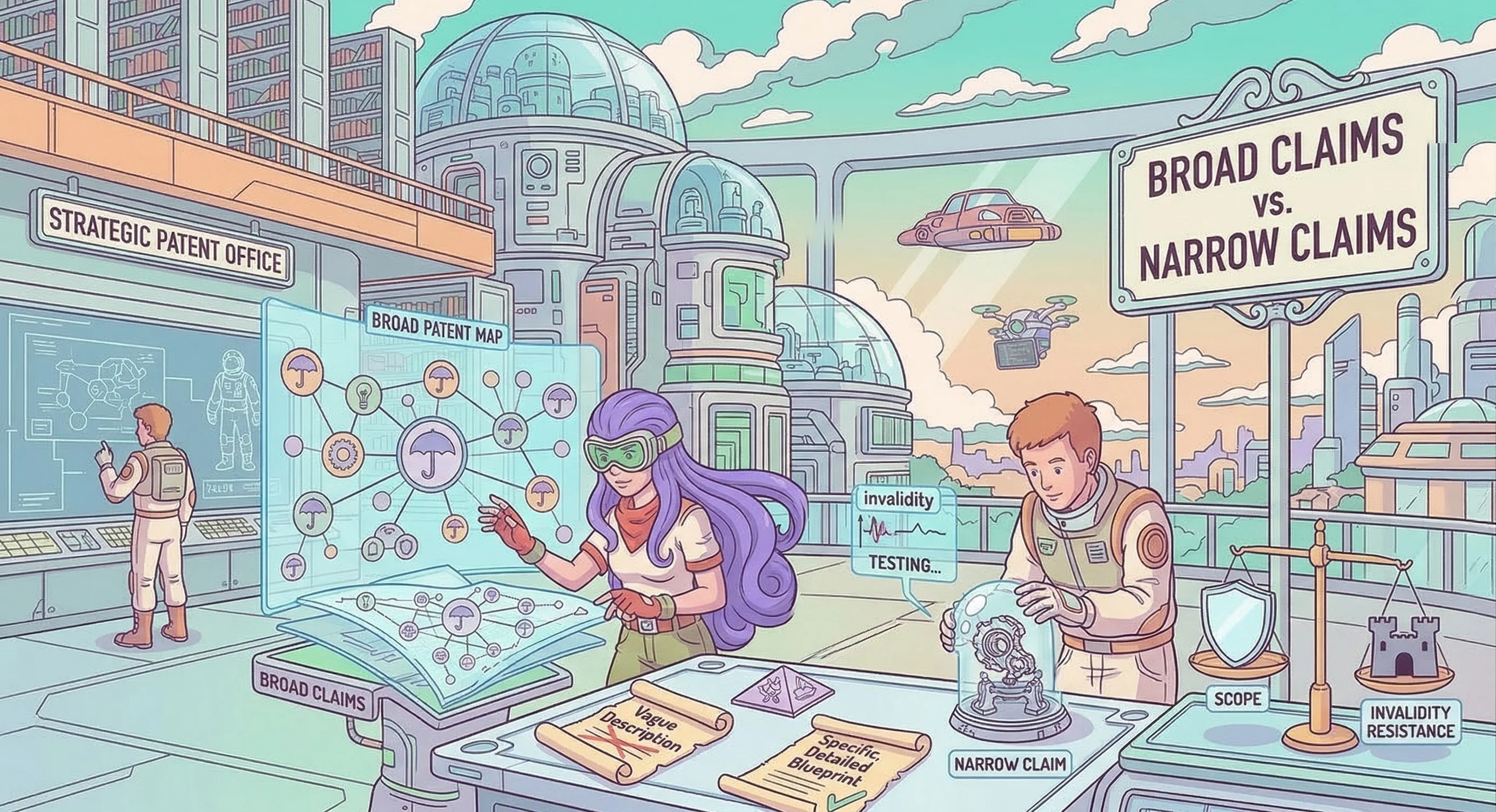
Claim drafting is where software patents succeed or fail. The same invention can be described in a way that gets rejected under Alice or in a way that passes. This is why software patent attorneys charge more than general patent attorneys. The claim strategy matters enormously.
Two claim types work well for software:
System claims describe a specific arrangement of components (processor, memory, modules) configured to perform the technical function. Example: “A system comprising a processor configured to [specific technical process], a memory storing [specific data structure], and a communication module that [specific function].”
Method claims describe the steps of the technical process. Example: “A computer-implemented method comprising: receiving [specific input], processing the input by [specific technical operation], and generating [specific output] based on [specific criteria].”
The claims should tie back to a specific technical problem and a specific technical solution. Vic Lin at iCap Law (patenttrademarkblog.com) emphasizes that software claims need to focus on “what the technology does differently, not what the business does differently.” That framing is the core of surviving an Alice rejection.
Avoid functional language that describes results without explaining how those results are achieved. “A system for optimizing delivery routes” will get rejected. “A system that optimizes delivery routes by calculating shortest-path distances using a modified Dijkstra algorithm applied to a weighted graph of real-time traffic data” has a much better chance.
Software Patent Cost Breakdown
Software patents cost more than mechanical or consumer product patents because of the Alice eligibility hurdle. Attorneys must spend more time on claim strategy and often deal with one or more office actions raising Section 101 issues.
| Component | Cost Range |
|---|---|
| Professional patent search | $1,500 to $3,000 |
| Provisional patent application | $3,500 to $6,000 |
| Non-provisional patent application | $8,000 to $15,000+ |
| USPTO filing fees (small entity) | $800 to $1,600 |
| Drawings (10 to 20 figures) | $500 to $1,500 |
| Office action responses (1 to 3 typical) | $1,000 to $5,000 each |
| Total through grant | $15,000 to $30,000+ |
The high end applies to complex AI/ML inventions or systems with multiple interacting components. Simpler software tools (a single algorithm with a clear technical improvement) fall toward the lower end.
For a broader cost comparison across all patent types, see the patent cost guide. Use the patent cost calculator to estimate costs for your specific invention type.
Timeline
Software patents take longer than average because of the Section 101 examination burden:
| Stage | Typical Duration |
|---|---|
| Provisional filing to non-provisional | 12 months |
| Non-provisional to first office action | 14 to 18 months |
| Office action responses (1 to 3 rounds) | 6 to 18 months |
| Total: filing to grant | 2.5 to 4 years |
The Technology Center that handles most software applications (TC 3600 for business methods, TC 2100 for computer architecture) has historically had longer pendency times. See the patent timeline guide for a full breakdown by technology area.
When to Hire a Software Patent Specialist
Software patent prosecution is a specialty. An attorney who primarily handles mechanical patents may draft a technically accurate application that fails the Alice test because the claims are framed around results rather than technical implementation.
Look for an attorney who:
- Has specific experience with Section 101 rejections and Alice arguments
- Can show examples of granted software patents in your technology area
- Understands the difference between business method claims (weak) and technical system claims (strong)
- Charges flat fees, so you know the total cost upfront
Browse software patent attorneys in your area, or filter by specialty in cities like San Francisco, Austin, or Seattle.
Should You File a Provisional First?
For most software inventions, yes. A provisional patent application costs $3,500 to $6,000 and gives you 12 months of patent pending status. During that time you can:
- Test the market and validate demand before committing $8,000+ to a non-provisional
- Continue developing the software and add improvements to the non-provisional filing
- Talk to investors with “patent pending” status, which signals you have protectable IP
The risk of skipping the provisional is the 12-month filing deadline. If you publicly release or demo the software, the clock starts. Filing a provisional before launch locks in your date.
If you already know your software is final, your budget allows it, and you are ready to commit, filing a non-provisional directly saves the cost of a provisional that would be superseded within a year anyway. But most software startups benefit from the 12-month buffer.
Other Ways to Protect Software
A utility patent is the strongest protection for software inventions, but it is not the only option. Depending on what you are protecting and your budget, other IP tools may complement or substitute for a patent.
| Protection | Best For | Cost | Notes |
|---|---|---|---|
| Trade secret | Algorithms, training data, proprietary processes | Near zero | Works only if you can keep it secret. Once reverse-engineered or independently discovered, protection is gone. |
| Copyright | Source code, UI designs, documentation | $45 to $65 registration | Protects the expression (the specific code), not the underlying idea or method. Competitors can write different code that does the same thing. |
| Design patent | Novel GUI layouts, icon designs, app interfaces | $1,500 to $3,000 | Protects the visual appearance of software interfaces. Cheaper and faster than a utility patent but covers only the look, not the function. |
| Trademark | Product name, brand identity, logos | $250 to $350 per class | Protects your brand, not the technology. Important for market positioning but does not prevent competitors from building similar software under a different name. |
For most software companies, the best approach is layered: trade secrets for proprietary algorithms, copyright for the codebase, trademark for the brand, and a utility patent for the core technical innovation that gives you a competitive advantage.
The Bottom Line
Software is patentable if it solves a technical problem with a specific technical implementation. The Alice test is the primary obstacle, and claim drafting strategy determines whether your application clears it. Budget $8,000 to $15,000+ for the non-provisional application and expect 2.5 to 4 years from filing to grant.
If you are unsure whether your software qualifies, a patent search and a consultation with a software patent specialist are the most cost-effective first steps. Many patent attorneys offer free initial consultations. Find one in the patent attorney directory.
.webp)