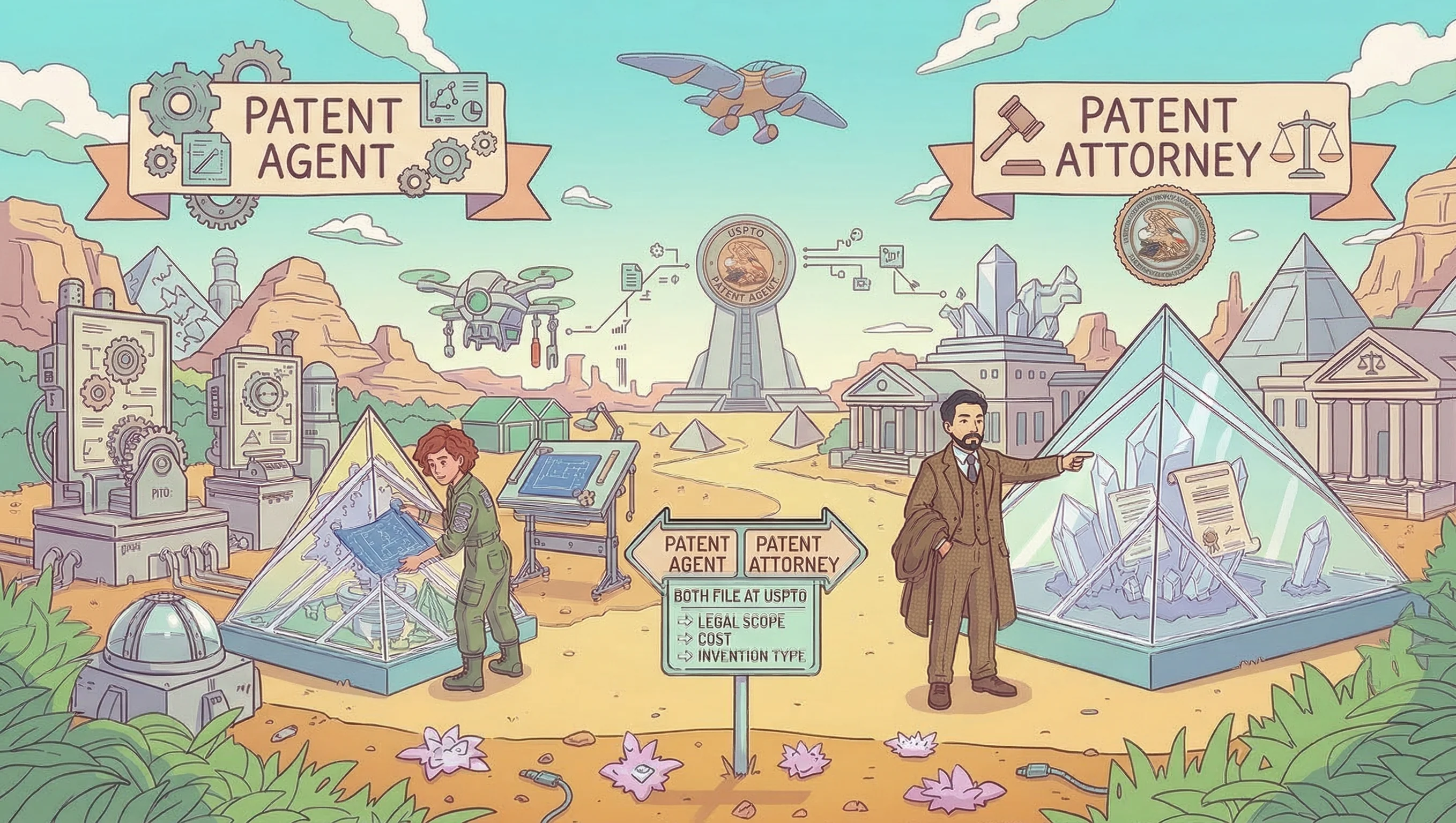
Patent agents charge 20-40% less than patent attorneys for the same filing work. Both pass the same USPTO patent bar exam. Both can draft, file, and prosecute patents. The difference: patent attorneys also have law degrees and can handle litigation, licensing agreements, and legal opinions that agents cannot.
For a straightforward patent filing, an agent saves you thousands. For anything involving legal risk, you need an attorney. For a full walkthrough on evaluating candidates of either type, see our guide on how to choose a patent attorney.
What Patent Agents and Attorneys Have in Common
Both have passed the USPTO patent bar exam. Both have technical backgrounds in science or engineering. Both can do all of the core patent work:
- Draft and file provisional patent applications
- Draft and file non-provisional (utility) patent applications
- Respond to office actions from patent examiners
- Conduct patent searches
- Prosecute patents through the USPTO examination process
The patent office treats them identically for these tasks. A patent filed by an agent has the same legal weight as one filed by an attorney.
What a Patent Attorney Can Do That an Agent Cannot
A patent attorney also has a law degree and a state bar license. That unlocks a different set of capabilities:
- Litigation. If someone infringes your patent, an attorney can represent you in court. An agent cannot.
- Licensing and contracts. Attorneys can negotiate and draft licensing agreements, assignment contracts, and NDAs.
- Trademark and copyright. Patent agents are limited to patent work. Attorneys can handle your broader IP portfolio.
- Legal opinions. Freedom-to-operate opinions, infringement analyses, and validity opinions typically require an attorney.
- Design-around strategies and cease-and-desist responses. If a competitor accuses you of infringement, or you need to design around an existing patent, that’s legal advice only an attorney can provide. An agent offering this counsel would be practicing law without a license.
If your situation is purely about getting a patent filed and granted, an agent does the same work. If you need legal strategy beyond the patent itself, you need an attorney.
Attorney-Client Privilege
This is an underappreciated difference. Communications with a patent attorney are protected under attorney-client privilege. Courts cannot compel a patent attorney to testify about your confidential discussions.
Communications with a patent agent receive some but not all of those protections. Federal courts have extended a limited privilege to patent agent communications in prosecution matters, but state-level protections remain unclear. If confidentiality of your communications is a concern (for example, you’re in a competitive market and worried about future litigation), this tips the scale toward an attorney.
The Cost Difference
Patent attorneys charge more. This is the biggest practical difference for most inventors.
| Patent Agent | Patent Attorney | |
|---|---|---|
| Typical hourly rate | $150 - $300 | $300 - $600+ |
| Provisional patent | $2,000 - $4,000 | $3,000 - $6,000+ |
| Non-provisional patent | $4,000 - $8,000 | $7,000 - $15,000+ |
| Office action response | $1,000 - $2,500 | $2,000 - $4,000+ |
Over a typical utility patent lifecycle (filing through grant with one or two office actions), choosing a patent agent over an attorney saves roughly $3,000 to $10,000. For a startup filing multiple patents, that difference compounds fast. For a full breakdown of what patents cost at each stage, see our patent cost guide.
The quality of the patent application depends on the individual professional, not on whether they have a law degree. A good patent agent who specializes in your technology area will write a stronger application than a generalist attorney who doesn’t understand your field.
Why the Cost Gap Exists
Patent attorneys carry more overhead. Law school debt, state bar dues, malpractice insurance for legal advice, and the expectation that attorneys charge attorney rates. None of that overhead improves the quality of a patent application.
Patent agents tend to run leaner practices. Many are solo practitioners or work in small firms focused exclusively on patent drafting and prosecution. Less overhead, lower fees, same USPTO work.
When to Choose a Patent Agent
A patent agent makes sense when:
- You need a patent drafted and filed. This is the core job. Agents do it every day.
- Cost matters. If you’re an independent inventor or early-stage startup, the savings are significant.
- Your invention is in their technical specialty. A mechanical engineer who’s also a patent agent will understand your widget better than a lawyer who studied chemistry.
- You don’t need litigation or licensing right now. Most inventors don’t, at least not at the filing stage.
When to Choose a Patent Attorney
A patent attorney makes sense when:
- You expect to enforce your patent in court. If you’re filing specifically because you plan to sue an infringer, start with an attorney so they understand the case from day one.
- You need licensing deals. If the business plan involves licensing your patent to manufacturers, an attorney can handle both the patent and the contracts.
- You have a complex IP portfolio. Multiple patents, trademarks, trade secrets, and copyrights benefit from a single attorney who sees the full picture.
- Your company requires it. Some corporate policies or investors require outside patent counsel to be attorneys.
Does Technical Background Matter?
More than the agent-vs-attorney distinction, honestly.
Patent applications live or die on the technical details. A patent professional who deeply understands your technology will write better claims, anticipate examiner objections, and describe your invention more precisely.
A biotech patent agent who spent 10 years in a genetics lab will write a stronger biotech patent than a patent attorney whose background is electrical engineering. The reverse is also true.
When evaluating patent professionals, ask what technical fields they specialize in and what their engineering or science background is. That matters more than whether they went to law school.
The Smart Approach
Many inventors start with a patent agent to file the initial application. This gets the patent on file at a lower cost. If they later need litigation, licensing, or broader legal work, they bring in a patent attorney at that stage.
Starting with an agent and bringing in an attorney later when you need legal work is how most experienced inventors handle it.
Common Questions
Can a patent agent call themselves a patent lawyer? No. Only licensed attorneys can use the term “lawyer” or “attorney.” Patent agents who misrepresent themselves are violating USPTO rules.
Are patent agents regulated? Yes. Patent agents are registered and regulated by the USPTO Office of Enrollment and Discipline. They must pass the patent bar exam and maintain their registration.
Can I switch from an agent to an attorney mid-application? Yes. You can change your patent professional at any time by filing a new power of attorney with the USPTO. Your application continues without interruption.
Do patent agents work at law firms? Some do. Many law firms employ patent agents alongside patent attorneys. Others work independently or at boutique patent firms.
Other Options Beyond Agents and Attorneys
Invention promoters. Companies that advertise “help getting your patent.” They cannot provide legal advice. Their role is limited to coordinating efforts and recommending patent professionals. Proceed with caution. The FTC has brought enforcement actions against invention promotion companies that charge large upfront fees and deliver little.
Online filing services. Platforms that provide template-based questionnaires and insert your answers into standard application sections. No personalized strategy, no claim drafting, no review of whether your description actually supports the protection you need. These can work for a bare-bones provisional filing, but they are not a substitute for a patent professional. For a closer look at the tradeoffs, see our guide on DIY filing vs. hiring a professional.
USPTO resources. The patent office itself offers free information, educational webinars, and pro bono programs that connect inventors with volunteer patent professionals. The USPTO cannot represent your interests, but their resources are a good starting point if you are early in the process and trying to understand your options.
You can verify any patent agent or attorney’s registration at the USPTO’s Patent Practitioner search tool (oedci.uspto.gov). Search by name to confirm they are active and in good standing before hiring.
Find a patent attorney in the directory or estimate costs with the patent cost calculator.