Most patent attorneys charge between $5,000 and $15,000 total to prepare and file a utility patent application. That’s based on our analysis of 2,999 patent attorney listings on MadePatents. The actual number depends on how the attorney bills, what service you need, and where they practice.
That range covers the attorney’s professional fees only. USPTO government filing fees are separate and add $800 to $1,600 for most filers ($320 to $640 for micro entities). Add them together and you’re looking at $6,000 to $17,000 all-in for a standard utility patent from start to filing.
This guide breaks down the full picture: billing methods, cost by service type, firm size differences, regional pricing, and how to compare quotes so you don’t overpay.
Key facts:
- Typical utility patent attorney fee: $5,000 to $15,000
- Provisional patent attorney fee: $2,000 to $5,000
- Hourly rates: $250 to $600/hr (varies by firm size)
- Flat fee is often 20% to 40% cheaper than hourly for the same work
- Solo practitioners charge 30% to 50% less than large firms
How Patent Attorneys Bill
Patent attorneys use two main billing models: hourly and flat fee.
Hourly billing is the traditional model. The attorney tracks time in six-minute increments (tenths of an hour) and sends you a bill at the end. Every phone call, email, and document review adds to the total. Most patent attorneys charge $250 to $600 per hour. The final bill depends entirely on how long the work takes.
The problem with hourly billing is you don’t know the total cost until it’s done. A “simple” patent can balloon past estimates when the attorney spends more time than expected on research, claim strategy, or revisions.
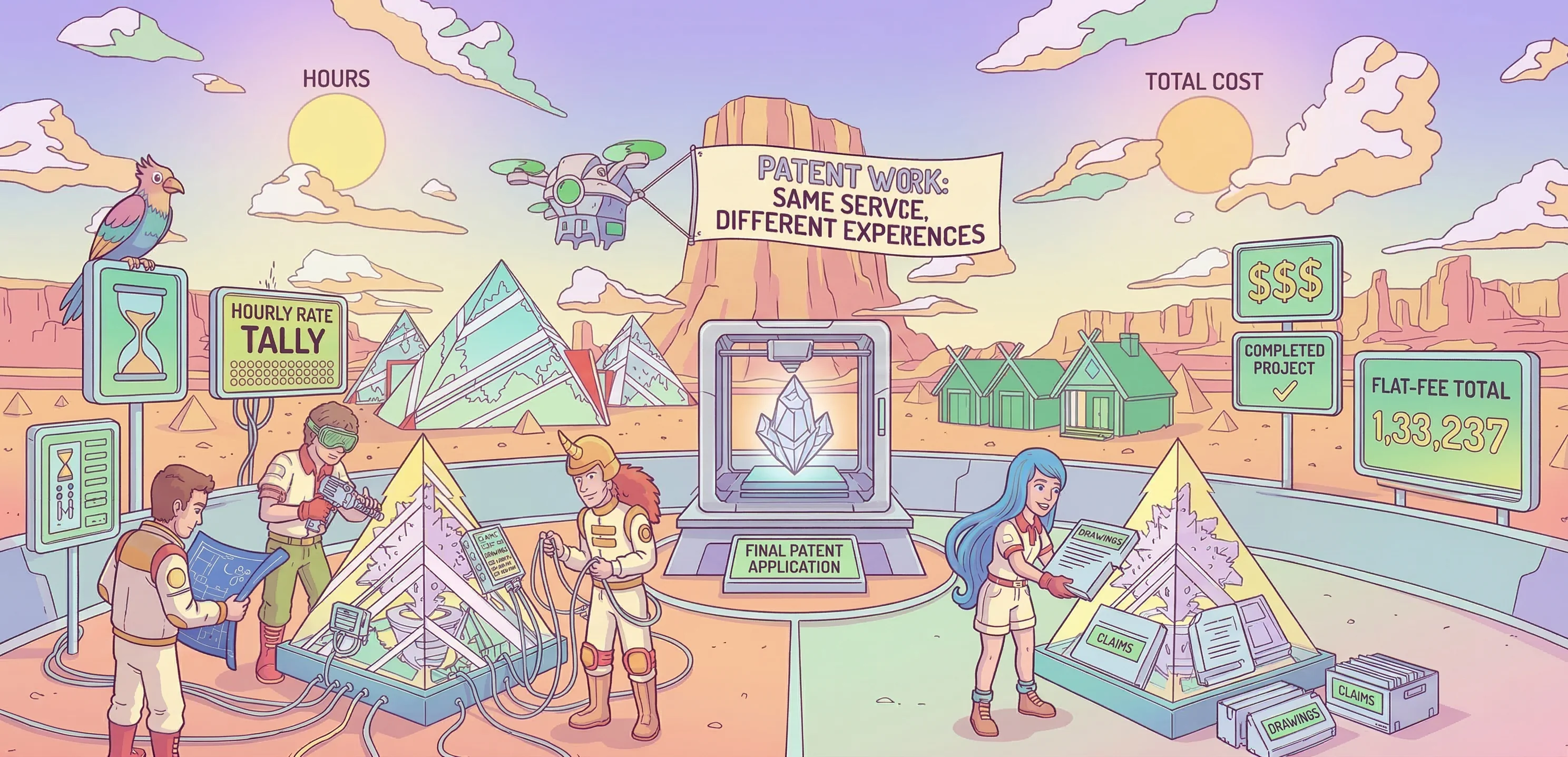
Flat fee billing is growing fast. The attorney quotes a single price for the entire service before work begins. You agree to that number, and that is what you pay. Flat fees give you cost certainty, which is why most independent inventors prefer them.
Based on our 2026 survey of 200+ patent attorneys, flat fee arrangements typically cost 20% to 40% less than hourly billing for the same work. The reason is simple: hourly billing charges for every interaction, including questions and status updates. Flat fee practitioners absorb that communication into one price.
We cover the full comparison in our flat-fee vs. hourly guide.
Cost by Service Type
Here’s what patent attorneys charge for each major service, based on our data from 2,999 attorney listings.
| Service | Flat Fee Range | Hourly Estimate |
|---|---|---|
| Prior art search | $500 to $1,500 | 2 to 6 hours |
| Provisional application | $2,000 to $5,000 | 8 to 20 hours |
| Non-provisional (utility) application | $5,000 to $15,000 | 20 to 60 hours |
| Office action response | $1,000 to $5,000 | 4 to 20 hours |
| Design patent | $1,500 to $3,500 | 6 to 14 hours |
| Patent prosecution (total through grant) | $8,000 to $25,000 | Varies widely |
A few notes on these numbers.
Prior art search ($500 to $1,500). Some attorneys include this in their filing fee. Others charge separately. A good search before filing saves money by identifying potential issues early. If a search turns up a blocking reference, you’ve spent $1,000 instead of $10,000 learning your idea isn’t patentable. See our full patent search guide.
Provisional application ($2,000 to $5,000). This gives you 12 months of “patent pending” status while you test the market. It’s the most common starting point for independent inventors. Simpler inventions fall at the low end. Complex software or biotech inventions push toward the top. Full breakdown in our provisional patent cost guide.
Non-provisional application ($5,000 to $15,000). This is the real patent application. It goes through examination and, if approved, becomes an enforceable patent. The wide range reflects complexity differences. A simple mechanical device might cost $5,000 to $7,000. A complex software system with multiple interdependent claims could run $12,000 to $15,000 or more. Details in our non-provisional patent cost guide.
Office action responses ($1,000 to $5,000 each). About 86% of patent applications get at least one office action from the USPTO examiner. That’s the examiner raising objections or rejections that your attorney needs to address. Most applications go through two or three rounds. Each response adds to your total cost, which is why the “total prosecution” number is substantially higher than just the filing fee.
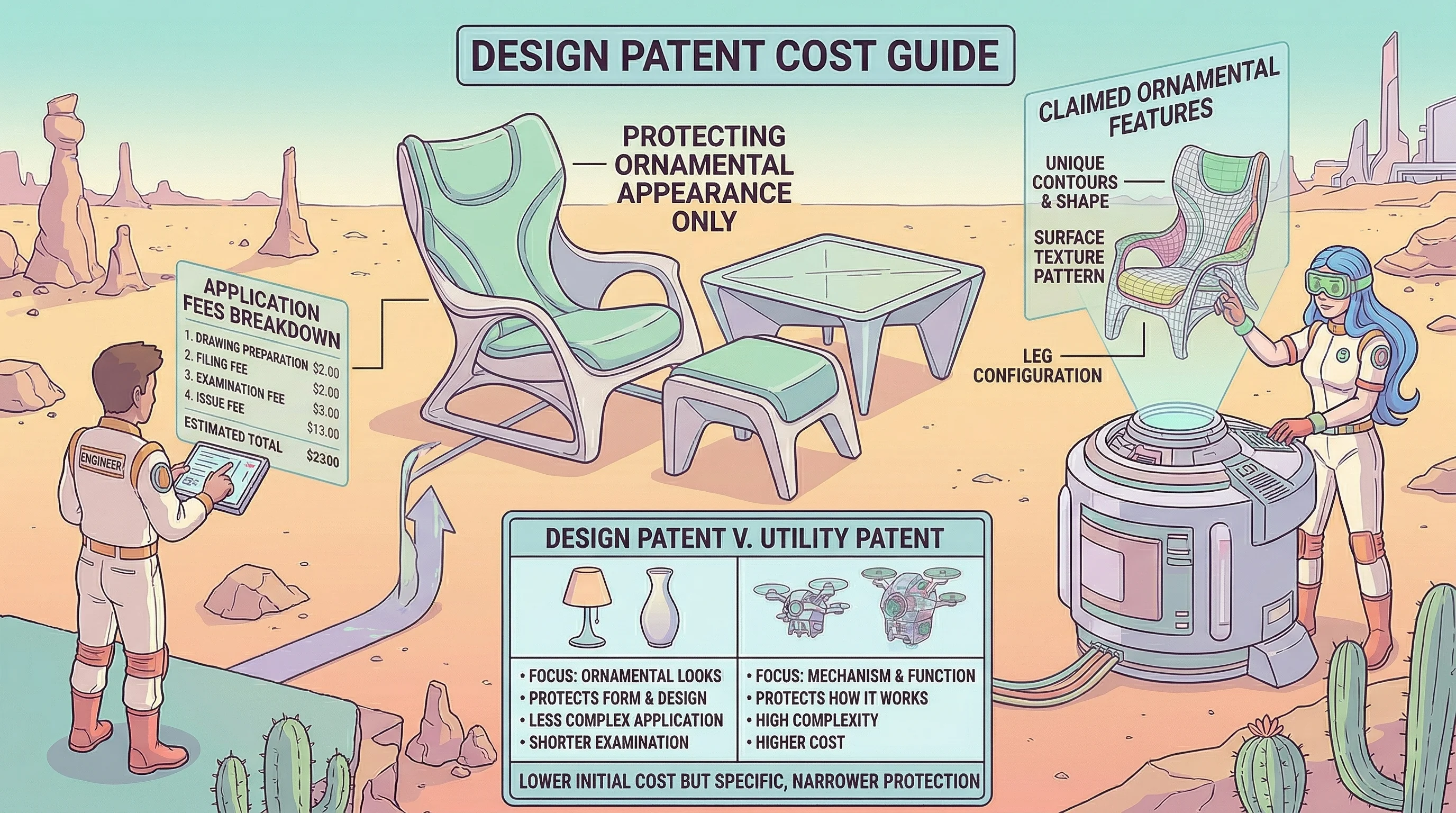
Design patent ($1,500 to $3,500). Design patents protect ornamental appearance rather than function. They’re simpler to draft than utility patents because the drawings do most of the work. Grant rates are high (around 85%), and most applications don’t require office action responses.
For a full comparison of all patent types, see our patent cost overview.
What Drives the Price Difference
The gap between a $5,000 patent and a $15,000 patent comes down to five factors.
Invention complexity
This is the biggest cost driver. A kitchen gadget with three moving parts is straightforward to describe and claim. A machine learning algorithm with multiple processing steps, data structures, and edge cases requires far more drafting work.
Simple mechanical inventions typically fall in the $5,000 to $8,000 range. Electrical and software inventions run $8,000 to $12,000. Biotech, pharmaceutical, and complex multi-system inventions push past $12,000.
The complexity shows up in the claims. A simple invention might need 10 to 15 claims. A complex one could require 20 to 30 claims, each of which needs to be precisely worded to provide meaningful protection without being so broad that the examiner rejects them.
Attorney experience and firm size
A patent attorney with 20 years in your specific technology area will charge more per hour than one fresh out of law school. But they’ll also work faster and write stronger claims. The total cost difference might be smaller than the hourly rate difference suggests.
Firm size has a bigger impact on price than individual experience. A solo practitioner billing $300/hr and working efficiently will often produce the same quality application as a large firm attorney billing $600/hr. The overhead is different. The patent law is the same.
Geographic region
Patent attorneys in New York, San Francisco, Washington DC, and Boston charge 20% to 40% more than attorneys in smaller markets. This is mostly an overhead issue. Office space in Manhattan costs more than office space in Omaha. More on regional differences below.
Number of claims
Most patent applications include 20 claims (the USPTO allows 20 before surcharges apply). If your invention needs more than 20, each additional claim costs $100 in USPTO fees for large entities, plus the attorney time to draft them. Applications with 30+ claims can add $1,000 to $3,000 to the attorney fee.
Quality of inventor documentation
This one is under your control. If you provide your attorney with detailed descriptions, clear diagrams, and organized notes about how your invention works, they spend less time figuring it out. If you show up with a napkin sketch and a verbal explanation, the attorney has to do all the documentation work from scratch.
Good preparation can save $1,000 to $3,000 on attorney fees. Write down everything you know about how the invention works, what makes it different, and what variations you’ve considered. Bring drawings, even rough ones.
Solo Practitioners vs. Large Firms
The firm your attorney works at has a massive impact on what you pay. Here’s how the numbers break down.
Solo practitioners and small firms (2 to 5 attorneys)
- Hourly rate: $250 to $400/hr
- Flat fee for utility patent: $3,000 to $8,000
- Flat fee for provisional: $1,500 to $3,500
Solo practitioners keep overhead low. No expensive office lease, no support staff to pay, no partner draws. Those savings show up in your bill. Many solo patent attorneys are former big-firm associates who left to run their own practice. They bring the same training and skills at a lower price point.
The tradeoff: solos sometimes have less bandwidth. If your patent hits complications during prosecution, a solo attorney might take longer to respond than a firm with multiple associates.
Mid-size firms (6 to 50 attorneys)
- Hourly rate: $350 to $500/hr
- Flat fee for utility patent: $6,000 to $12,000
- Flat fee for provisional: $2,500 to $5,000
Mid-size firms offer a middle ground. They have enough attorneys to cover different technology areas and enough support staff (paralegals, docketing) to keep prosecution on track. Rates are higher than solos but significantly lower than large firms.
For most inventors, a mid-size patent firm hits the sweet spot of quality, responsiveness, and cost.
Large firms (50+ attorneys)
- Hourly rate: $500 to $800+/hr
- Flat fee for utility patent: $10,000 to $25,000+
- Flat fee for provisional: $4,000 to $8,000
Large firms charge premium rates because they carry premium overhead: downtown office space, large support teams, marketing departments, and partner profit expectations. The attorneys doing the work are often junior associates supervised by partners. You’re paying partner rates for associate work.
Large firms make sense for companies with complex patent portfolios, litigation risk, or need for international coordination. For a single patent filing, they’re usually overkill.
The quality question. Independent research, including data from the AIPLA and patent bar analysis discussed on patenttrademarkblog.com, suggests that patent quality does not correlate strongly with firm size. Grant rates and claim breadth are similar across firm sizes when controlling for technology area. What you’re paying for at a large firm is infrastructure and brand, not necessarily better patent drafting.
For help evaluating candidates, see our guide on how to choose a patent attorney. For a full state-by-state comparison of attorney fees, see patent cost by state.
Regional Price Differences
Where your attorney practices affects what they charge. Geography matters less than it used to, thanks to remote work, but it still matters.
Major metros (highest rates)
New York City, San Francisco, Washington DC, Boston. These markets run 20% to 40% above the national average. A utility patent that costs $8,000 from a solo in a mid-size city might cost $11,000 to $13,000 from a comparable solo in Manhattan. The premium is driven by cost of living and market positioning, not by better patent law.
Washington DC is a special case. It’s home to the USPTO and has the highest concentration of patent practitioners in the country. Competition is intense, which keeps prices somewhat in check despite the high cost of living.
Mid-tier cities (moderate rates)
Denver, Austin, Minneapolis, Raleigh, Salt Lake City, Portland. These cities have growing patent practices with rates close to the national average. You’ll find plenty of experienced attorneys without the major-metro premium. Many inventors get the best value from attorneys in these markets.
Smaller markets (lowest rates)
Cities under 500,000 population, rural areas. Fewer patent attorneys practice in smaller markets, but those who do typically charge the lowest rates. A utility patent from a solo in a smaller city might run $4,000 to $7,000.
Remote and virtual attorneys
A growing number of patent attorneys work entirely remotely. They maintain low overhead (no office lease, minimal staff) and pass those savings to clients. Remote attorneys often charge rates comparable to smaller markets regardless of where they’re physically located.
Since patent work is almost entirely done via email, phone, and digital filing, there’s no practical disadvantage to working with a remote attorney. The USPTO doesn’t care where your attorney sits. What matters is their experience with your technology and their drafting quality.
How to Compare Attorney Quotes
Getting three quotes is the minimum. Five is better. Here’s what to ask each attorney.
What’s included in the quoted price?
This is the most important question. Some flat fee quotes include everything: consultation, drafting, filing, drawings coordination, and one round of revisions. Others quote the drafting only and charge separately for filing, drawings, and revisions. An $8,000 all-inclusive quote might be cheaper than a $6,000 quote that excludes $3,000 in extras.
Specifically ask about:
- USPTO filing fees (included or separate?)
- Patent drawings (included, or do you arrange separately?)
- Number of revisions before additional charges apply
- Filing and docketing fees
Are office action responses included?
This is where many inventors get surprised. Most flat fee quotes cover only the initial filing. Office action responses are billed separately, usually at $1,000 to $5,000 each. Since most applications receive at least one office action, budget for this.
Some attorneys offer “prosecution packages” that bundle the initial filing with one or two office action responses at a discount. These can save 15% to 25% over paying for each response separately.
What is their experience with your technology?
A patent attorney who has written 50 patents in your specific field will work faster and write better claims than one seeing your technology for the first time. Ask how many patents they’ve drafted in your area. Ask for examples of granted patents in similar technology (these are public record on Google Patents).
Specialization matters more than general experience. Ten years writing pharmaceutical patents doesn’t make someone an expert at software patents. The technical vocabulary, claim strategies, and examiner expectations are different.
What is their communication style?
Some attorneys send weekly updates and respond to emails within hours. Others go silent for weeks and surface only when they need something from you. Ask about their typical response time and how they handle questions. If you’re paying hourly, ask whether questions and calls are billed.
For more on choosing between a patent attorney and a patent agent, see our patent agent vs. attorney comparison.
When You Might Not Need a Patent Attorney
Not every patent situation requires a full-service attorney. There are cases where the cost may not be justified.
Simple provisional applications
A provisional patent application is less formal than a non-provisional. It doesn’t require claims, and the USPTO doesn’t examine it. If you have a straightforward invention and can write a clear, detailed description of how it works, filing a provisional yourself is possible. The USPTO filing fee is $320 for micro entities.
The risk: a poorly written provisional might not adequately describe your invention, which could undermine your later non-provisional filing. If your invention has significant commercial value, the $2,000 to $5,000 for professional help is good insurance.
We cover the full DIY analysis in our DIY vs. professional filing guide.
Design patents for simple products
Design patents protect how something looks, not how it works. For products with a distinctive appearance that you can capture in clear drawings, the process is more straightforward than a utility patent. Some inventors successfully file design patents themselves using the USPTO’s design patent guide and high-quality drawings.
When money is genuinely tight
If you’re an early-stage inventor with limited funds, a provisional application (even a self-filed one) is better than no filing at all. It establishes your priority date and gives you 12 months to find funding for a professionally drafted non-provisional application.
Our guide on how to patent with no money covers strategies for bootstrapping patent protection on a limited budget.
Hidden Costs to Watch For
Beyond the attorney’s quoted fee, several additional costs catch inventors off guard.
USPTO filing fees. These are separate from attorney fees and required for every filing. For a standard utility patent, expect $800 to $1,600 for large entities, $320 to $640 for small entities, and $160 to $320 for micro entities. The full fee schedule is on the USPTO website.
Patent drawings. Professional patent drawings cost $75 to $150 per sheet. A typical utility patent needs 3 to 8 sheets. Some attorneys include drawings in their fee; others don’t. Always ask.
Maintenance fees. After your patent grants, you pay the USPTO maintenance fees at 3.5, 7.5, and 11.5 years to keep it active. These total roughly $12,000 for large entities over the patent’s life. Most attorneys don’t mention this upfront. See our patent maintenance fees guide for the full schedule.
International filing. If you want patent protection outside the US, costs increase substantially. A PCT (Patent Cooperation Treaty) application costs $3,000 to $8,000 in attorney fees plus government fees. Individual country filings add more. Full details in our international patent cost guide.
What You’re Actually Paying For
When you hire a patent attorney, the fee covers several distinct activities.
Invention intake and analysis (5% to 10% of total). The attorney learns your invention, reviews prior art, and develops a claim strategy. This front-end work determines the quality of everything that follows.
Claim drafting (25% to 35% of total). Claims define the legal scope of your patent. This is the most technically demanding part of the work and where experience matters most. Well-drafted claims are broad enough to provide meaningful protection but specific enough to survive examination.
Specification writing (25% to 30% of total). The specification is the detailed written description of your invention. It must describe the invention thoroughly enough that someone in your field could build it from the description alone.
Drawings coordination (5% to 10% of total). The attorney works with a draftsperson to create formal patent drawings that comply with USPTO requirements.
Filing and administration (5% to 10% of total). Preparing the formal filing, submitting to the USPTO, docketing deadlines, and handling correspondence.
Revisions and client communication (10% to 20% of total). Reviewing drafts with you, incorporating feedback, answering questions, and making revisions.
Understanding this breakdown helps you evaluate quotes. If an attorney quotes significantly below market, ask which of these activities are included. A low quote that excludes revisions or filing administration isn’t actually cheap.
Find a Patent Attorney in Your Price Range
MadePatents lists 2,999+ patent attorneys and agents across the United States with verified pricing data, client reviews, and detailed profiles. You can filter by technology specialty, location, pricing model, and budget range.
Every listing includes the attorney’s estimated costs for provisional and non-provisional applications, so you can compare prices before reaching out.
Browse patent attorneys on MadePatents
You can also explore attorneys by specialty or location:
Getting quotes from multiple attorneys is the single best way to ensure you pay a fair price. The range is wide, and your situation is specific. Three to five quotes will give you a clear picture of what your patent should cost.