Patent maintenance fees (also called patent renewal fees) are what you pay the USPTO to keep a granted utility patent in force. Miss a payment and your patent expires. The total cost over a patent’s 20-year life is $3,365 for micro entities and $13,460 for large entities.
These fees are separate from what you pay to file and prosecute the patent. They only kick in after the patent has been granted. Three payments. Three deadlines. That’s it.
Most inventors focus on the cost of getting a patent (see our full patent cost breakdown) and forget about the ongoing cost of keeping it alive. That’s a mistake. If you don’t pay, the patent lapses, and your competitors can use your invention freely.
The Fee Schedule
The USPTO requires three maintenance fee payments at 3.5 years, 7.5 years, and 11.5 years after the patent grant date. The fees increase substantially at each interval.
| Payment | Large Entity | Small Entity | Micro Entity |
|---|---|---|---|
| 3.5-year fee | $2,000 | $1,000 | $500 |
| 7.5-year fee | $3,760 | $1,880 | $940 |
| 11.5-year fee | $7,700 | $3,850 | $1,925 |
| Total | $13,460 | $6,730 | $3,365 |
Small entities pay 50% of the large entity rate. Micro entities pay 25%. These are the same entity size categories used for patent filing fees.
Most independent inventors and small companies qualify as small entities. If you’ve been named on four or fewer prior patent applications and earn under roughly $200,000 per year, you likely qualify as a micro entity.
The fees escalate sharply. The 11.5-year payment is nearly four times the 3.5-year payment. This is intentional. The USPTO wants patent holders to actively decide whether maintaining the patent is worth the cost. About 50% of patents are abandoned before the 11.5-year mark because the owner decides the patent no longer has enough value.
Payment Windows and Grace Periods
Each maintenance fee has a six-month payment window followed by a six-month grace period.
| Payment | Window Opens | Window Closes (No Surcharge) | Grace Period Ends |
|---|---|---|---|
| 3.5-year | 3 years after grant | 3.5 years after grant | 4 years after grant |
| 7.5-year | 7 years after grant | 7.5 years after grant | 8 years after grant |
| 11.5-year | 11 years after grant | 11.5 years after grant | 12 years after grant |
Pay during the window and there’s no surcharge. Pay during the grace period and you owe an extra fee on top of the maintenance fee itself.
The USPTO sends no reminders. This is entirely on you. Mark the dates. Set calendar alerts. Or hire someone to manage it.
Grace Period Surcharges
If you miss the initial payment window, the grace period gives you six more months. But it costs extra.
| Entity Size | Surcharge |
|---|---|
| Large entity | $500 |
| Small entity | $200 |
| Micro entity | $100 |
These surcharges apply to each late payment. So if you miss the 7.5-year window by one day or five months, the surcharge is the same. There is no sliding scale.
What Happens If You Miss a Deadline Entirely
If you miss both the payment window and the six-month grace period, your patent expires. It’s gone. The invention enters the public domain and anyone can use it.
But there is a path back. The USPTO allows a petition to revive an expired patent under certain conditions.
Unintentional late payment. You can petition for revival if the delay was unintentional. You must pay the maintenance fee, the surcharge, and a petition fee ($1,050 for large entities, $420 for small, $210 for micro). You also need to file a statement explaining why the delay was unintentional.
The two-year window. Petitions must be filed before the earlier of: (a) six years after the fee was due, or (b) the expiration date of the patent. In practice, the sooner you act, the stronger your case.
Third-party intervening rights. Here is the catch. If someone started manufacturing or selling your invention while the patent was expired, they may have “intervening rights” to continue. Reviving a patent does not always give you full retroactive protection. This is why missing a deadline is dangerous even if revival succeeds.
Bottom line: Treat maintenance fee deadlines like tax deadlines. Missing them creates real problems that are expensive and sometimes impossible to fully fix.
Total Cost of Maintaining a Patent Over Its Full Life
A utility patent lasts 20 years from filing, but maintenance fees keep it enforceable. Here is the full picture of patent costs from filing through the entire maintenance period.
| Cost Category | Large Entity | Small Entity | Micro Entity |
|---|---|---|---|
| Filing + prosecution (typical) | $10,000 to $15,000 | $8,000 to $12,000 | $5,000 to $10,000 |
| Maintenance fees (total) | $13,460 | $6,730 | $3,365 |
| Estimated lifetime cost | $23,460 to $28,460 | $14,730 to $18,730 | $8,365 to $13,365 |
Filing and prosecution costs include attorney fees, USPTO filing fees, search fees, examination fees, issue fees, and responding to office actions. See our utility patent cost guide for a detailed breakdown of those numbers.
The key insight: maintenance fees can nearly double the total cost of patent ownership. For a large entity, maintenance fees ($13,460) are comparable to the initial filing and prosecution cost. This is a real operating expense that needs to be in your budget from day one.
Use our patent cost calculator to estimate your specific costs based on your entity size and invention complexity.
Design Patents: No Maintenance Fees
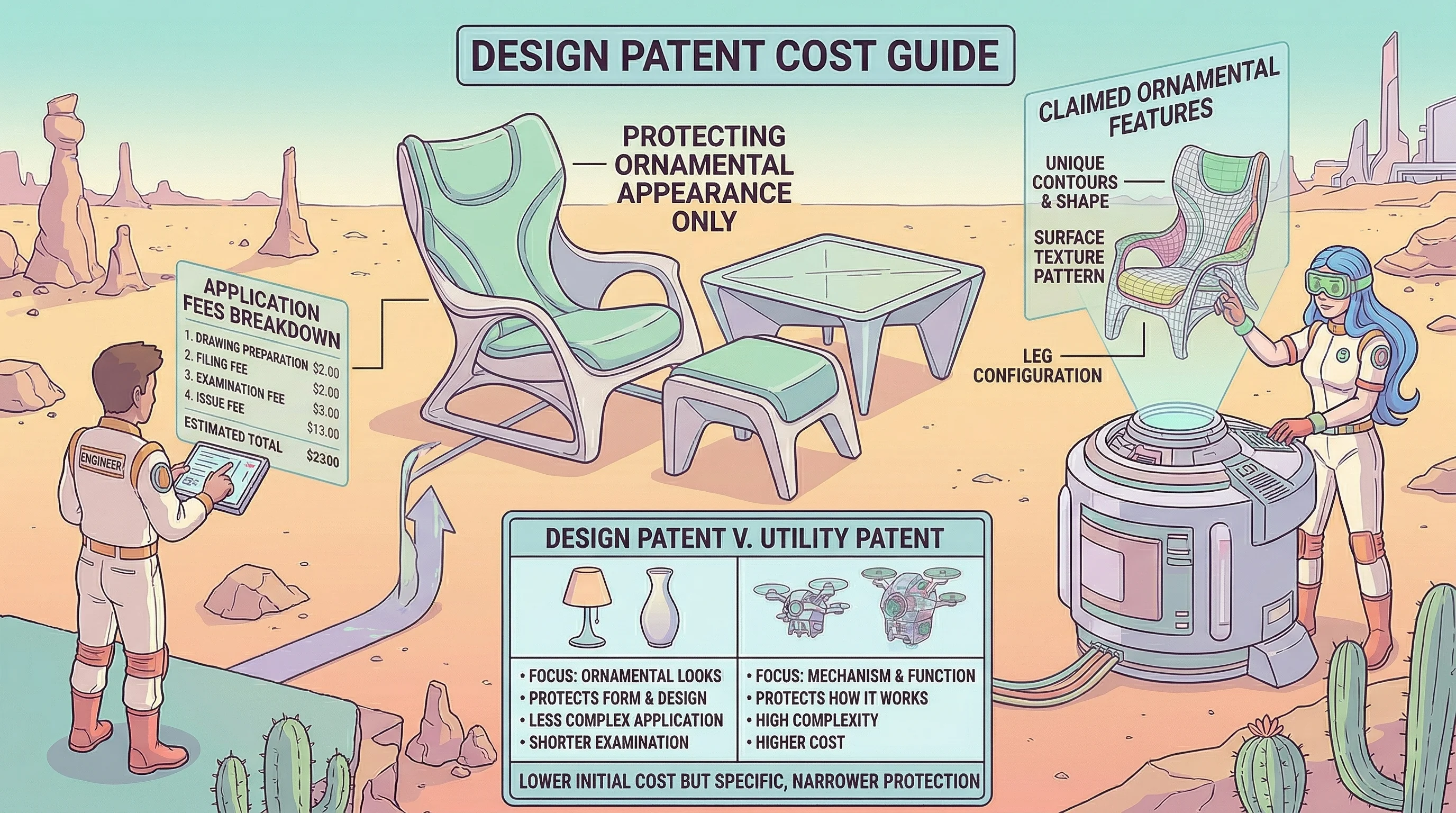
Design patents do not require any maintenance fees. Once granted, a design patent stays in force for 15 years from the grant date with no additional payments.
This is one of the financial advantages of design patents. The upfront cost is lower (typically $1,500 to $5,000) and there are zero ongoing costs. The tradeoff is that design patents only protect the ornamental appearance of an article, not how it works.
If your invention has both a functional mechanism and a distinctive visual design, you might file both a utility patent and a design patent. The utility patent will require maintenance fees. The design patent will not.
Provisional Patents: No Maintenance Fees
Provisional patent applications do not require maintenance fees. They cannot even be maintained past their initial 12-month term. A provisional simply expires after one year.
This is because a provisional is not a granted patent. It’s a placeholder filing that establishes your priority date. To get actual patent protection, you must file a non-provisional application before the provisional expires.
Once the non-provisional is granted, the maintenance fee clock starts. The fees are due based on the grant date of the issued patent, not the filing date of the provisional.
For more on how provisionals work and what they cost, see our patent cost guide.
Tips for Tracking Maintenance Fee Deadlines
The USPTO does not send reminders. This is the most common reason patents accidentally lapse. Here are practical ways to avoid that.
Set multiple calendar reminders. Put alerts at six months before, three months before, and the opening of each payment window. Use a calendar that won’t be deleted or lost.
Use the USPTO Patent Maintenance Fee page. You can look up your patent on the USPTO website and see upcoming fee due dates. Check this annually at minimum.
Hire a docketing service or patent attorney. Law firms and specialized services track these deadlines as part of their standard patent management. This costs money, but it is the most reliable method. If you have multiple patents, this becomes essential. Browse patent attorneys to find one who handles maintenance fee tracking.
Set up multiple payment methods. The USPTO accepts credit cards, deposit accounts, and electronic fund transfers. Don’t let a declined credit card or closed bank account cause you to miss a payment window.
Track the grant date, not the filing date. A common error is calculating deadlines from the application filing date. Maintenance fees are calculated from the date the patent is granted (issued). These dates are usually 18 to 36 months apart.
How Maintenance Fees Compare to Initial Filing Costs
Many inventors are surprised that the ongoing cost of a patent can rival the upfront cost. Here is how to think about it.
Filing a utility patent typically costs $5,000 to $15,000+ including attorney fees, USPTO fees, and office action responses. That gets the patent granted.
Maintaining that patent costs $3,365 to $13,460 over the next 12 years (depending on entity size). No attorney work is required for maintenance fee payments. You just pay the USPTO directly.
So the total cost of having a patent from start to finish is roughly twice what most people budget for the filing alone. If you’re planning to patent an invention, factor in the full lifecycle cost.
The good news: you do not have to maintain a patent for its full term. If the patent stops being commercially valuable, you can let it lapse at the next maintenance window. Many companies make strategic decisions to maintain only patents that still generate revenue or competitive advantage.
When to Let a Patent Lapse
Not every patent is worth maintaining for 20 years. Each maintenance window is a decision point. Here is how to think about it.
The patent is still generating revenue. If you’re licensing the patent or it protects a product you’re actively selling, pay the fee. The math is simple: if the patent generates more than it costs to maintain, keep it.
The market has moved on. Technology evolves. If your patent covers a method or product that the industry has abandoned in favor of something better, the competitive value of the patent may be zero. Paying $7,700 to protect something nobody wants to copy is a bad investment.
Maintenance cost exceeds licensing revenue. If you licensed the patent for $2,000 per year and the next maintenance fee is $7,700, you need to honestly assess whether licensing revenue will grow enough to justify the cost. If not, let it go.
The patent is purely defensive. Some companies maintain patents not to generate revenue but to prevent lawsuits. If the patent blocks a competitor from suing you over overlapping technology, it may be worth maintaining even without direct revenue. But if the litigation risk has passed, the defensive value drops.
You have a large portfolio. Companies with dozens or hundreds of patents should review the portfolio at each maintenance window and rank patents by commercial value. Letting low-value patents lapse frees budget for filing new applications on current technology. This is standard practice at companies of every size.
About 50% of patents lapse before the 11.5-year mark. Letting a patent expire is not failure. It is a rational economic decision that every patent holder should evaluate at each payment window.
One more thing. Maintenance fees apply only to US patents. If you file patents in other countries, each country has its own renewal schedule and fees. European patents, for example, require annual renewal fees that start much earlier and must be paid to each country where the patent is validated. International patent maintenance is significantly more expensive than US-only.
For help budgeting the full cost of patent protection, start with our patent cost calculator or talk to a patent attorney who can assess your specific situation.