An office action is a written communication from a USPTO patent examiner explaining why your patent claims cannot be allowed in their current form. If your patent application was rejected, this is the document that explains why and what you can do about it. It is not a final rejection of your invention. It is the start of a negotiation over exactly what your patent will cover.
About 86% of patent applications receive at least one office action. Responding costs $1,000 to $5,000 depending on the complexity of the issues raised. The typical application goes through 1 to 3 rounds of office actions before the patent is either granted or finally rejected.
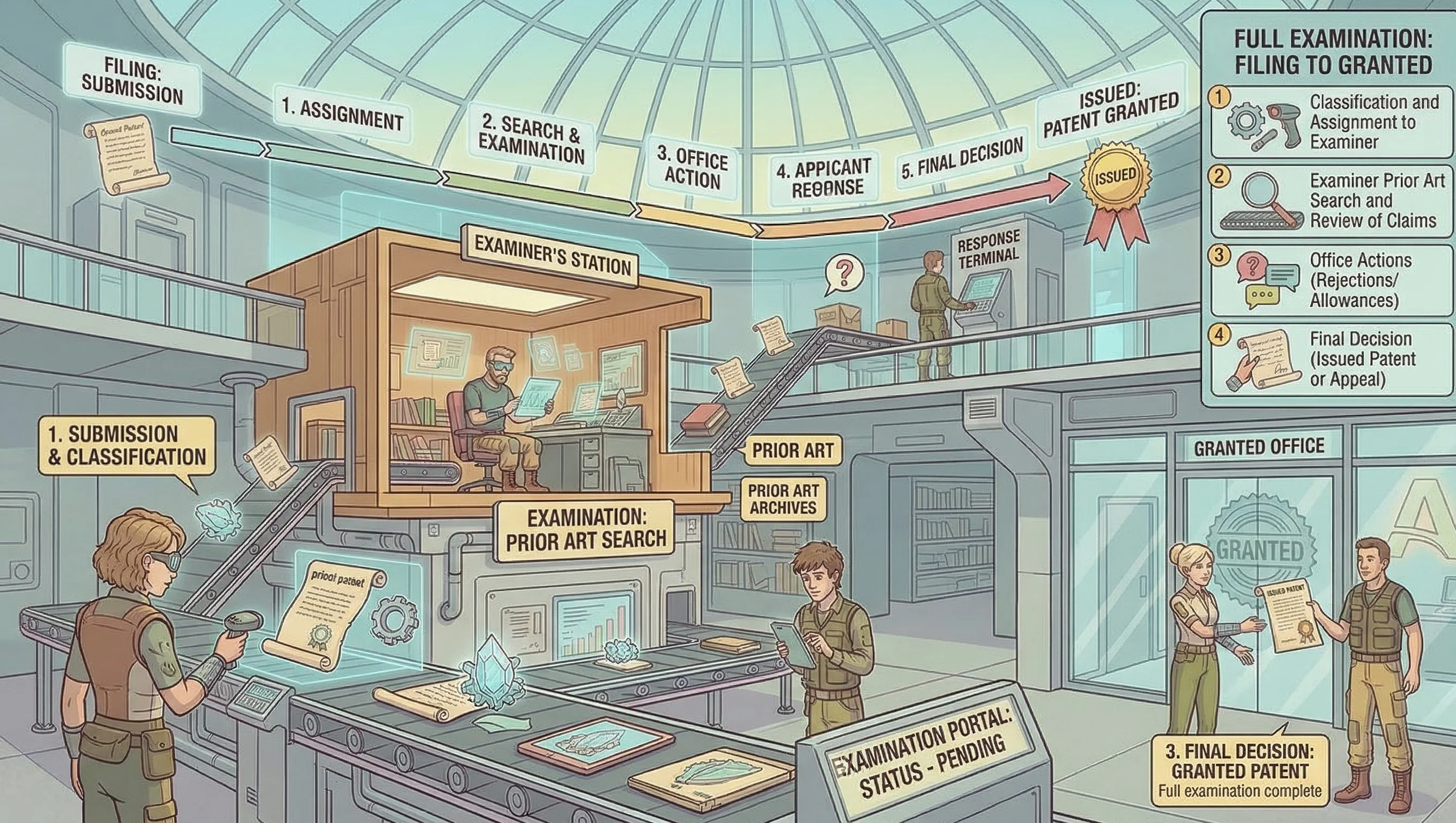
For an overview of the full examination process from filing to grant, see what happens after you file a patent application. This guide focuses specifically on understanding and responding to office actions.
Types of Office Actions
Non-Final Office Action
The first office action is almost always non-final. The examiner lays out every issue with your claims: prior art references that overlap with your invention, clarity problems in your claim language, and any eligibility concerns. You get one full opportunity to respond by arguing against the rejections, amending your claims, or both.
A non-final office action is routine. Do not panic when you receive one.
Final Office Action
If the examiner is not persuaded by your response to the non-final action, they issue a final office action. “Final” does not mean your application is dead. It means the examiner has considered your arguments and is maintaining the rejections, possibly with modified reasoning.
After a final office action, your options narrow. You can file a request for continued examination (RCE), appeal to the Patent Trial and Appeal Board (PTAB), or file a continuation application. More on those options below.
Restriction Requirement
If your application contains claims directed to more than one distinct invention, the examiner issues a restriction requirement before examining the substance. This forces you to choose which invention to pursue in this application. The other inventions can be filed as separate continuation applications later, each with its own filing fee.
Restriction requirements are common in applications covering both a product and a method, or multiple independent product variations. They add cost but do not kill the application. See can you include multiple inventions in one patent application for strategy around this.
Common Rejection Types
Each rejection in an office action cites a specific section of patent law:
| Rejection | Statute | What It Means |
|---|---|---|
| Anticipation | 35 U.S.C. 102 | A single prior art reference discloses every element of your claim |
| Obviousness | 35 U.S.C. 103 | A combination of references makes your claim obvious to someone skilled in the art |
| Indefiniteness | 35 U.S.C. 112 | Your claim language is unclear or ambiguous |
| Eligibility | 35 U.S.C. 101 | Your claim is directed to an abstract idea, law of nature, or natural phenomenon |
Section 102 (anticipation) is the most straightforward. The examiner found a patent or publication that describes your exact invention. Your response must show that the reference is missing at least one element of your claim, or that the reference does not actually teach what the examiner says it teaches.
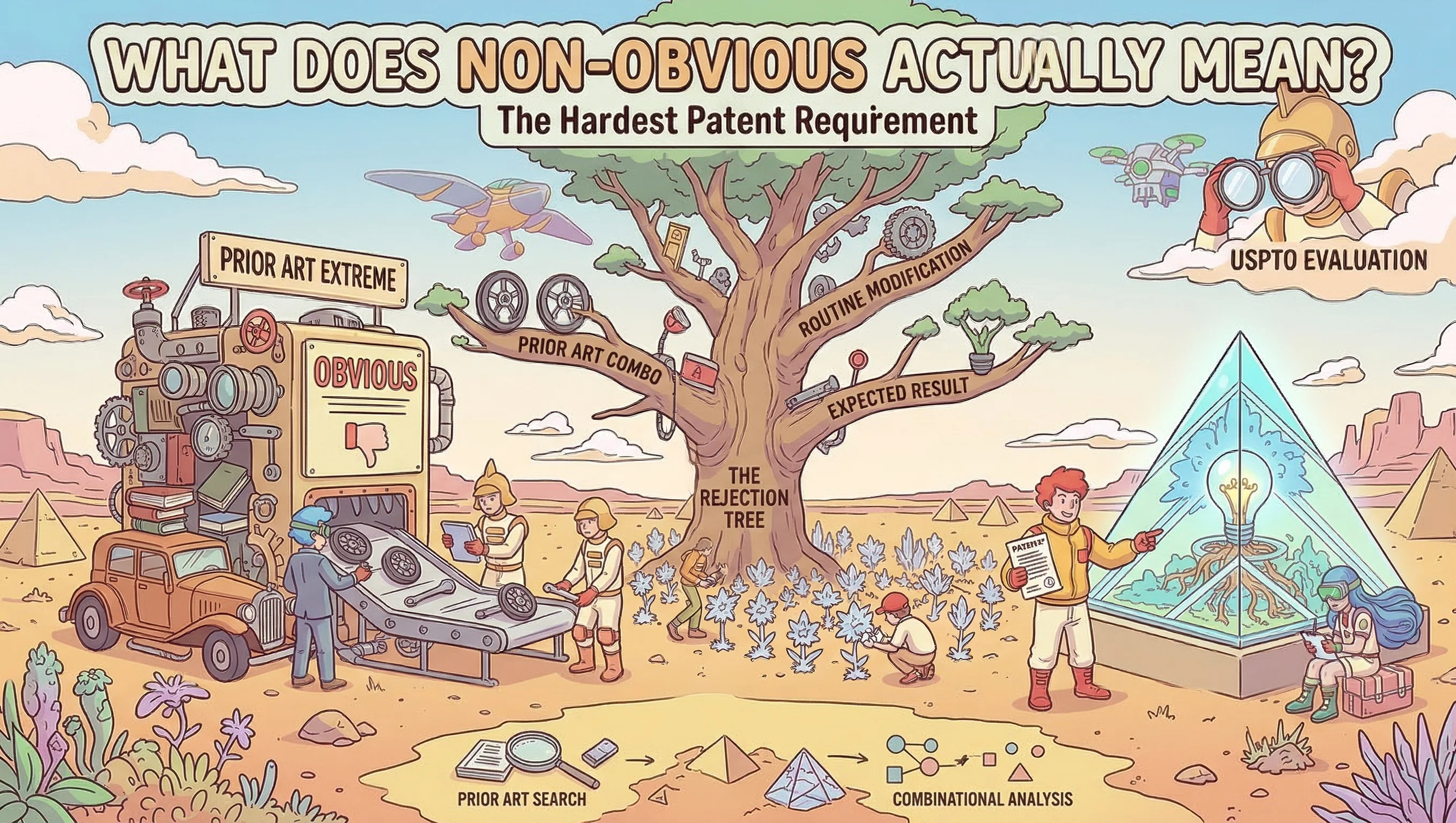
Section 103 (obviousness) is the most common rejection. The examiner combines two or more references and argues that a skilled person would find the combination obvious. Your response can challenge the combination logic, argue that the references teach away from combining, or present evidence of unexpected results. For more on this standard, see the non-obvious requirement explained.
Section 112 (indefiniteness) is usually fixable. The examiner wants clearer language. Amend the claims to use more precise terms and it is typically resolved.
Section 101 (eligibility) is the toughest rejection for software and biotech applications. It invokes the Alice test. For software-specific guidance, see how to patent software.
Deadlines and Extension Fees
Every office action comes with a 3-month response window from the mailing date. You can extend this by up to 3 months (to a maximum of 6 months total), but each extra month costs a fee.
| Extension | Micro Entity | Small Entity | Large Entity |
|---|---|---|---|
| 1st month (month 4) | $110 | $220 | $440 |
| 2nd month (month 5) | $110 | $220 | $440 |
| 3rd month (month 6) | $110 | $220 | $440 |
| Max extension cost | $330 | $660 | $1,320 |
Extension fees are cumulative. If you respond in month 5, you pay for both the 1st and 2nd month extensions.
Missing the 6-month deadline causes your application to go abandoned. You can petition to revive it ($850 for small entities), but revival is not guaranteed and adds months. Set calendar reminders for every office action deadline.
Most patent attorneys respond within the initial 3-month window to avoid extension fees and keep prosecution moving.
Response Strategies
You have three basic moves when responding to an office action, and you can combine them:
1. Argue (Traverse the Rejection)
Challenge the examiner’s reasoning without changing your claims. This works when:
- The examiner misread a prior art reference
- The combination of references does not actually teach your claimed features
- The examiner applied the wrong legal standard
A strong argument cites specific passages of the prior art and explains, element by element, why your claims are different. Generic statements like “the references do not teach the claimed invention” will not persuade the examiner.
2. Amend the Claims
Narrow or clarify your claims to avoid the cited prior art. This is the most common response. You add limitations that distinguish your invention from what the examiner found.
The trade-off: narrower claims are easier to get granted but protect less. Before amending, consider whether the narrower claim still covers the products you want to protect. See broad vs. narrow claims for the strategic implications.
3. Request an Examiner Interview
Call or video-conference with the examiner before filing your written response. This is one of the most underused tools in patent prosecution. An interview lets you:
- Understand exactly what the examiner thinks is missing
- Propose amendments informally and get real-time feedback
- Resolve misunderstandings that would take months to sort out on paper
Vic Lin at iCap Law (patenttrademarkblog.com) recommends requesting an interview for any office action that involves a 103 (obviousness) rejection with multiple references. The examiner can often tell you in 15 minutes what specific limitation would overcome the rejection.
Interviews are free. Your attorney typically charges $300 to $800 for prep and attendance.
Response Cost
| Complexity | Attorney Fee | When |
|---|---|---|
| Simple (1 to 2 rejections, minor amendments) | $1,000 to $2,500 | Clear path forward, straightforward prior art |
| Moderate (3+ rejections, substantial arguments) | $2,500 to $4,000 | Multiple prior art references, some 101 issues |
| Complex (Alice/101 issues, appeal-level arguments) | $3,500 to $5,000+ | Software eligibility, biotech written description |
These are attorney fees only. Add USPTO extension fees if you respond after month 3.
For a full breakdown of patent costs from start to finish, see the patent cost guide.
What Happens After a Final Rejection
A final rejection is not the end. You have three main options:
Request for Continued Examination (RCE)
An RCE reopens prosecution. You pay a filing fee ($480 for small entities, $960 for large), submit amended claims or new arguments, and the examiner starts a new round of examination.
Pros: Keeps the original application alive. You can submit new evidence or arguments. Cons: Costs money. Resets the examination queue. Adds 6 to 12 months to the timeline.
RCE is the most common path after a final rejection. Many patents are ultimately granted after one or two RCEs.
Appeal to the PTAB
File an appeal with the Patent Trial and Appeal Board. A panel of three administrative patent judges reviews the examiner’s rejections.
Pros: Gets a fresh set of eyes. PTAB reverses examiners roughly 40% of the time (fully or partially). Cons: Expensive ($2,000 to $6,000 in attorney fees plus a $640 to $1,280 appeal fee). Slow (12 to 18 months for a decision). If you lose, options are very limited.
Appeal makes sense when the examiner is wrong on the law or facts and further argument will not change their mind.
Continuation Application
File a new application claiming the benefit of the original filing date. This lets you present new claims while keeping the priority date.
Pros: Clean slate with potentially a new examiner. Can refocus claims based on what you learned during prosecution. Cons: New filing fee ($800 to $1,600 for small entities). Starts the examination process over. Adds 2+ years.
Continuations are strategic when the original claims were too broad and you want to pursue narrower but still valuable claims.
| Option | Cost (Small Entity) | Added Time | Best When |
|---|---|---|---|
| RCE | $480 + attorney fees | 6 to 12 months | Close to allowance, minor issues remain |
| PTAB appeal | $640 + $2,000 to $6,000 attorney | 12 to 18 months | Examiner is wrong on the law |
| Continuation | $800 to $1,600 + attorney fees | 2+ years | Need to reframe claims entirely |
When to Hire an Attorney for Office Action Response
If you filed your application yourself using the DIY approach, an office action is the point where most inventors benefit from professional help. The legal arguments required, especially for 103 (obviousness) rejections, involve case law and claim construction techniques that are difficult to learn on the fly.
Even if you want to draft the initial response yourself, consider paying for an examiner interview with an attorney. The interview alone can save you from filing an ineffective response that leads to a final rejection.
Find a patent attorney in the patent attorney directory or use the patent cost calculator to estimate total prosecution costs including office action responses.
The Bottom Line
Office actions are normal. Most patents go through at least one round. The key is responding strategically: understand the rejection type, choose between arguing and amending, and use examiner interviews to get direct feedback. Budget $1,000 to $5,000 per response, and factor in 1 to 3 rounds when estimating your total patent cost.