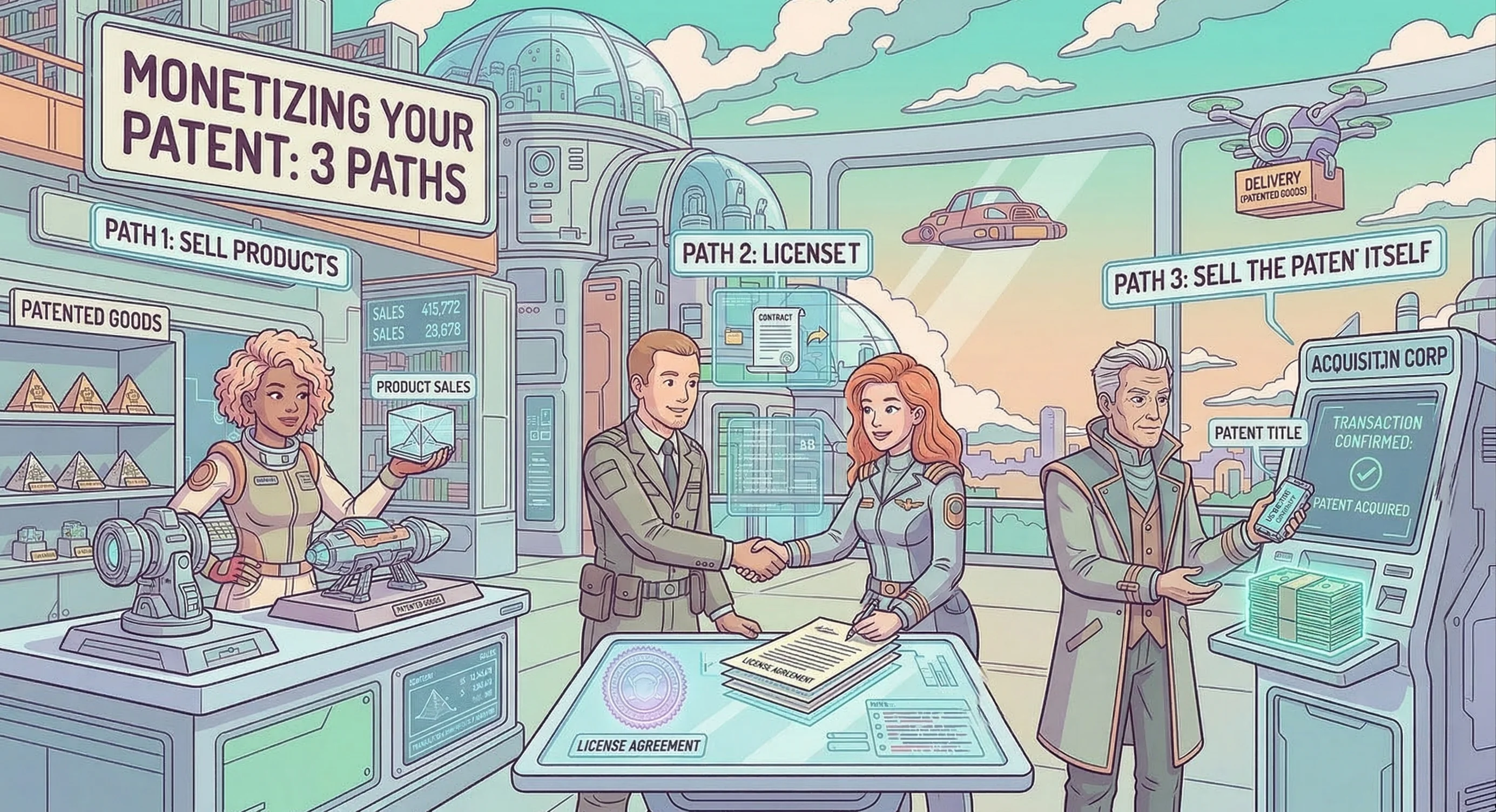
Three ways to make money from a patent: sell products with patent protection so competitors cannot copy you, license it to other companies for 2-5% royalties, or sell the patent outright for $10,000 to $500,000+. Most inventors profit by selling the patented product themselves.
A granted patent gives you the legal right to exclude others from making, using, or selling your invention for 20 years. That exclusion right is a business asset, but only if you do something with it.
Path 1: Sell Products (Exclusion Advantage)
You make and sell the patented product yourself. The patent prevents competitors from copying it.
The economics are straightforward. Without a patent, a competitor can buy your product, reverse-engineer it, and sell a knockoff at a lower price because they did not pay for the R&D. With a patent, they cannot do that legally. You maintain pricing power and market share because you are the only authorized source.
This is especially valuable for products sold on Amazon, where counterfeiters and listing hijackers are a constant problem. A patent gives you access to Amazon’s Brand Registry and APEX program, which are the strongest enforcement tools available on the platform.
When this works best: You have manufacturing capability. Your product has a clear market. Competitors are likely to copy successful products in your category.
What it requires: Strong structural claims that cover the features competitors would need to copy. Vague claims make enforcement difficult because they leave room for design-arounds.
Path 2: License the Patent
Licensing means granting another company permission to use your patented invention in exchange for royalty payments. You keep the patent. They pay you a percentage of sales (typically 2-5% for consumer products, higher for specialized technology) or a flat licensing fee.
Licensing makes sense when someone else is better positioned to manufacture, market, or distribute the product. Maybe they have the factory capacity, the retail relationships, or the brand recognition. Instead of competing with their infrastructure, you let them use your invention and collect a royalty.
The patent is what makes licensing possible. Without it, the company could copy your idea without paying you.
When this works best: A larger company already operates in your market. You do not want to manufacture yourself. Multiple companies could use your technology.
What it requires: A strong patent with broad claims that clearly cover the feature being licensed. If claims are narrow, the licensee can design around them instead of paying.
Important: Most licensing deals happen after the patent is granted, not while the application is pending. Companies are more willing to pay royalties when they can see the actual claims that issued.
License Types
Not all licenses are the same. The structure you choose determines how much control you retain and how much revenue you can generate.
| License Type | What It Means | When to Use |
|---|---|---|
| Exclusive | Only one licensee can use the patent. You may or may not retain rights to use it yourself. | When one company will pay a premium for sole access. Exclusive licenses command higher royalties. |
| Non-exclusive | Multiple licensees can use the patent at the same time. | When the technology has broad applicability across an industry. More licensees means more total revenue, even at lower individual rates. |
| Field-of-use exclusive | Exclusive within a specific industry or application, but you can license to other industries separately. | When the technology applies to multiple industries with different leaders. For example, exclusive for medical devices but non-exclusive for consumer electronics. |
An exclusive license is not the same as selling the patent. You still own it. The licensee is paying for the right to be the only one using it. That exclusivity is valuable, so exclusive licenses typically command 2x to 3x the royalty rate of non-exclusive deals.
Typical Royalty Rates by Industry
Royalty rates vary by industry because margins, competitive dynamics, and the relative value of the patented feature differ across sectors.
| Industry | Typical Royalty Rate (% of net sales) |
|---|---|
| Consumer products | 2 to 8% |
| Electronics / hardware | 1 to 5% |
| Software / technology | 5 to 15% |
| Medical devices | 4 to 12% |
| Pharmaceuticals | 8 to 25% |
| Industrial / machinery | 2 to 6% |
Pharma rates are highest because a single patent can protect a molecule worth billions in annual sales. Consumer product rates are lower because margins are thinner and design-arounds are easier. Software sits in the middle: patents on core algorithms or architectures command strong rates, while patents on minor UI features trade at the low end.
Many license agreements also include an upfront payment that the licensee pays regardless of future sales. These range from $10,000 to several million dollars depending on patent value and negotiating leverage.
Some deals include minimum annual royalties. These floors guarantee you receive a baseline payment even if the licensee’s sales are low. Minimum royalties protect against a licensee who takes an exclusive license and then sits on the technology.
Finding Licensees
The hardest part of licensing is not negotiating the deal. It is finding companies willing to have the conversation.
Identify companies already in your space. If a company sells products that your patent covers, they either need a license or are infringing. Search Amazon, industry directories, and trade publications to find companies in adjacent product categories.
Industry conferences and trade shows. Exhibitors are active market participants with real products. Walk the floor, identify companies whose products overlap with your claims, and approach their business development contacts. A face-to-face introduction is worth more than a cold email.
LinkedIn outreach. Search for “business development,” “licensing,” or “IP” roles at target companies. A short, specific message explaining what your patent covers and why it is relevant to their product line is more effective than a generic pitch.
Check USPTO assignment records. Companies that have licensed patents in the past are more likely to license again. The USPTO assignment database shows who licenses what.
Patent brokers. If you do not want to do outreach yourself, patent brokerage firms connect patent owners with licensees. They handle marketing, valuation, and negotiation. The tradeoff: brokers typically take 15 to 30% of licensing revenue as commission. That is significant, but a broker with industry connections can reach companies you could not access on your own.
How to make initial contact. Start with a brief introduction letter or email to the company’s business development or IP department. Describe your patent, its application, and why it is relevant to their business. Do not accuse them of infringement in the first message. Accusations create defensiveness. The most productive licensing conversations start as business discussions about mutual benefit.
Path 3: Sell the Patent
You can sell (assign) a patent outright. The buyer gets full ownership, including the right to enforce it, license it, or use it however they want. You get a one-time payment.
Patent sales happen in several contexts: a company acquires your startup and the patents come with it, a competitor buys your patent to remove it as a threat, you exit an industry and sell the IP as an asset.
When this works best: You are exiting the business. The patent covers technology more valuable to someone else. You need capital now rather than ongoing royalties.
What it requires: A granted patent with clear, enforceable claims. The buyer evaluates scope, remaining term, and market size.
Three Tests Before You File
Understanding these paths helps you make better decisions before filing:
1. Is it patentable? Does the invention have novel, non-obvious structural features? A patent search answers this. See the three requirements for patentability.
2. Is it detectable? If a competitor copied your invention, could you tell? For physical products, the answer is almost always yes because you can buy the competing product and compare it to your claims. For internal manufacturing processes, detection is harder, which is why those are often better protected as trade secrets.
3. Is it monetizable? Does the patent cover a product that generates revenue (Path 1), that other companies would pay to use (Path 2), or that a buyer would want to own (Path 3)? If none of these apply, the patent may not justify the filing cost.
If your invention clears all three, it is worth filing. Find a patent attorney in the directory or estimate costs with the patent cost calculator.
.webp)