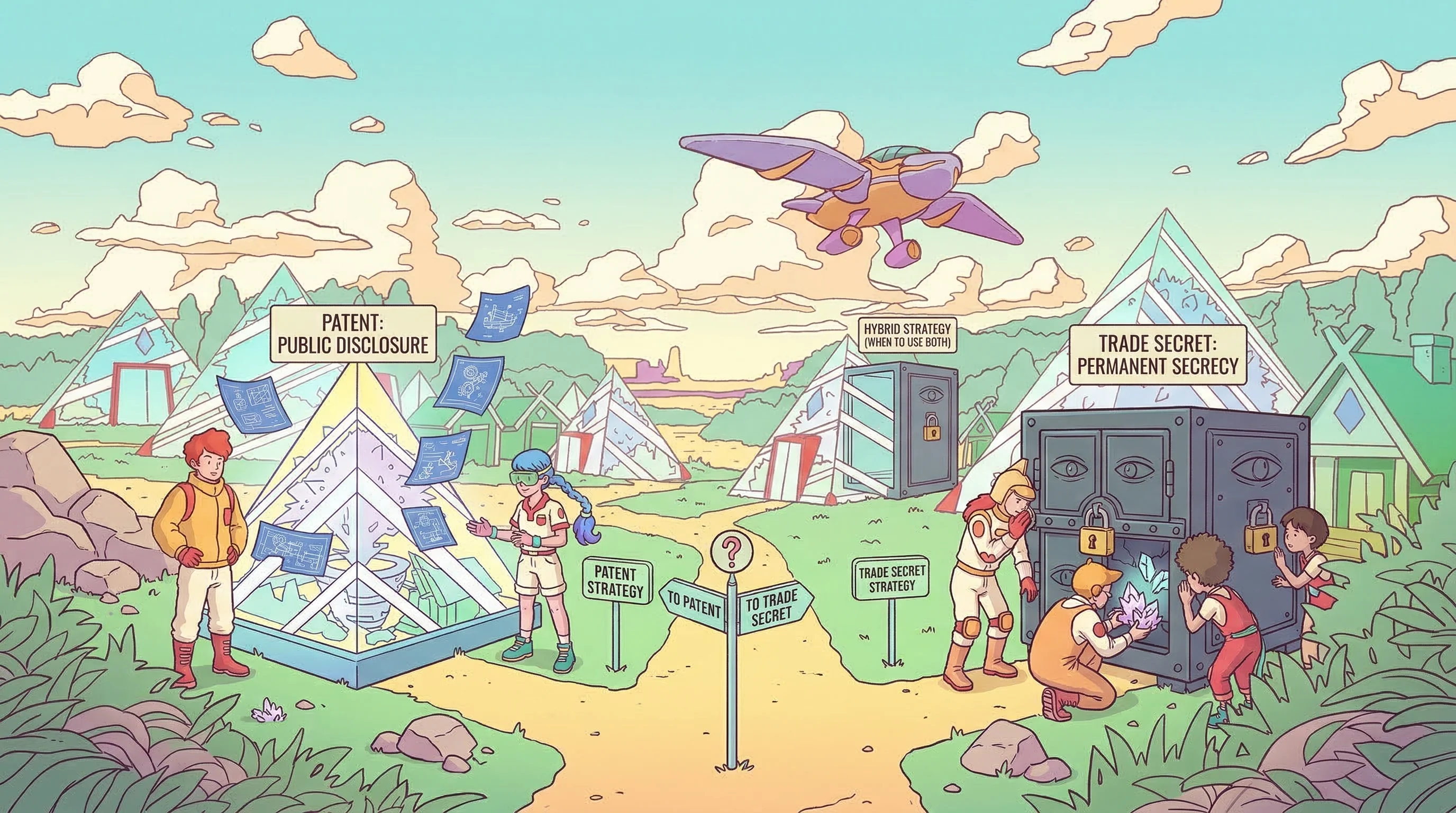
A patent gives you 20 years of enforceable exclusivity but requires full public disclosure of how your invention works. A trade secret lasts indefinitely but dies the moment someone reverse-engineers it or an employee leaks the information. The right choice depends on what your invention is, how it is manufactured, and whether competitors could figure it out from the finished product.
How Patents Work
When you file a patent, you are entering a deal with the government. You disclose your invention to the public in complete detail (the specification), and in exchange, the government grants you the exclusive right to make, use, and sell that invention for 20 years from your filing date.
After 20 years, the patent expires and your invention enters the public domain.
Key characteristics:
- Protection lasts 20 years (utility) or 15 years (design)
- Requires full public disclosure
- Enforceable against independent inventors (even if they never saw your patent)
- Requires filing fees, drafting costs, and maintenance fees
- Can be licensed, sold, or used as collateral
- Publishes approximately 18 months after filing
How Trade Secrets Work
A trade secret is any information that derives value from being secret and that you take reasonable steps to keep secret. There is no filing, no examination, no registration.
Key characteristics:
- Protection lasts indefinitely (as long as secrecy is maintained)
- No filing required, no government fees
- Lost immediately if the secret becomes public
- NOT enforceable against independent discovery
- NOT enforceable against reverse engineering
- Requires active secrecy measures (NDAs, restricted access, security protocols)
Three Questions to Decide
1. Can competitors reverse-engineer your invention?
If your product is sold to the public and a competitor can buy one, take it apart, and understand how it works, trade secret protection is worthless. They will figure it out, and you will have no legal recourse because reverse engineering is legal.
This applies to almost every physical consumer product. If you sell a kitchen tool, phone case, or furniture piece, anyone can purchase it and study the mechanism. For these products, a patent is the right choice.
Trade secrets work better for processes, formulas, and manufacturing methods that are not visible in the final product.
2. How long do you need protection?
If your product’s competitive advantage will last more than 20 years, a trade secret might be worth considering. If the advantage has a shorter lifespan (which is true for most consumer products, where cycles run 3-7 years), a patent’s 20-year term is more than enough.
3. Is the secret maintainable?
Trade secrets require organizational discipline. Every employee, contractor, and manufacturer who touches the information needs an NDA. Access must be restricted. If you are a solo inventor working with overseas manufacturers, maintaining true secrecy is extremely difficult.
When Patents Are the Clear Choice
- Physical products are reverse-engineerable. If someone can buy your product and understand how it works, you need patent protection.
- You need enforcement tools. Patents give you legal standing to stop copycats, send cease-and-desist letters, and file infringement lawsuits. Trade secrets do not give you these tools unless someone actively stole the information.
- You plan to raise investment. Investors want patents because they represent a defensible moat. Trade secrets are harder to evaluate and easier to lose.
- You want to license. Licensing a patent is straightforward because the scope is defined in the claims. Licensing a trade secret requires elaborate confidentiality agreements.
When Trade Secrets Make Sense
- Manufacturing processes. If your edge is how you make the product and that process is not visible in the final product, a trade secret keeps it protected indefinitely.
- Formulas and recipes. Compositions that are difficult to analyze (chemical formulations, material blends) may be better kept secret than disclosed in a patent that expires.
- Internal business methods. Pricing algorithms, customer acquisition strategies, supplier relationships. These are typically not patentable anyway.
Using Both Together
The best strategy for many product companies is to combine both. Patent the product itself (the structural features, the mechanism, the design) and keep your manufacturing processes as trade secrets.
Example: an inventor with a new foam roller design might patent the roller’s geometry, surface texture pattern, and internal support structure. At the same time, they keep their specific material formulation and manufacturing process as trade secrets. The patent protects the product from copycats. The trade secret protects the manufacturing edge.
Industry-Specific Guidance
The right strategy varies by industry. Here is a general breakdown.
| Industry | Best Strategy | Why |
|---|---|---|
| Consumer products | Patent | Products are sold publicly and can be reverse-engineered |
| Software | Often both | Patent the user-facing method, keep algorithms as trade secrets |
| Food and beverage | Trade secret | Formulas and recipes are hard to reverse-engineer from the final product |
| Manufacturing | Often both | Patent the product, keep the manufacturing process secret |
| Pharmaceuticals | Patent | Required for FDA approval process and regulatory exclusivity |
| Chemical formulations | Depends | Patent if easily analyzed; trade secret if composition is hard to determine |
Most companies do not fall cleanly into one category. A food company might patent a new packaging mechanism while keeping the recipe secret. A software company might patent a user-facing feature while keeping its training data and optimization algorithms confidential. The table above is a starting point. Your specific invention, competitive environment, and business model will determine the final mix.
Real-World Examples
Coca-Cola’s formula. Coca-Cola has kept its syrup formula as a trade secret since 1886. That is over 130 years of protection with no expiration date. A patent would have given them 20 years and then handed the formula to every competitor in the world. For a recipe that cannot be reverse-engineered from the final product, permanent secrecy was the better bet.
WD-40. The WD-40 Company has never patented its signature formula. The recipe stays locked in a vault, known to only a few employees at any given time. Like Coca-Cola, they decided that the formula’s value comes from secrecy, not from a time-limited government monopoly. If they had patented it in 1953, the formula would have been public domain since 1973.
Dyson vacuum cyclone technology. James Dyson took the opposite approach. His cyclone separation technology is visible in the product itself. Anyone who buys a Dyson vacuum can see the cyclone chambers. Reverse engineering is trivial. Dyson filed over 1,000 patents to protect his designs. Without patents, competitors would have copied the technology within months.
Pharmaceutical patents and FDA exclusivity. Drug companies patent their compounds because the FDA approval process requires full disclosure of the drug’s composition and mechanism. You cannot get a drug approved while keeping the formula secret. Patents also unlock regulatory exclusivity periods that prevent generic manufacturers from entering the market. For pharmaceuticals, patents are not optional. They are the only viable protection strategy.
Cost Comparison
Trade secrets cost less upfront but require ongoing investment in security measures.
Trade secret costs:
- NDA drafting: $500 to $2,000 per agreement (or use templates for less)
- Security measures: varies widely (access controls, employee training, document management)
- No government filing fees
- No expiration, so no renewal fees
- Ongoing cost: maintaining secrecy protocols for as long as the secret exists
Patent costs:
- Total cost for a utility patent: $5,000 to $15,000 (including attorney fees, filing fees, and prosecution)
- Maintenance fees over 20 years: $3,365 total for micro entities ($6,730 for small entities)
- Design patents: lower upfront cost, no maintenance fees
- Fixed timeline: costs are predictable and finite
For a detailed breakdown of patent costs, see the patent cost guide. For maintenance fee schedules and deadlines, see the maintenance fees guide.
The cost difference matters most for solo inventors and small companies. If you are bootstrapping, trade secret protection costs almost nothing to start. A patent requires thousands of dollars upfront. But if your product is visible and copyable, that upfront investment is the only thing standing between you and cheap knockoffs.
The Provisional as Insurance
If you are not ready to commit to a full patent but want to protect your position, a provisional patent application acts as insurance. It establishes a filing date and stops the 12-month disclosure clock from working against you. If you later decide not to pursue the full patent, you can let the provisional expire and maintain the trade secret instead.
For the fundamentals of patentability, see the three requirements. For cost details, see the patent cost guide. Find a patent attorney in the directory or estimate costs with the patent cost calculator.
.webp)