A patent costs $5,000 to $15,000+, a copyright costs $45 to $125, and a trademark costs $250 to $750 in government fees alone. These three forms of intellectual property (IP) protect completely different things: patents cover inventions, copyrights cover creative works, and trademarks cover brand names. Most people only need one. Some products need all three.
Quick Comparison
| Patent | Copyright | Trademark | |
|---|---|---|---|
| Protects | Inventions, processes, designs | Creative works (books, code, music, art) | Brand names, logos, slogans |
| Duration | 20 years (utility), 15 years (design) | Life of author + 70 years | Indefinite (with renewal every 10 years) |
| Cost | $5,000 to $15,000+ | $45 to $125 | $250 to $750 filing + $1,000 to $3,000 attorney |
| Registration required? | Yes, must be granted by USPTO | No, automatic at creation. Registration optional but recommended | No, common law rights exist. Registration gives stronger protection |
| Federal agency | USPTO | U.S. Copyright Office | USPTO |
| How long to get | 2 to 3 years | 3 to 6 months | 8 to 12 months |
The biggest difference: patents require examination and approval. Someone at the USPTO reads your application and decides whether your invention is new and non-obvious. Copyright and trademark registration are simpler processes with much higher approval rates.
Patents
A patent gives you the exclusive right to make, use, and sell an invention for a limited time. In exchange, you publicly disclose how the invention works. It is a deal with the government: you share the knowledge, and they give you a temporary monopoly.
Patents are the most expensive and most difficult form of IP protection to obtain. They are also the most powerful for physical products and technical inventions.
What Patents Protect
Patents cover inventions: new and useful processes, machines, manufactures, and compositions of matter. The invention must be:
- Novel (nobody has done it before)
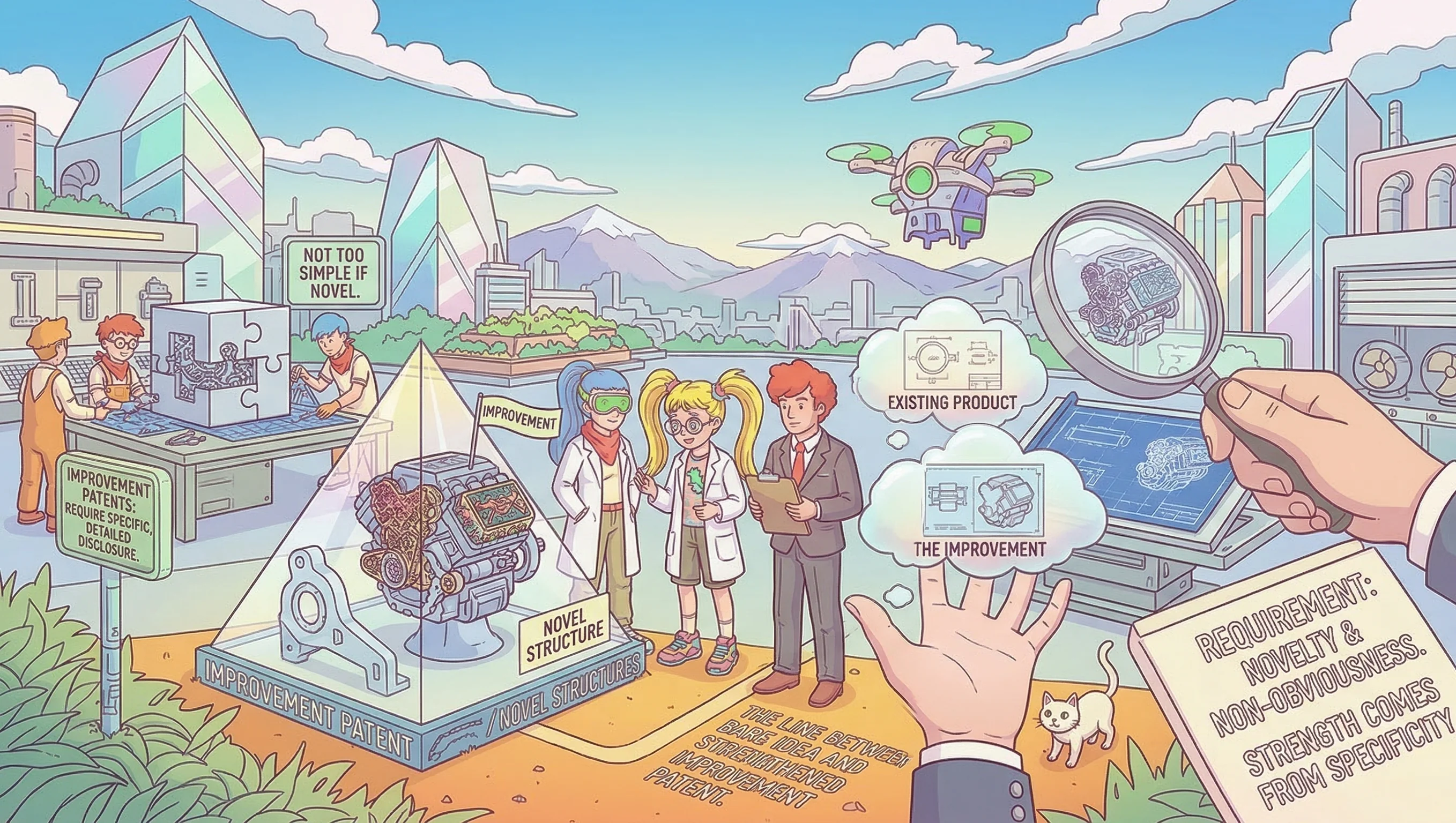
- Non-obvious (not a trivial combination of known things)
- Useful (it actually works and has a practical application)
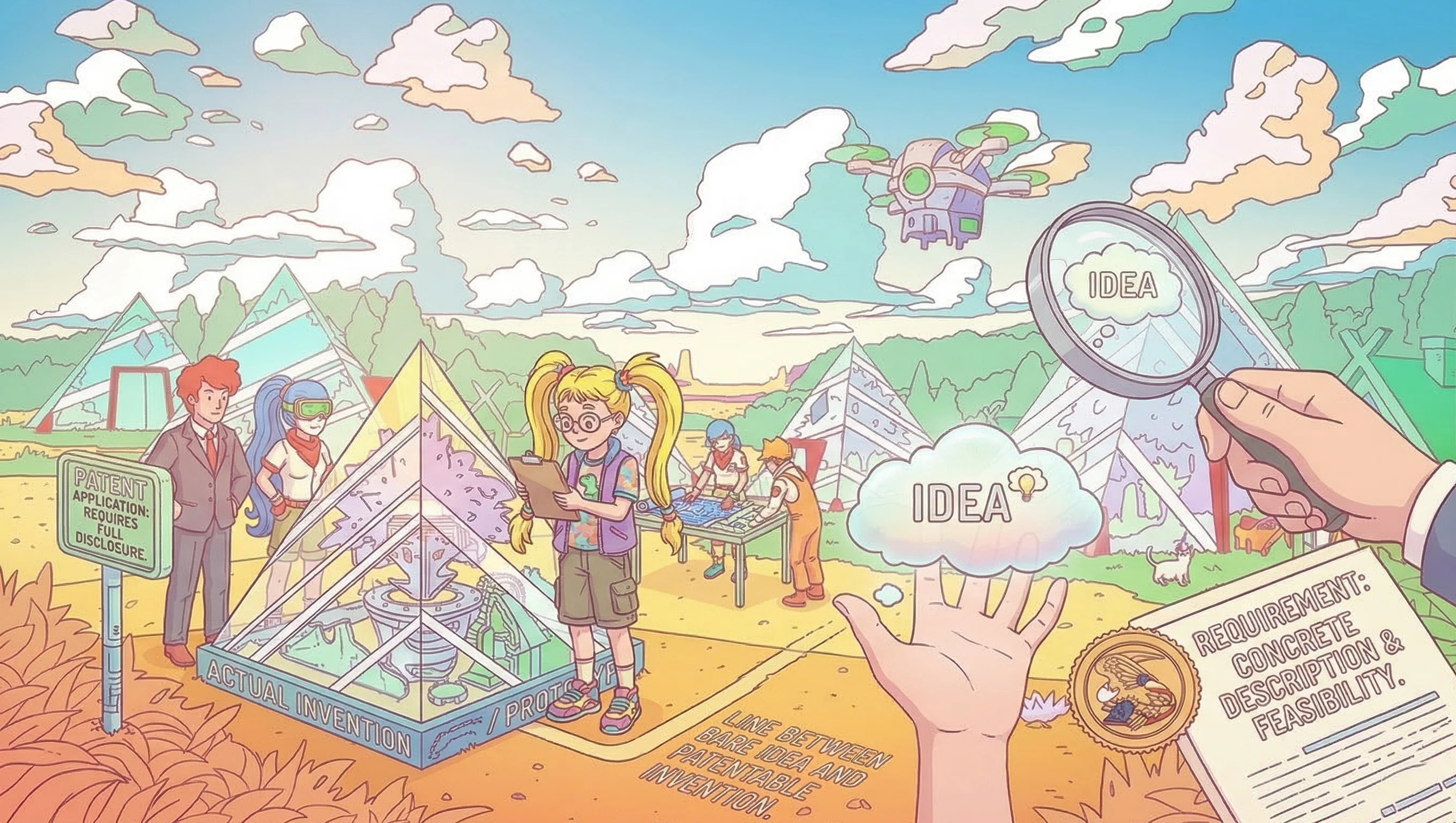
You cannot patent abstract ideas, laws of nature, or mathematical formulas on their own. You can patent a specific machine or process that applies those principles in a new way. For a deeper look at what qualifies, see our guide on whether you can patent an idea.
Types of Patents
Utility patents cover how something works. This is what most people mean when they say “patent.” A new type of engine, a chemical process, a software method. Duration: 20 years from filing date.
Design patents cover how something looks. The ornamental appearance of a functional item, not how it works. A distinctive shoe shape, a unique phone case pattern. Duration: 15 years from grant date.
Plant patents cover new varieties of asexually reproduced plants. Unless you are in agriculture, this is not relevant to you.
What Patents Cost
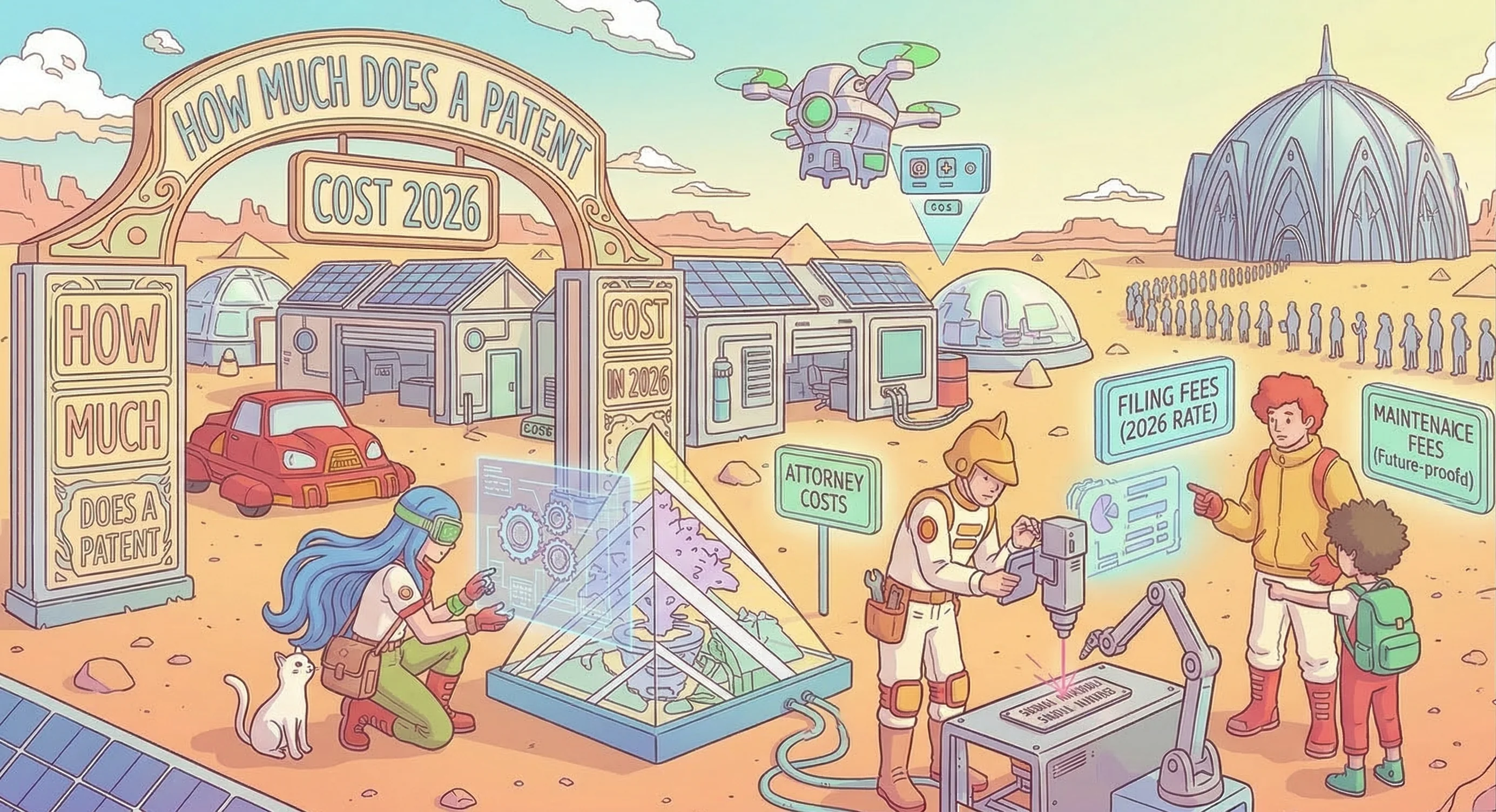
A utility patent typically costs $5,000 to $15,000+ in total, including attorney fees and USPTO filing fees. For a detailed breakdown, see our patent cost guide or try the patent cost calculator.
The major expenses:
- USPTO filing fees: $800 to $1,600 (micro-entity pays 25% of full fees)
- Attorney drafting fees: $4,000 to $12,000+
- Maintenance fees: $400 to $3,760 at years 3.5, 7.5, and 11.5
Design patents cost less, typically $2,000 to $4,000 total.
The Patent Process
- Conduct a prior art search
- Draft the patent application (specification + claims)
- File with the USPTO
- Wait for examination (12 to 24 months)
- Respond to office actions (rejections or requests for clarification)
- Receive grant or final rejection
The whole process takes 2 to 3 years on average. Some applications take longer. You can file a provisional patent application first to establish an early filing date while you prepare the full application.
When You Need a Patent
You need a patent if:
- You invented a product or process and want to stop competitors from copying it
- You plan to license the technology to others
- You need IP assets for fundraising or acquisition
- Your competitive advantage is in how your product works, not just your brand
You probably do not need a patent if your innovation is in content, design, branding, or a business model that is hard to define as a technical process.
Copyright
Copyright protects original creative works from being copied. It is automatic, free, and lasts a very long time.
The moment you write a sentence, paint a picture, compose a song, or write a line of code, you own the copyright. No registration required. No fees. No application. You created it, you own it.
What Copyright Protects
Copyright covers “original works of authorship fixed in a tangible medium.” In plain English: creative works you can see, hear, or read. This includes:
- Books, articles, blog posts
- Music and lyrics
- Photographs and illustrations
- Software source code
- Movies and videos
- Architectural drawings
- Sculptures and visual art
Copyright does NOT protect:
- Ideas (only the specific expression of an idea)
- Facts or data
- Titles, names, or short phrases (those might be trademarks)
- Functional elements of a design (those might be patents)
- Anything in the public domain
Duration
For works created today: life of the author plus 70 years. If the work is made for hire (created by an employee for a company), it is 95 years from publication or 120 years from creation, whichever is shorter.
This is far longer than any other form of IP protection. A patent filed today expires in 2046. A copyright on something you create today could last until 2150 or later.
Cost
Creating the copyright: $0. It is automatic.
Registering the copyright with the U.S. Copyright Office: $45 to $125 depending on the type of work and filing method. The online system (eCO) is cheapest.
Automatic vs. Registered Copyright
You own the copyright the moment you create the work. So why register?
Registration gives you two critical things in a lawsuit:
- Statutory damages: Without registration, you can only sue for actual damages (what you lost + what they gained). With registration, you can claim $750 to $30,000 per work infringed, or up to $150,000 for willful infringement. That is often more than actual damages.
- Attorney fees: Only available if you registered before the infringement began (or within 3 months of publication).
You also need a registration to file a copyright infringement lawsuit in the first place, though you can register after discovering the infringement.
When You Need to Register
Register your copyright if:
- The work has significant commercial value
- You are distributing software or publishing content commercially
- You want the strongest legal position against copiers
- You are licensing the work to others
For a personal blog post or an internal company document, registration is usually not worth the effort.
Trademarks
A trademark protects your brand identity: the name, logo, slogan, or other marker that tells customers “this product comes from this company.” Unlike patents and copyrights, trademarks can last forever.
What Trademarks Protect
Trademarks cover any word, phrase, symbol, design, or combination that identifies and distinguishes the source of goods or services. Examples:
- Word marks: Apple, Nike, Google
- Logos: The Nike swoosh, the Apple apple, the McDonald’s arches
- Slogans: “Just Do It,” “Think Different”
- Trade dress: The distinctive shape of a Coca-Cola bottle, the layout of an Apple Store
- Sounds: The NBC chimes, the Intel bong
- Colors: Tiffany blue (in the context of jewelry packaging)
The key requirement: the mark must be distinctive. It must identify YOUR products as different from everyone else’s. Generic terms (“Computer Store”) cannot be trademarked. Descriptive terms (“Fast Computer Repair”) are difficult. Made-up words (“Xerox”) and suggestive terms (“Coppertone”) are strongest.
Duration
Trademarks last indefinitely, as long as you:
- Continue using the mark in commerce
- File maintenance documents between years 5 and 6
- Renew every 10 years
A trademark you register today and keep using could protect your brand for 100 years or more. But if you stop using it, you lose it.
Common Law vs. Registered Trademarks
You get some trademark rights just by using a mark in commerce. This is “common law” trademark. You can use the TM symbol without registering anything.
Registering with the USPTO (which earns you the circle-R symbol) gives you:
- Nationwide priority (common law rights only cover your geographic area)
- Presumption of ownership in court
- Ability to sue in federal court
- Listing in the USPTO database (which deters others from using similar marks)
- Basis for international registration
What Trademarks Cost
USPTO filing fees: $250 to $750 per class of goods/services, depending on which filing basis and form you use. TEAS Plus ($250) is cheapest but requires selecting from pre-approved descriptions.
Attorney fees: $1,000 to $3,000 for a trademark search and application. Some people file without a lawyer, but a comprehensive search beforehand is important. Filing a mark that conflicts with an existing registration wastes your filing fee and your time.
Total cost: $1,250 to $3,750 for one class, including attorney fees.
Trade Dress
Trade dress is a type of trademark that protects the overall commercial appearance of a product. This includes its shape, packaging, color combinations, and visual design. Think of it as trademark protection applied to how a product looks rather than what it is called.
Examples: the Coca-Cola bottle shape, the red soles on Louboutin shoes, the overall look and layout of an Apple Store.
Trade dress requires distinctiveness. The product’s appearance must be recognizable as identifying a specific source. If customers see the shape and immediately think of your company, that is distinctiveness. Trade dress that is merely functional (the shape exists because of how the product works, not how it looks) cannot be protected.
Unlike design patents (which expire after 15 years), trade dress protection can last indefinitely as long as the design remains distinctive and in use. Registration costs $250 to $350 per class, similar to standard trademarks.
Many product companies use trade dress alongside design patents. The design patent provides immediate, finite protection while the product appearance builds recognition. Once the design becomes associated with the brand, trade dress provides indefinite protection that outlasts the patent.
When You Need a Trademark
You need to register a trademark if:
- You are building a brand that you want to protect nationally
- You plan to expand beyond your local area
- Competitors might use a similar name
- The brand name is a significant business asset
If you are selling locally under your own name and have no plans to scale, common law trademark rights might be enough.
Trade Secrets
There is a fourth type of IP protection that does not get as much attention: trade secrets. A trade secret is any valuable business information that you keep confidential.
The Coca-Cola formula, Google’s search algorithm, KFC’s spice blend. These are all trade secrets. No registration. No fees. No expiration date. The protection lasts as long as the secret stays secret.
How Trade Secrets Work
Unlike the other three types, trade secret protection requires no government filing. You get protection automatically, but only if you take “reasonable measures” to keep the information secret. That means:
- NDAs with employees and contractors
- Restricted access (not everyone in the company knows)
- Physical and digital security measures
- Labeling confidential documents as such
If the secret leaks because you were careless, you lose protection. If someone independently discovers the same information, you have no recourse. If a competitor reverse-engineers your product, that is legal.
Trade Secret Cost
$0 for the protection itself. But maintaining secrecy has real costs: NDAs, security systems, access controls, employee training.
When Trade Secrets Make Sense
- Manufacturing processes that are invisible in the final product
- Customer lists and pricing strategies
- Algorithms that cannot be reverse-engineered
- Formulas and recipes
For a more detailed comparison, see our guide on patents vs. trade secrets.
When You Need Multiple Types of Protection
Most products need only one type of IP protection. But some products benefit from layering multiple types. You can and often should use multiple types of IP protection on the same product. The product name gets a trademark. The visual design gets a design patent (and potentially trade dress). The functional mechanism gets a utility patent. The source code gets copyright protection. Each covers a different dimension.
Here are real examples.
Software Product
A SaaS application like Slack might use:
- Patent: The underlying method or algorithm (e.g., a novel notification prioritization system)
- Copyright: The source code, UI designs, documentation, and marketing copy
- Trademark: The name “Slack,” the logo, the distinctive loading messages
- Trade secret: Internal algorithms, training data, proprietary processes
Consumer Product
A company like Dyson selling a new vacuum:
- Patent: The cyclone separation technology (utility patent) and the distinctive form factor (design patent)
- Trademark: The name “Dyson,” the product line names like “V15 Detect”
- Trade dress: The distinctive visual appearance of the product if it becomes recognizable as a Dyson (outlasts the design patent)
- Trade secret: Manufacturing processes and supplier relationships
Mobile App
A fitness app:
- Copyright: The app code, UI design, workout content, and illustrations
- Trademark: The app name and icon
- Patent: Possibly, if the app uses a novel method (e.g., a new way to calculate calories from sensor data)
Book or Course
An educational product:
- Copyright: The text, videos, worksheets, and illustrations
- Trademark: The brand name, course name, and logo
No patent needed. Books and courses are not inventions.
Decision Tree: Which IP Protection Do You Need?
Start with what you are trying to protect.
“I built something that works in a new way.” You need a patent. Whether it is a physical device, a chemical process, or a software method, patents protect functional inventions. Check if your invention qualifies and estimate the cost.
“I created something original.” (wrote it, designed it, coded it, composed it) You have copyright automatically. Consider registering if the work has commercial value.
“I have a brand name, logo, or slogan.” You need a trademark. Register with the USPTO if you are doing business beyond your local area.
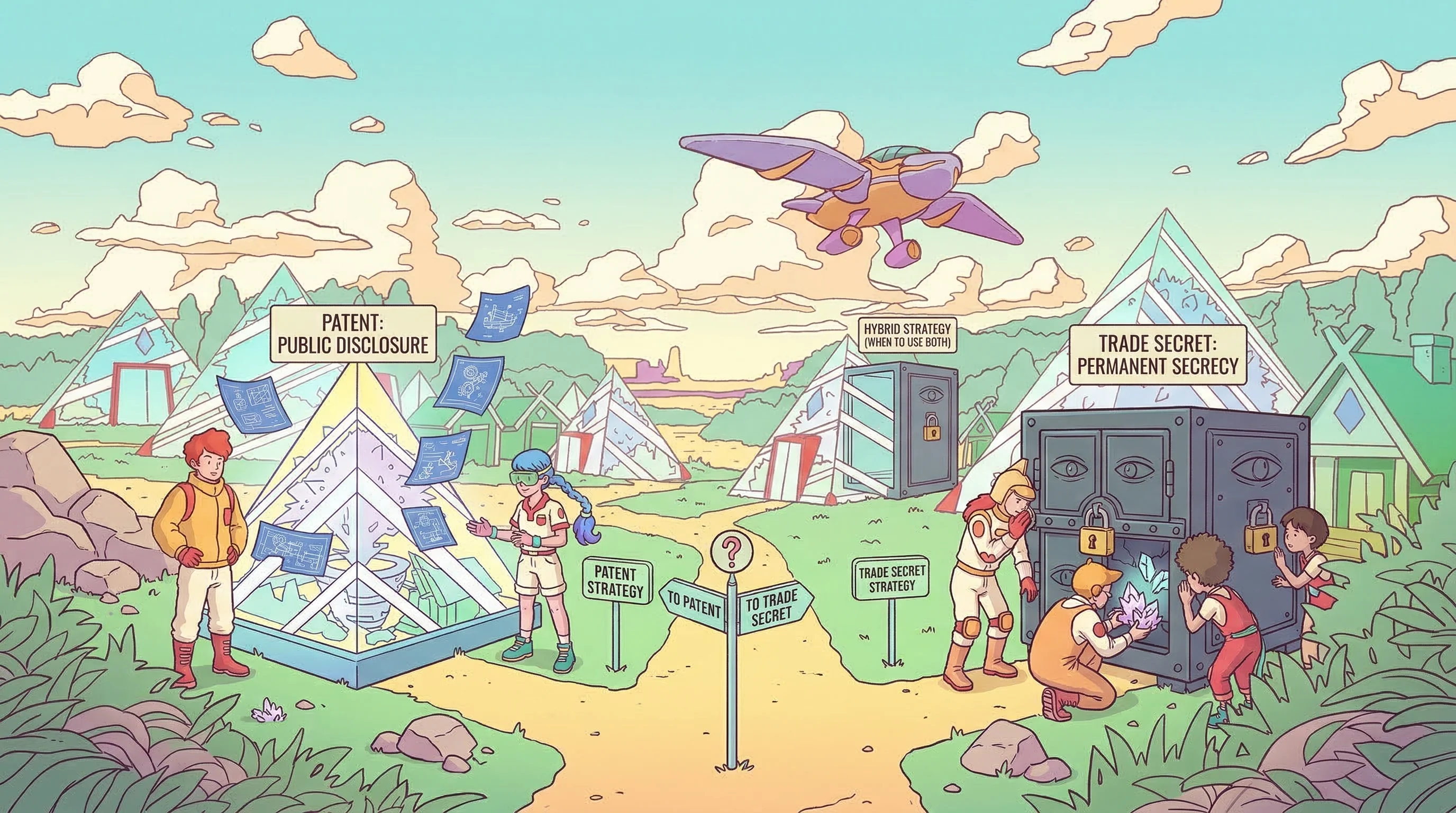
“I have a secret process or formula that gives me a competitive advantage.” Protect it as a trade secret. But if competitors could reverse-engineer it from your product, a patent is the better choice.
“I designed a product that looks distinctive.” This is tricky. A design patent protects ornamental appearance. Copyright might protect artistic elements. Trade dress (a type of trademark) protects distinctive product packaging or appearance. The right answer depends on what exactly is distinctive.
Common Mistakes
Filing a trademark when you need a patent. A trademark protects your product’s name. It does not stop competitors from copying how your product works. If someone sells an identical product under a different name, your trademark does not help.
Assuming copyright protects your invention. Copyright protects the description of your invention (your drawings, your written specification). It does not protect the invention itself. Someone can read your blog post about your new device, build one that works the same way, and not violate your copyright, because they copied the idea, not your words.
Waiting too long. Patent law has strict deadlines. In the U.S., you have one year from your first public disclosure, sale, or offer for sale to file a patent. Miss that deadline and you lose the right permanently. Copyright and trademark are more forgiving on timing, but earlier registration is always stronger. See our guide on the 12-month filing deadline.
Skipping the trademark search. Before investing in a brand name, search the USPTO database and do a broader common law search. Building a brand around a name that is already taken is expensive to fix later.
What to Do Next
- Identify what you are protecting: an invention, a creative work, or a brand
- For inventions: estimate patent costs and find a patent attorney to evaluate your idea
- For creative works: register with the Copyright Office if the work has commercial value
- For brands: search the USPTO trademark database, then file an application or hire a trademark attorney
- For secrets: implement NDAs and security measures immediately
Most solo inventors and small businesses start with one type of protection and add others as the business grows. Start with the one that matches your most immediate risk. If someone could copy your invention tomorrow, file a patent. If someone could steal your brand name, register a trademark. If someone could republish your course content, register the copyright.
The right IP strategy depends on what you have, what you are building, and where the real threat is. For most inventors reading this site, that starts with a patent. See what a patent attorney costs in your state.