The average utility patent has 15 to 25 claims. The USPTO base filing fee covers 3 independent claims and 20 total claims; each additional independent claim costs $100 to $240 extra depending on entity size. Claims are the most important part of your patent application. They define the legal boundary of your protection. Everything else in the application exists to support them.
If you read a granted patent, scroll to the end. That is where the claims live. Each claim is a single sentence (sometimes a very long one) that describes a specific combination of structural features. If a competing product includes all the features listed in one of your claims, it infringes. If it is missing even one feature, it does not.
What Is an Independent Claim?
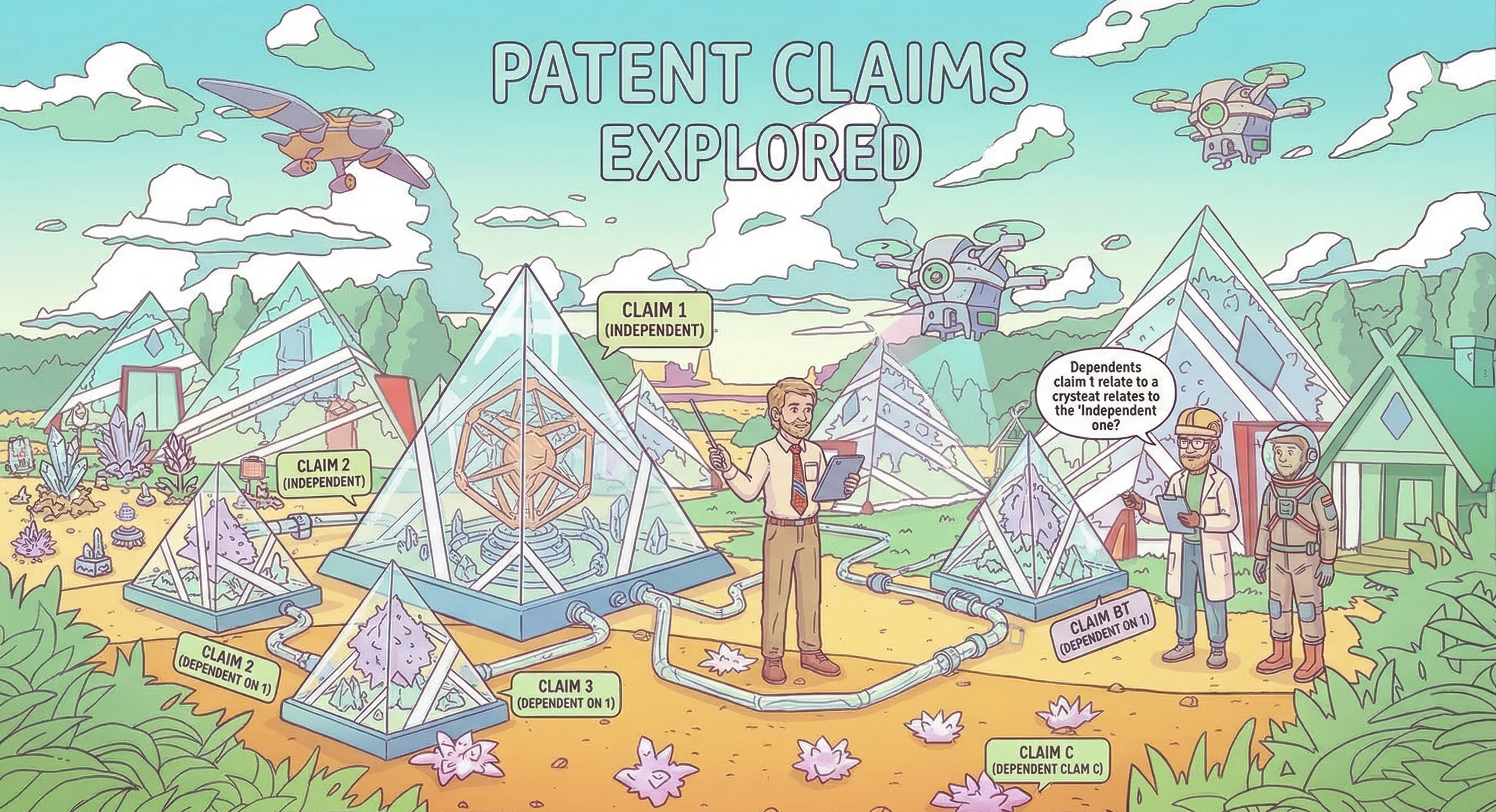
An independent claim stands on its own. It does not reference any other claim. It describes your invention using the minimum set of features needed to distinguish it from prior art.
Example for a collapsible water bottle:
Claim 1. A collapsible liquid container comprising: a flexible body formed from silicone having a plurality of concentric folds, a rigid rim at an open end configured to receive a cap, and a flat base member connected to the body’s lowest fold, wherein the body collapses into the base member when the folds are compressed.
This claim covers any collapsible container that has those three features: a silicone body with concentric folds, a rigid rim for a cap, and a flat base that receives the collapsed body. If a competitor makes a collapsible bottle that matches all three, it infringes regardless of the color, size, or brand name.
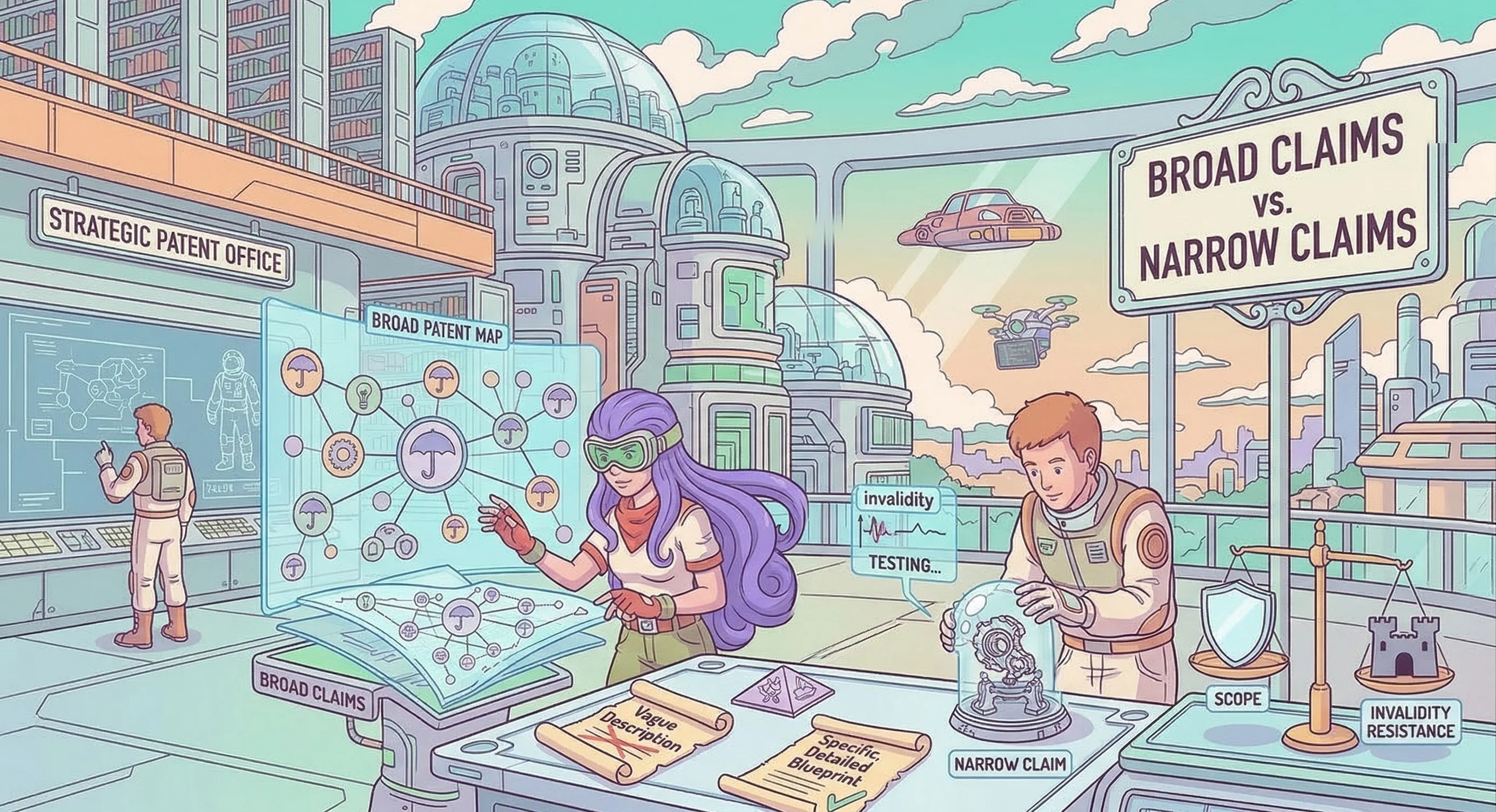
Independent claims are your broadest protection. You want them as wide as the prior art allows.
What Is a Dependent Claim?
A dependent claim references an independent claim and adds additional features. It narrows the scope in exchange for being harder to invalidate.
Claim 2. The container of Claim 1, wherein the flexible body includes four concentric folds.
Claim 3. The container of Claim 1, further comprising an insulating sleeve that surrounds the flexible body when the body is in an expanded configuration.
Claim 4. The container of Claim 3, wherein the insulating sleeve is formed from neoprene and includes a releasable fastener along a longitudinal seam.
Claim 2 narrows Claim 1 by specifying four folds. Claim 3 adds a new element (insulating sleeve). Claim 4 narrows Claim 3 further by specifying the sleeve material and closure method.
Each dependent claim creates a fallback position. If the examiner finds prior art that covers your independent claim, your dependent claims may still survive because they describe a more specific version.
Why You Need Both
Think of patent claims as concentric circles. The independent claim is the largest circle, covering the broadest version of your invention. Each dependent claim is a smaller circle inside it.
You want the largest circle to be as wide as possible because that gives you maximum protection. But if someone finds prior art that lands inside your large circle, you fall back to the next circle down.
A patent with only independent claims has no fallback. If the examiner narrows your independent claim, you lose significant scope. A patent with only dependent claims has narrow protection that competitors can design around easily.
The standard approach: 3 independent claims and 17 dependent claims (20 total, which is the USPTO’s base allowance before extra fees). The 3 independent claims typically cover your invention from different angles:
- Apparatus claim (the physical product itself)
- Method claim (how it is used)
- System claim (the product in context with other components)
The 17 dependent claims add specificity to each, creating a layered defense.
The “Comprising” Language
Patent claims often start with “comprising.” This legal term means “including but not limited to.” A claim that says “a device comprising A, B, and C” covers any device that has A, B, and C, even if it also has D, E, and F.
This is different from “consisting of,” which means “including only these elements.” If your claim says “consisting of A, B, and C,” a competitor who adds feature D is no longer infringing.
“Comprising” is almost always the right choice for independent claims because it prevents competitors from avoiding your patent by adding an extra feature.
Strong Claims vs. Weak Claims
Strong claims describe structural features: shapes, geometries, spatial relationships, material compositions, how components connect. These are hard to design around because they describe physical reality.
Weak claims describe functions or goals: “a device that reduces noise” or “a mechanism for improving grip.” These are easy to design around because a competitor can achieve the same function with a completely different structure.
For more on balancing claim scope, see Broad Claims vs. Narrow Claims.
Building a Strong Claim Set
A practical claim strategy starts with three independent claims that cover your invention from different angles: an apparatus claim (the physical product), a method claim (how it is used), and a system claim (the product working with other components).
For each independent claim, draft 5 to 6 dependent claims. Layer them from broader to narrower, with each dependent claim adding one meaningful feature. This creates a cascade of fallback positions.
Example cascade for a kitchen tool with a novel grip mechanism:
- Claim 1 (independent): The tool with the core grip mechanism
- Claim 2 (dependent on 1): Adds a specific handle material
- Claim 3 (dependent on 1): Adds a dimensional range for the grip surface
- Claim 4 (dependent on 1): Adds a secondary locking feature
- Claim 5 (dependent on 2 and 3): Combines the material and dimensional range
This structure means the examiner has to knock out multiple layers to fully invalidate your protection. If Claim 1 falls to prior art, you fold in features from Claim 2 or 3. If that combination falls, you still have Claim 5 with its tighter scope.
Do not waste dependent claims on trivial variations like color or branding. Each dependent claim should add a feature that has real engineering significance and that a competitor would need to design around.
USPTO Fees for Claims
The USPTO charges extra fees when your application exceeds the base allowance of 20 total claims and 3 independent claims. Here are the current fee schedules:
| Fee Type | Micro Entity | Small Entity | Large Entity |
|---|---|---|---|
| Base filing (covers 20 claims, 3 independent) | $80 | $160 | $320 |
| Each claim over 20 | $20 | $40 | $100 |
| Each independent claim over 3 | $120 | $240 | $480 |
| Examination fee | $180 | $360 | $720 |
| Search fee | $165 | $330 | $660 |
These are government filing fees only. They do not include attorney drafting costs, which make up the majority of total patent expense. Most applications stay within the 20-claim, 3-independent-claim base to avoid extra fees, but adding claims is worth the cost when broader protection justifies it.
For a full breakdown of total patent costs, see patent cost guide. If budget is tight, see how to patent with no money for entity size qualification and fee reduction strategies.
What Happens During Examination
After filing, a USPTO examiner reviews your claims against prior art. 86% of applications receive at least one office action identifying prior art and explaining why the examiner thinks some claims are not patentable.
This is normal. It is the start of a negotiation. You respond by arguing why your claims differ from the cited prior art, or by amending the claims to narrow them.
This is where dependent claims earn their keep. If the examiner’s prior art covers your broad independent claim, you fold features from a dependent claim into the independent claim. This narrows the scope but preserves the patent. Without dependent claims, you are negotiating with nothing in reserve.
See what happens after filing for the full examination process. Find a patent attorney in the directory or estimate costs with the patent cost calculator.
.webp)