Patent infringement means someone makes, uses, sells, or imports your patented invention without your permission. If you hold a granted U.S. patent and discover a competitor copying your invention, you have legal options ranging from a $1,500 demand letter to multimillion-dollar federal litigation. The right move depends on how much money is at stake, how strong your claims are, and how deep your pockets go.
What Patent Infringement Actually Is
Your patent does not protect your invention in a general sense. It protects what your claims describe. The claims are the numbered paragraphs at the end of the patent document, and they define the exact boundaries of your legal monopoly. Everything else in the patent (the description, the drawings, the abstract) is context. Only the claims matter for infringement.
Someone infringes your patent when they do any of the following without authorization:
- Make the patented invention
- Use the patented invention
- Sell or offer to sell the patented invention
- Import the patented invention into the United States
Notice: each of those is independently sufficient. A company that manufactures your invention overseas and imports it into the U.S. infringes even if they never sell a single unit here. A company that buys an infringing product from someone else and uses it in their own operations also infringes.
This is why broad claims matter so much. The broader your claims, the more products and processes fall within their scope. Narrow claims are harder for an infringer to invalidate, but they are easier to design around.
Literal Infringement vs. Doctrine of Equivalents
There are two ways a product can infringe your patent.
Literal infringement is straightforward. The accused product includes every single element of at least one of your claims, exactly as written. If your claim says “a fastening mechanism comprising a threaded bolt and a flanged nut,” the accused product must have a threaded bolt and a flanged nut. If it uses a rivet instead, it does not literally infringe.
Doctrine of equivalents catches the clever copycats. Even if a product does not match every claim element word-for-word, it can still infringe if each element performs substantially the same function, in substantially the same way, to achieve substantially the same result. The rivet example might still infringe under this doctrine if the court finds that a rivet performs the same fastening function in essentially the same manner.
Courts apply this test on an element-by-element basis. You do not argue that the overall product is “basically the same.” You show that each specific claim element has a corresponding equivalent in the accused product.
How to Assess Infringement: The Claim Chart
Before you call a lawyer or send a threatening letter, you need evidence. The standard tool is a claim chart.
A claim chart is a two-column table. The left column lists each element of your patent claim, broken into individual limitations. The right column maps each limitation to a specific feature of the accused product, with evidence (photos, screenshots, product specs, marketing materials, teardown results).
Here is the process:
-
Build the claim chart. Map every element of your strongest claim against the accused product. If you cannot find a corresponding feature for every element, you probably do not have infringement of that claim. Try another claim.
-
Investigate independently. Buy the competing product. Photograph it. Save marketing materials and technical specifications. If it is software, document the user-facing behavior. You need concrete evidence, not assumptions.
-
Check your own patent’s vulnerabilities. The infringer’s first move will be to challenge your patent’s validity. Look at the prior art the examiner cited during prosecution. Understand what arguments were made and what limitations were added. If your patent barely survived examination, that affects your leverage.
-
Estimate damages. What is this infringement costing you? Lost sales? Lost licensing revenue? A rough damages number determines whether enforcement makes economic sense.
A patent attorney can do a formal infringement analysis for $2,000 to $5,000. This is money well spent before you commit to any enforcement path. Going in without an analysis is like filing a lawsuit without reading the complaint.
Enforcement Options
Not every infringement situation calls for the same response. Here are your options, ordered from least aggressive to most aggressive.
| Option | Typical Cost | Timeline | Best For |
|---|---|---|---|
| Licensing offer | $2,000 to $10,000 in legal fees | Weeks to months | Legitimate businesses that would prefer paying a royalty over redesigning their product |
| Cease and desist letter | $1,500 to $5,000 | Weeks | Small infringers who may not know about your patent and will stop when confronted |
| Federal court litigation | $500,000 to $5M+ | 2 to 4 years | High-value disputes where the infringer refuses to negotiate and significant damages are at stake |
| ITC complaint | $2M to $5M+ | 12 to 18 months | Imported infringing products; the ITC can block goods at the border faster than district court |
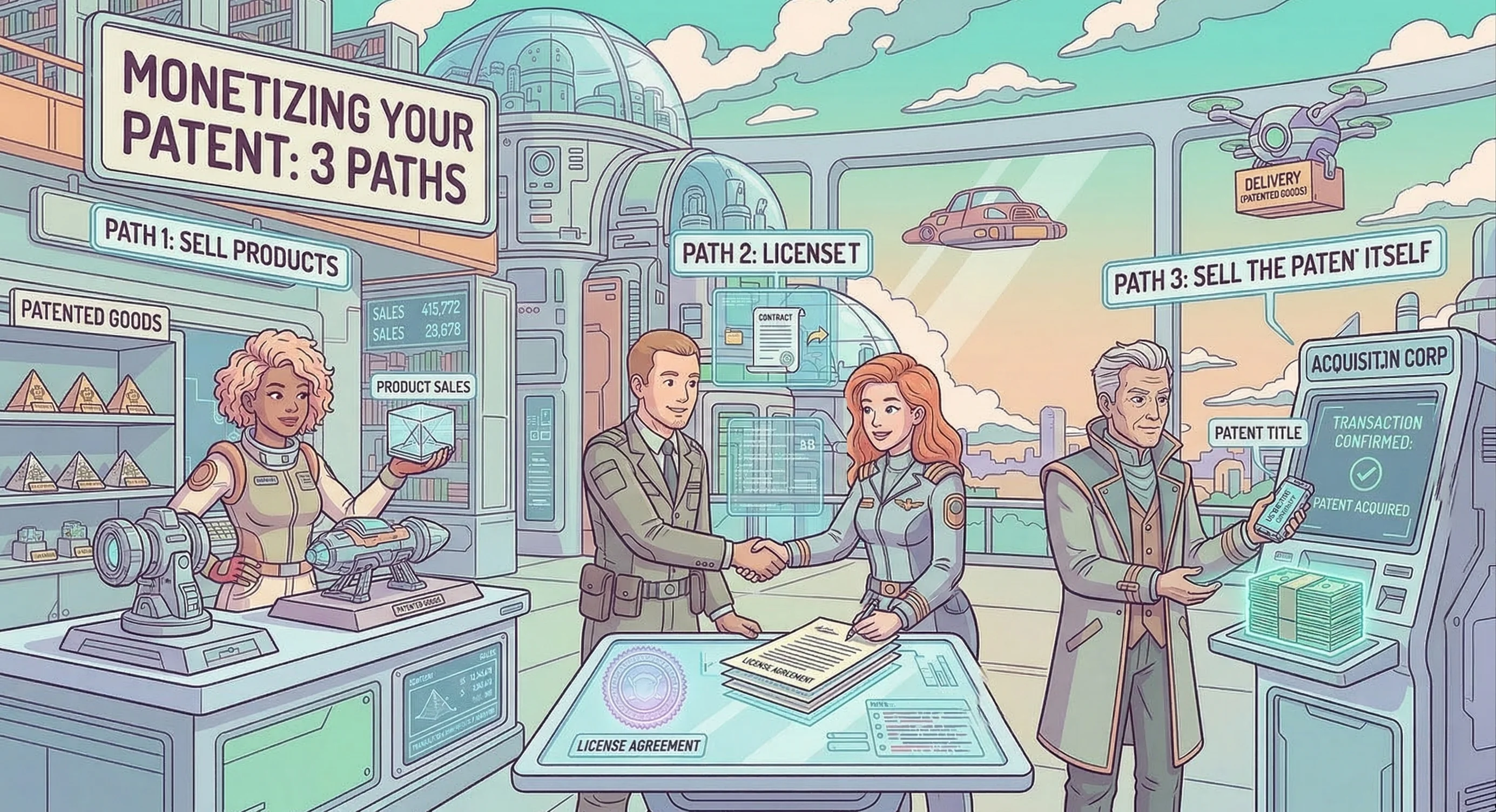
Licensing is the most common resolution. You approach the infringer, show them your claim chart, and negotiate a royalty rate. Many companies prefer licensing because it is cheaper than redesigning their product and far cheaper than litigation. A well-structured licensing program can turn infringement into a revenue stream. See our guide on how to monetize your patent for more on this approach.
Cease and desist letters work best against small operators who genuinely did not know they were infringing. The letter puts them on legal notice, which matters later if you need to prove willful infringement. But be careful: sending a C&D to a large company with deep pockets can trigger a declaratory judgment action where they sue you first, asking the court to declare your patent invalid or not infringed. That puts you on defense in their preferred forum.
Federal litigation is the nuclear option. The median cost of patent litigation through trial is over $2 million for cases with $1 million to $25 million at stake, according to the AIPLA’s economic survey. Cases take 2 to 4 years. But if the infringement is large-scale and the infringer refuses to license, litigation may be the only path to meaningful compensation.
ITC complaints are specialized. The International Trade Commission can issue exclusion orders that block infringing imports at the U.S. border. This is faster than district court (12 to 18 months versus 2 to 4 years) but only applies to imported goods and does not award monetary damages. Companies often file both an ITC complaint and a district court case simultaneously.
Types of Damages
If you prevail in a patent infringement case, you can recover several types of damages.
Reasonable royalty. This is the floor. The court calculates what a willing licensor and a willing licensee would have agreed to in a hypothetical negotiation before the infringement began. The analysis considers factors like established royalty rates, the nature of the invention, the profitability of the infringing product, and comparable licenses.
Lost profits. If you can show that you would have made the sales the infringer captured, you can recover your actual lost profits. This requires proving four things: demand for the patented product, absence of acceptable non-infringing alternatives, your manufacturing and marketing capability, and the amount of profit you would have made. Lost profits are typically larger than a reasonable royalty but harder to prove.
Enhanced (treble) damages. For willful infringement, a court can award up to three times the actual damages. Willful infringement means the infringer knew about your patent and proceeded without a reasonable basis to believe they were not infringing or that the patent was invalid. This is why cease and desist letters matter strategically. They establish knowledge and set up a potential willfulness argument.
Attorney fees. In “exceptional cases,” the court can shift attorney fees to the losing party. This is not automatic, but egregious behavior (like continuing to infringe after receiving clear notice) can trigger it.
Contingency Litigation: The No-Money-Down Option
If you cannot afford $500,000+ in legal fees, contingency arrangements exist. Some patent litigation firms will take your case for no upfront cost, instead taking 30% to 40% of any recovery (settlement or judgment).
The catch: contingency firms are selective. They evaluate your patent’s strength, the infringer’s ability to pay, the estimated damages, and the likelihood of success. If your patent has validity issues, or if the infringer is a small company with minimal revenue, contingency firms will pass.
You can also sell your patent outright to a patent assertion entity, though you will receive a fraction of the patent’s enforcement value. Or you can partially assign the patent to a litigation funder who covers legal costs in exchange for a share of the proceeds.
When NOT to Sue
Enforcement is not always the right call. Here are situations where the economics do not work:
The infringer is too small. If the infringing company generates $200,000 in annual revenue and your litigation will cost $500,000, the math does not add up. Even if you win, collecting a judgment from a small company can be difficult or impossible.
Your patent is weak. If the examiner allowed your patent on narrow grounds, or if there is strong prior art that was not considered during examination, litigation exposes your patent to an invalidity challenge. Losing in court does not just end the lawsuit. It can invalidate your patent entirely, destroying its value against all future infringers.
The infringer can design around. If there is a straightforward way to achieve the same result without hitting your claims, litigation buys you nothing long-term. The infringer makes a small design change, and you are back to square one with $500,000 less in the bank.
You need the relationship. If the infringer is a potential customer, partner, or investor, suing them may win a battle but lose the war. A licensing conversation preserves the relationship.
Time has passed. Patent infringement has a six-year statute of limitations for damages. You can still sue after six years, but you can only recover damages for the six years before you filed. If you sat on your rights for a long time, a court may also apply the doctrine of laches, limiting your remedies.
The Bottom Line
Discovering infringement is not the end of a process. It is the beginning of a strategic decision. The right response depends on the strength of your claims, the scale of the infringement, your financial resources, and your business goals.
Start with a professional infringement analysis. Build a claim chart. Understand your patent’s vulnerabilities. Then choose the enforcement path that matches your situation, whether that is a licensing letter, a demand, or full litigation.
The patent cost you invested in getting the patent is just part of the picture. Enforcing it is where the real value gets captured or lost.
Find a patent attorney experienced in enforcement through our directory or estimate your patent costs with the calculator.
.webp)