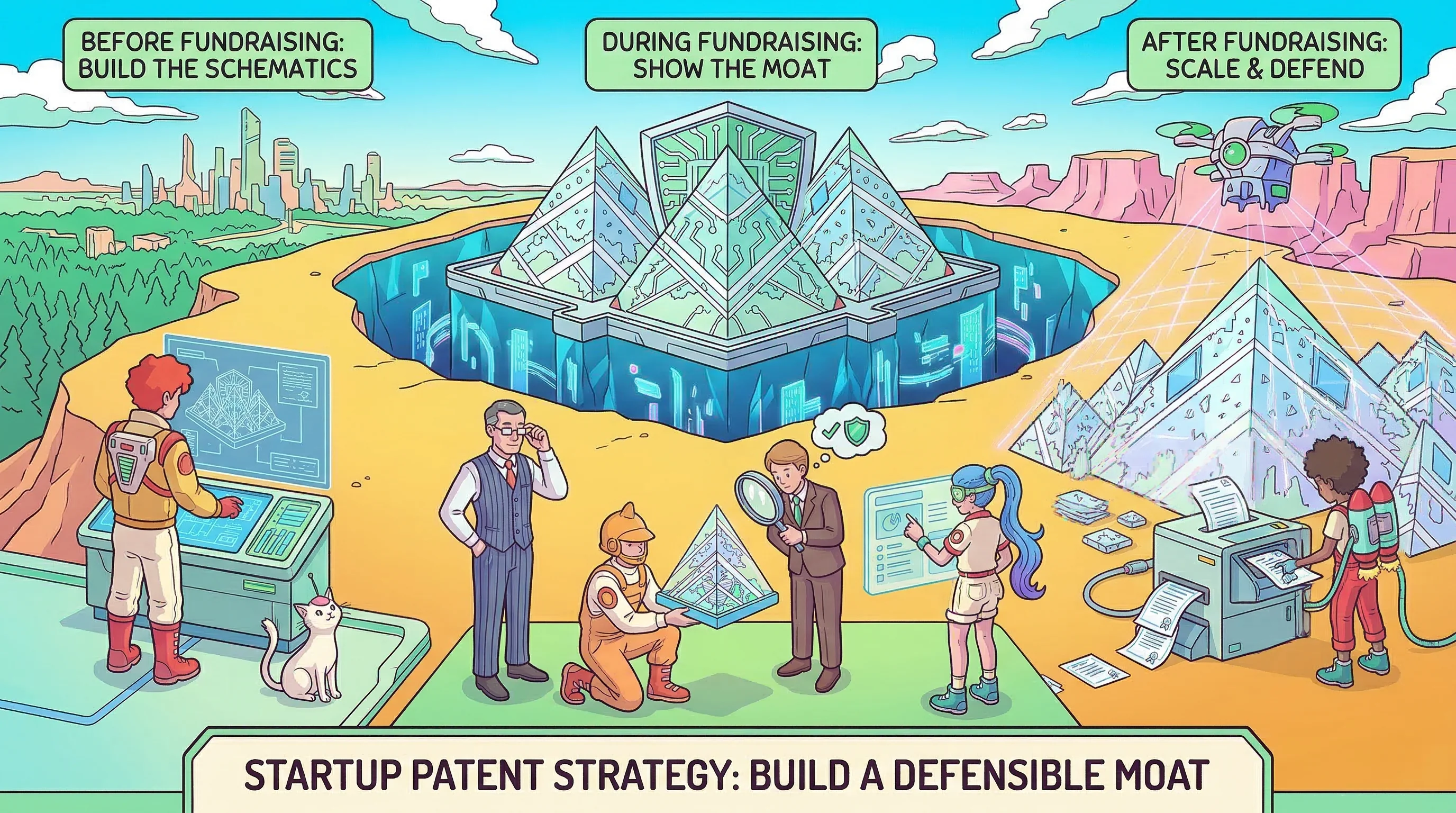
File a provisional patent ($2,000-$5,000) before you talk to investors. Budget $8,000-$15,000 for the full non-provisional after fundraising. Most startups qualify for micro entity status, which cuts USPTO fees by 80%.
Investors ask about patents. “What’s your IP position?” is a polite way of asking “Can someone else build this?” If you are building a hardware startup or a company around a physical product, your answer matters. A patent filing signals that you have something defensible. No patent filing signals that your competitive advantage depends entirely on execution speed, and investors know that execution speed is not a moat.
Before You Raise: File Something
The best time to file a patent is before you talk to investors. Even better, before you publicly disclose the product at all.
A provisional patent application gives you:
- A filing date. This establishes your priority over anyone who files after you.
- Patent pending status. Signals to the market (and to investors) that the IP is being protected.
- 12 months of flexibility. Time to decide whether to file the full non-provisional while you iterate on the product.
Filing before fundraising also avoids a timing trap. Once you pitch investors, demo at a conference, or post on social media, the 12-month disclosure clock starts running. If you wait until after a seed round to think about patents, you may have already burned months of that deadline.
USPTO Fee Discounts for Startups
The USPTO offers significant fee reductions based on company size. Most startups qualify for at least small entity status.
| Entity Size | Qualification | Fee Discount | Non-provisional Filing Fee |
|---|---|---|---|
| Micro entity | Gross income under ~$240,000, fewer than 5 prior patent filings | 80% off | $400 |
| Small entity | Fewer than 500 employees | 50% off | $800 |
| Large entity | 500+ employees | No discount | $1,600 |
Most early-stage startups qualify as small entities. Solo founders with low income may qualify as micro entities, cutting government fees to 20% of the standard rate. For a full breakdown of entity discounts and budgeting, see our small business patent cost guide.
What Investors Want to See
Investors are not patent lawyers. They do not read claims. What they want is assurance that the company has a defensible position:
Patent pending (provisional filed). The minimum bar. Shows you have initiated the process.
Patent pending (non-provisional filed). Stronger. The application is in the USPTO examination queue with actual claims.
Patent granted. The strongest signal. The USPTO has examined your claims and determined your invention qualifies.
Patent portfolio (multiple filings). Multiple filings covering different aspects of your product shows strategic IP thinking.
Most startups at the seed stage have a provisional filing. By Series A, investors expect at least a non-provisional. By Series B, a granted patent or portfolio is increasingly expected for hardware companies.
Here is what investors typically expect to see in a due diligence package at each stage:
| Funding Stage | IP Expectation |
|---|---|
| Pre-seed | At least one provisional patent application filed. “Patent pending” status is the minimum bar. |
| Seed | 1 to 2 pending patent applications with a clear IP strategy articulated. Shows you are thinking beyond one filing. |
| Series A | 3 to 10 patents pending or granted. Non-provisional applications in prosecution. IP chapter in the due diligence package. |
| Series B+ | Established patent portfolio. Freedom-to-operate analysis completed. IP moat clearly defined and defensible. |
The jump from seed to Series A is where IP expectations increase sharply. At seed, investors accept that you are early. By Series A, they want evidence that you are building a defensible position, not just checking a box.
Patent Costs in Context
| Stage | Typical Raise | Patent Costs (provisional + non-provisional) |
|---|---|---|
| Pre-seed | $250K - $1M | ~$6,000 - $12,000 |
| Seed | $1M - $3M | Same, plus optional patent search |
| Series A | $3M - $15M | Same, plus potential additional filings |
$6,000 to $12,000 to protect the IP of a company raising $1M or more is not a material expense. But the absence of any filing raises questions that are harder to answer than the cost of filing.
When Patents May Not Make Sense
Patents are not the right move for every startup. Skip or delay if:
- Your market moves faster than the 2 to 3 year patent timeline. In fast-changing markets (social media, fashion, many consumer apps), the product may be obsolete before the patent grants.
- The invention is easy to design around. If competitors can replicate the core value with a different technical approach, a patent on one approach has limited value.
- You plan to pivot. Filing on a product you might abandon in 6 months wastes budget. File provisionals only when the core innovation is stable.
- Your advantage is execution, not technology. Some businesses win on speed, brand, or distribution. Patents protect technology. If your moat is something else, allocate budget there.
- Secrecy is more valuable. If your innovation is a process competitors cannot reverse-engineer (like a manufacturing technique), a trade secret may offer stronger and cheaper protection.
Patent Alternatives Worth Considering
| Protection Type | Best For | Cost | Duration |
|---|---|---|---|
| Trade secret | Processes, formulas, algorithms that are hard to reverse-engineer | Near zero | Indefinite if maintained |
| Trademark | Brand name, logo, product name | $250 to $350 per class | Indefinite with use |
| Copyright | Software code, content, creative works | $45 to $65 registration | Life + 70 years |
| Trade dress | Distinctive product appearance or packaging | $250 to $350 per class | Indefinite with use |
For a full comparison, see our patent vs. copyright vs. trademark guide.
Employee IP Agreements: Do This on Day One
Before you file a single patent, make sure you actually own the inventions your team creates. This sounds obvious. It is not.
Every employee and contractor should sign a Proprietary Information and Invention Assignment Agreement (PIIA) before they start work. This document assigns all inventions created during their employment to the company. Without it, an engineer who builds your core technology could argue that they own the IP, not the company.
Founders need to do this too. At incorporation, all founder-created IP should be formally assigned to the company through an IP assignment agreement. If a founder leaves and the company’s core patent is still in their name, that is a title defect that can derail a fundraise or acquisition.
Contractors are the most common gap. Many startups hire freelance developers or consultants without IP assignment clauses. Under default copyright law, contractors often retain ownership of what they create. A work-for-hire clause or invention assignment in the contractor agreement fixes this.
One more detail: include a prior inventions schedule in every PIIA. This lets employees list pre-existing IP they are bringing into the job and not assigning. It prevents disputes later about what the company owns versus what the employee invented before joining.
Investors check for this during due diligence. A clean IP assignment chain from every inventor to the company is expected. A missing assignment is a red flag that can delay or kill a deal.
Common Mistakes Startups Make
Filing too late. The product is already selling, the 12-month window is ticking, and the startup scrambles to file before the deadline. Filing early produces better applications.
Filing only a design patent. Design patents protect how a product looks, not how it works. They are cheaper and faster but provide narrow protection. A competitor who changes the visual design can sell a functionally identical product. For investor purposes, utility patents are far more valuable.
Using a cheap filing service. A cover-sheet provisional may not contain enough structural detail to support strong non-provisional claims. If investors or their lawyers review the application and find it thin, it undermines confidence rather than building it.
Not budgeting for office actions. 86% of applications receive at least one office action. This is normal. But responding has costs, and startups should budget for this in their IP spending plan.
How to Position IP in Your Pitch
One slide, three things:
- What is patented (or patent pending). Describe the core innovation in plain language.
- What it prevents. Explain what a competitor would have to do differently to avoid infringing.
- Where you are in the process. Provisional filed, non-provisional filed, patent granted, additional filings planned.
If investors want to dig deeper, they can review the application or have their IP counsel review it. Your job in the pitch is to demonstrate that you take IP seriously and have taken concrete steps.
For a full breakdown of costs at each stage, see the patent cost guide. Find a patent attorney in the directory or estimate costs with the patent cost calculator.
.webp)