Patent law has its own vocabulary. If you are filing for the first time, the terminology can slow you down more than the actual process. This glossary defines 45+ patent terms in plain language and links each one to our detailed guides.
Key facts:
- The USPTO uses specific legal terms that have precise meanings different from everyday English
- Understanding patent terminology helps you communicate with attorneys and read office actions
- Each term below links to a full guide where we explain the concept in depth
Filing and Application Terms
Prior Art
Prior art is any evidence that your invention was already known before your filing date. This includes patents, published applications, academic papers, products on sale, public demonstrations, and even YouTube videos. The USPTO examiner searches prior art to decide whether your invention is new. A thorough patent search before filing saves you from wasting money on an application that will be rejected.
Claims
Claims are the numbered sentences at the end of a patent that define exactly what the patent protects. They are the legal boundaries of your invention. Everything else in the application (drawings, description, abstract) supports the claims but does not define the scope of protection. Writing strong claims is the most important part of the patent process. See our guide on broad vs. narrow claims and independent vs. dependent claims.
Specification
The specification is the written description of your invention. It includes the background, a summary, a detailed description, and the drawings. The specification must describe your invention in enough detail that someone skilled in the field could build it. This is called the “enablement” requirement.
Provisional Patent Application
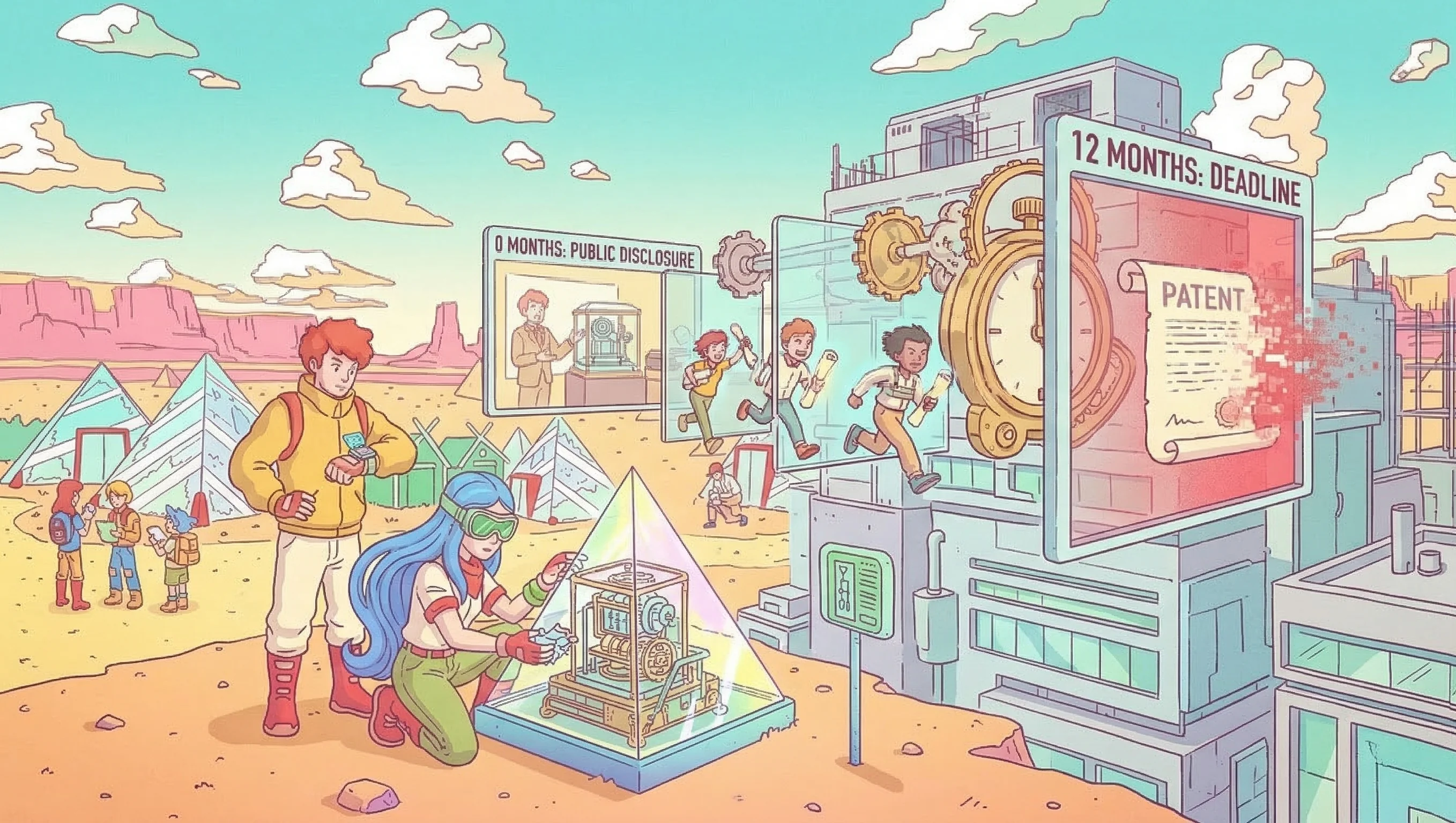
A provisional application is a temporary filing that gives you 12 months of “patent pending” status. It is cheaper and simpler than a full application. You must file a non-provisional application within 12 months or you lose your priority date. A provisional typically costs $2,000 to $6,000. See provisional vs. non-provisional for a full comparison.
Non-Provisional Patent Application
A non-provisional application is the formal patent application that gets examined by the USPTO. It includes claims, a specification, drawings, and an abstract. This is what actually gets reviewed and (if approved) granted as a patent. Filing costs range from $5,000 to $15,000+ depending on complexity.
Patent Pending
Patent pending means you have filed a patent application but the USPTO has not yet granted it. This status does not give you any legal right to stop others from copying your invention. It does establish your priority date and puts competitors on notice. You get this status the day you file either a provisional or non-provisional application. Read more about what happens after filing.
Filing Date / Priority Date
Your filing date is the day the USPTO receives your complete application. Your priority date is the earliest date you can claim for your invention. If you filed a provisional first, your priority date is the provisional filing date. The priority date matters because it determines what counts as prior art against your application. See our 12-month filing deadline guide.
Micro Entity
A micro entity is an applicant who qualifies for a 80% discount on most USPTO fees. To qualify, you must meet the small entity requirements, have a gross income below a certain threshold (roughly $229,000 in 2026), and not be listed as an inventor on more than four previous patent applications. This discount cuts filing costs significantly. See our patent cost guide for fee tables.
Small Entity
A small entity is an individual, small business (under 500 employees), or nonprofit that qualifies for a 50% discount on most USPTO fees. Most independent inventors and startups qualify. You self-certify your status when filing. If you also meet the income and filing limits, you may qualify as a micro entity for even deeper discounts.
PCT (Patent Cooperation Treaty)
The PCT is an international treaty that lets you file a single application to seek patent protection in over 150 countries. A PCT application does not itself become a patent. It gives you up to 30 months from your priority date to decide which countries to enter. This buys you time and reduces upfront costs for international patent filing.
National Phase
National phase is the stage where a PCT application enters individual countries. After filing a PCT, you have 30 months from your priority date to file in each country where you want protection. Each country then examines the application under its own patent laws. National phase filing is expensive because you pay fees and translation costs for every country.
Track One (Prioritized Examination)
Track One is the USPTO’s fast-track examination program. For an extra fee (about $1,000 for micro entities, $4,000 for large entities), the USPTO aims to reach a final decision within 12 months instead of the typical 24 to 36 months. See our patent timeline guide for how Track One compares to standard processing.
Examination Terms
Office Action
An office action is a written response from the patent examiner after reviewing your application. It usually contains rejections or objections that you must address. Most applications receive at least one office action. Responding correctly is critical to getting your patent granted. Read our full guide on patent office actions.
Patent Prosecution
Patent prosecution is the back-and-forth process between you (or your attorney) and the USPTO examiner. It starts when you file your application and ends when the patent is granted or abandoned. This is not a lawsuit. The word “prosecution” in patent law just means “pursuing your application.” It involves responding to office actions, amending claims, and sometimes interviewing the examiner. Learn about the costs in our patent cost guide.
101 Rejection (Subject Matter Eligibility)
A 101 rejection means the examiner believes your invention falls outside what can be patented. Under 35 U.S.C. 101, you cannot patent abstract ideas, laws of nature, or natural phenomena. This rejection is common for software patents and business methods. Overcoming it usually requires showing that your invention applies the abstract idea in a specific, practical way.
102 Rejection (Lack of Novelty)
A 102 rejection means the examiner found a single piece of prior art that discloses every element of your claim. In other words, your exact invention already exists. This is the most straightforward rejection. You can overcome it by narrowing your claims to distinguish from the prior art. See three requirements for patentability.
103 Rejection (Obviousness)
A 103 rejection means the examiner believes your invention is an obvious combination of two or more prior art references. This is the most common rejection. The examiner does not need to find your exact invention in one reference. They just need to show that someone with ordinary skill could combine existing ideas to arrive at yours. See our detailed guide on non-obvious explained.
112 Rejection (Insufficient Description)
A 112 rejection means your application does not adequately describe or enable your invention. This can mean your claims are too vague, your specification does not explain how to build the invention, or your claims cover more than what you actually described. Fixing a 112 rejection usually requires rewriting claims or adding detail to the specification.
Restriction Requirement
A restriction requirement is the examiner’s notice that your application contains more than one distinct invention. The USPTO requires you to pick one invention to prosecute. You can file the other inventions as divisional applications later. This is not a rejection of your ideas. It is a procedural requirement.
Examiner Interview
An examiner interview is a phone call or in-person meeting between your attorney and the patent examiner. Interviews are often the fastest way to resolve disagreements about your claims. The examiner can explain their concerns directly, and your attorney can propose amendments on the spot. Most patent attorneys consider interviews one of the most effective prosecution tools.
RCE (Request for Continued Examination)
An RCE is a filing you submit after receiving a final rejection. It reopens prosecution so you can submit new arguments or amended claims. An RCE costs about $660 for micro entities ($2,640 for large entities). It restarts the examination cycle. Some applications go through multiple RCEs before getting allowed.
Final Rejection
A final rejection does not mean your application is dead. It means the examiner will not consider further amendments under the current examination cycle. You have several options: file an RCE to reopen prosecution, appeal to the PTAB, or amend your claims in a limited way. The word “final” is misleading. Most applicants continue fighting after a final rejection. See patent office actions for strategies.
Allowance
An allowance (also called a notice of allowance) means the examiner has approved your claims. You must pay the issue fee within three months to receive your granted patent. This is the finish line of patent prosecution.
Claim Drafting Terms
Independent Claim
An independent claim stands on its own and does not reference any other claim. It defines the broadest version of your invention. Most patents have one to three independent claims covering different aspects (for example, a method claim, a system claim, and a device claim). See our guide on independent vs. dependent claims.
Dependent Claim
A dependent claim references and narrows an independent claim by adding specific features. For example, if your independent claim covers “a widget,” a dependent claim might specify “the widget of claim 1, made of aluminum.” Dependent claims act as fallback positions. If the independent claim is invalidated, a dependent claim may survive.
Broad vs. Narrow Claims
A broad claim covers more ground but is harder to get allowed because more prior art applies. A narrow claim is easier to get allowed but protects less. Good patent strategy involves filing both: broad claims to try for maximum protection and narrow claims as backup. Read our full guide on broad vs. narrow claims.
Means-Plus-Function
A means-plus-function claim uses the word “means” followed by a function (for example, “means for fastening”). Under patent law, this type of claim is interpreted to cover only the specific structures described in the specification and their equivalents. It is narrower than it sounds. Many patent attorneys avoid means-plus-function language because courts interpret it restrictively.
Claim Chart
A claim chart is a table that maps each element of a patent claim to where it appears in an accused product or in a piece of prior art. Patent attorneys use claim charts during prosecution to argue over prior art and during litigation to prove infringement. If you are considering patent enforcement, you will likely see claim charts.
Post-Grant Terms
Maintenance Fees
Maintenance fees are payments required to keep a utility patent active after it is granted. You pay them at 3.5, 7.5, and 11.5 years after the grant date. Miss a payment and your patent expires. Micro entities pay $475 at the first interval (2026 rates). Total maintenance fees over the life of a patent run $3,600 to $14,000 depending on entity size. See our maintenance fees guide.
Continuation
A continuation is a new patent application that claims the same priority date as an earlier application. It lets you pursue different or broader claims based on the same original description. Companies often file continuations to build a portfolio of related patents from a single invention disclosure. See our continuation patent guide.
Continuation-in-Part (CIP)
A continuation-in-part is like a continuation, but it adds new subject matter not in the original application. The new matter gets a later priority date. The original matter keeps the earlier priority date. CIPs are useful when you have improved your invention since the original filing.
Divisional Application
A divisional application is filed when the examiner issues a restriction requirement, forcing you to split your application into separate inventions. Each divisional claims the same priority date as the parent application. Filing divisionals is a routine part of patent prosecution.
PTAB (Patent Trial and Appeal Board)
The PTAB is the administrative tribunal within the USPTO that hears appeals from examiner rejections and challenges to granted patents. If you disagree with a final rejection, you can appeal to the PTAB instead of filing an RCE. The PTAB also handles inter partes review (IPR) proceedings, where third parties challenge the validity of granted patents.
Patent Types
Utility Patent
A utility patent protects how an invention works. It covers processes, machines, manufactured items, and compositions of matter. Utility patents last 20 years from the filing date. They are the most common type, making up about 90% of all patents filed. See our utility patent cost guide.
Design Patent
A design patent protects the ornamental appearance of a product, not how it works. It covers shapes, patterns, and surface decoration. Design patents last 15 years from the grant date and require no maintenance fees. They are faster and cheaper to obtain than utility patents. See our design patent cost guide.
Plant Patent
A plant patent protects a new and distinct plant variety that you have invented or discovered and asexually reproduced. This includes hybrids, mutants, and cultivars. Plant patents last 20 years from the filing date. They are rare compared to utility and design patents. See our plant patent cost guide.
Trade Secret
A trade secret is confidential business information that gives you a competitive advantage. Unlike patents, trade secrets have no filing requirement, no expiration date, and no public disclosure. The tradeoff: if someone independently discovers or reverse-engineers your secret, you have no legal protection. See our comparison of patents vs. trade secrets.
Trade Dress
Trade dress protects the overall visual appearance of a product or its packaging that identifies the source to consumers. Think of the distinctive shape of a Coca-Cola bottle. Trade dress is a form of trademark protection, not patent protection. It lasts as long as the appearance remains distinctive and is in use.
Enforcement and Licensing Terms
Patent Infringement
Patent infringement occurs when someone makes, uses, sells, or imports your patented invention without permission. There are two main types: literal infringement (every claim element is present) and infringement under the doctrine of equivalents. Enforcing a patent through litigation is expensive, often costing $1 million or more through trial. Read our patent infringement guide.
Cease and Desist
A cease and desist letter is a formal demand that someone stop infringing your patent. It is usually the first step before filing a lawsuit. The letter puts the infringer on notice, which can increase damages if the case goes to court. Not every cease and desist letter leads to litigation. Many disputes settle after the letter.
Freedom-to-Operate (FTO)
A freedom-to-operate analysis determines whether your product infringes any existing patents. An attorney searches active patents, reads the claims, and compares them to your product features. An FTO analysis typically costs $5,000 to $15,000. It is a smart investment before launching a product in a crowded market.
Doctrine of Equivalents
The doctrine of equivalents extends patent protection beyond the literal words of the claims. If an accused product performs substantially the same function in substantially the same way to achieve substantially the same result, it may infringe even if it does not match the claims word-for-word. This prevents competitors from making trivial changes to avoid infringement.
Reasonable Royalty
A reasonable royalty is the minimum measure of damages in patent infringement cases. It is the amount a willing licensor and willing licensee would have agreed to for a license at the time infringement began. Courts consider factors like the patent’s value, existing licenses, and the infringer’s profits. Learn about licensing in our guide on how to monetize your patent.
Lost Profits
Lost profits are a measure of patent infringement damages based on the sales the patent owner lost because of the infringement. To recover lost profits, you must show that you would have made those sales but for the infringement. This requires proof of demand, manufacturing capacity, and absence of non-infringing alternatives. Lost profits awards are typically larger than reasonable royalties.
ITC (International Trade Commission)
The ITC is a federal agency that can block infringing products from entering the United States. Patent owners can file a complaint at the ITC to stop imports that violate their patents. ITC cases move faster than federal court (typically 15 to 18 months). The ITC cannot award money damages, but an import ban is often more powerful.
APEX (Amazon Patent Evaluation Express)
APEX is Amazon’s program for resolving patent disputes on its marketplace. If someone is selling a product on Amazon that infringes your utility patent, you can file an APEX complaint. A neutral evaluator reviews the patent and the accused product and issues a decision within about two months. If you win, Amazon removes the infringing listing. See our Amazon APEX guide.
Patent Thicket
A patent thicket is a dense web of overlapping patents held by multiple companies in the same technology area. Thickets make it difficult and expensive for new entrants to operate without licensing dozens of patents. They are common in smartphones, pharmaceuticals, and semiconductors.
Patent Troll (Non-Practicing Entity)
A patent troll, formally called a non-practicing entity (NPE), is a company that owns patents but does not make products. NPEs buy patents and sue or threaten to sue operating companies for licensing fees. The term is controversial. Some NPEs hold legitimate patents from real inventors. Others file broad, low-quality lawsuits hoping for quick settlements.
Patent Prosecution Highway (PPH)
The PPH is an agreement between patent offices in different countries that lets you fast-track examination based on a favorable ruling in another country. If the USPTO allows your claims, you can use that result to speed up examination in Japan, Europe, or other PPH member offices. This saves time and money when filing international patents.
Next Steps
If you are ready to move beyond definitions, here is where to go:
- Estimate your costs. Use our patent cost calculator to get a rough budget based on your invention type and entity status.
- Find an attorney. Browse our patent attorney directory to compare pricing, ratings, and specialties from 2,900+ patent professionals.
- Read the full guides. Every term above links to a detailed guide. Start with can I patent my idea? if you are at the beginning, or what happens after filing if you have already started the process.
.webp)